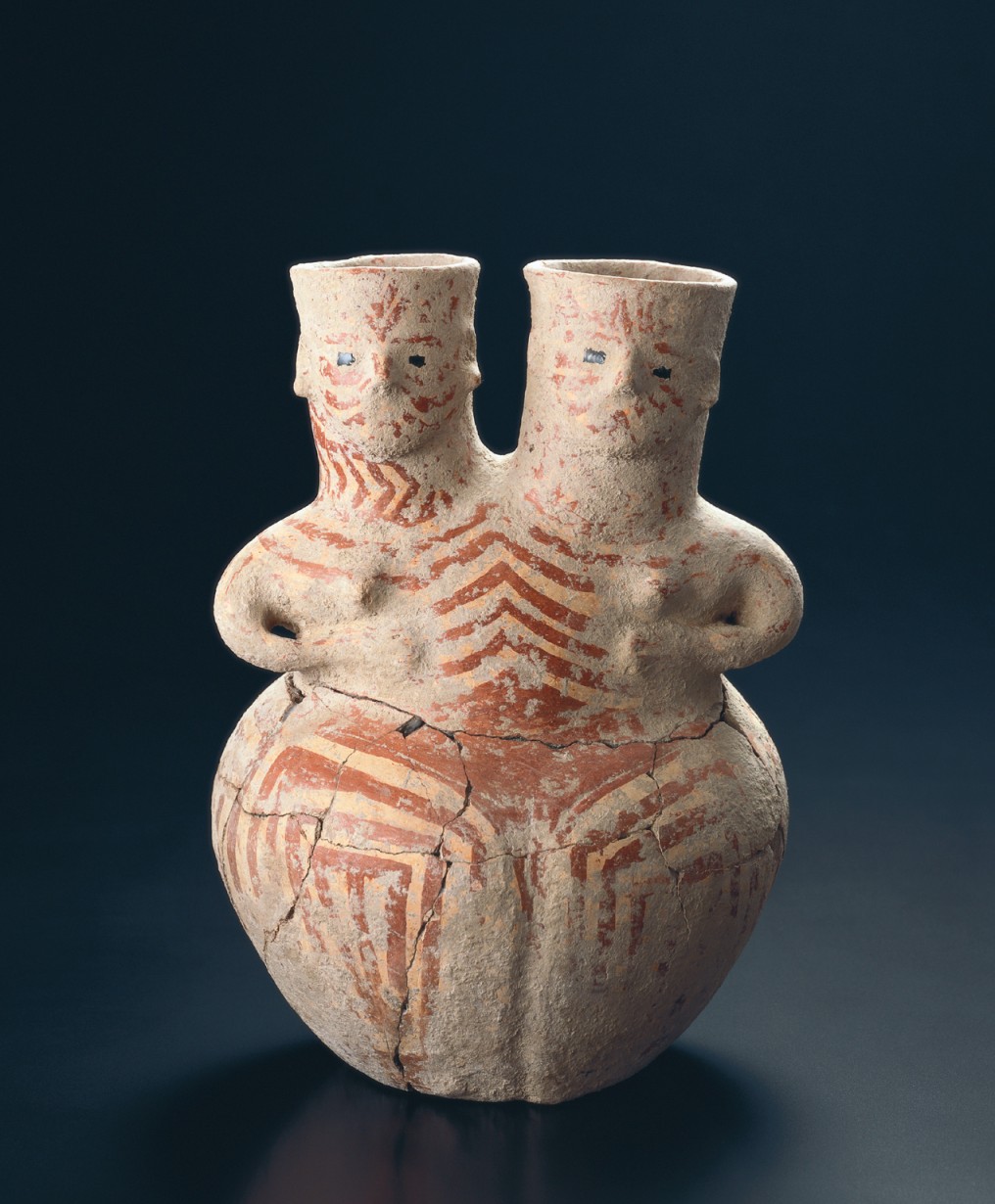
The late 7th millennium saw the emergence of a rich culture centred on the Neolithic settlement at Hacilar in south-western Anatolia. Its most important accomplishment was the creation of artfully designed objects made of fired clay. These mark the beginning of the Mediterranean pottery tradition. Painted anthropomorphic vessels were a peculiarity of Hacilar. The bulging belly of the vessel shown here embodies the hips and thighs; the handles are the arms and the necks the faces. | Anatolia, 5900–5600 BCE, earthenware, painted, h. 32 cm, inv. no. 3.113.72
Close up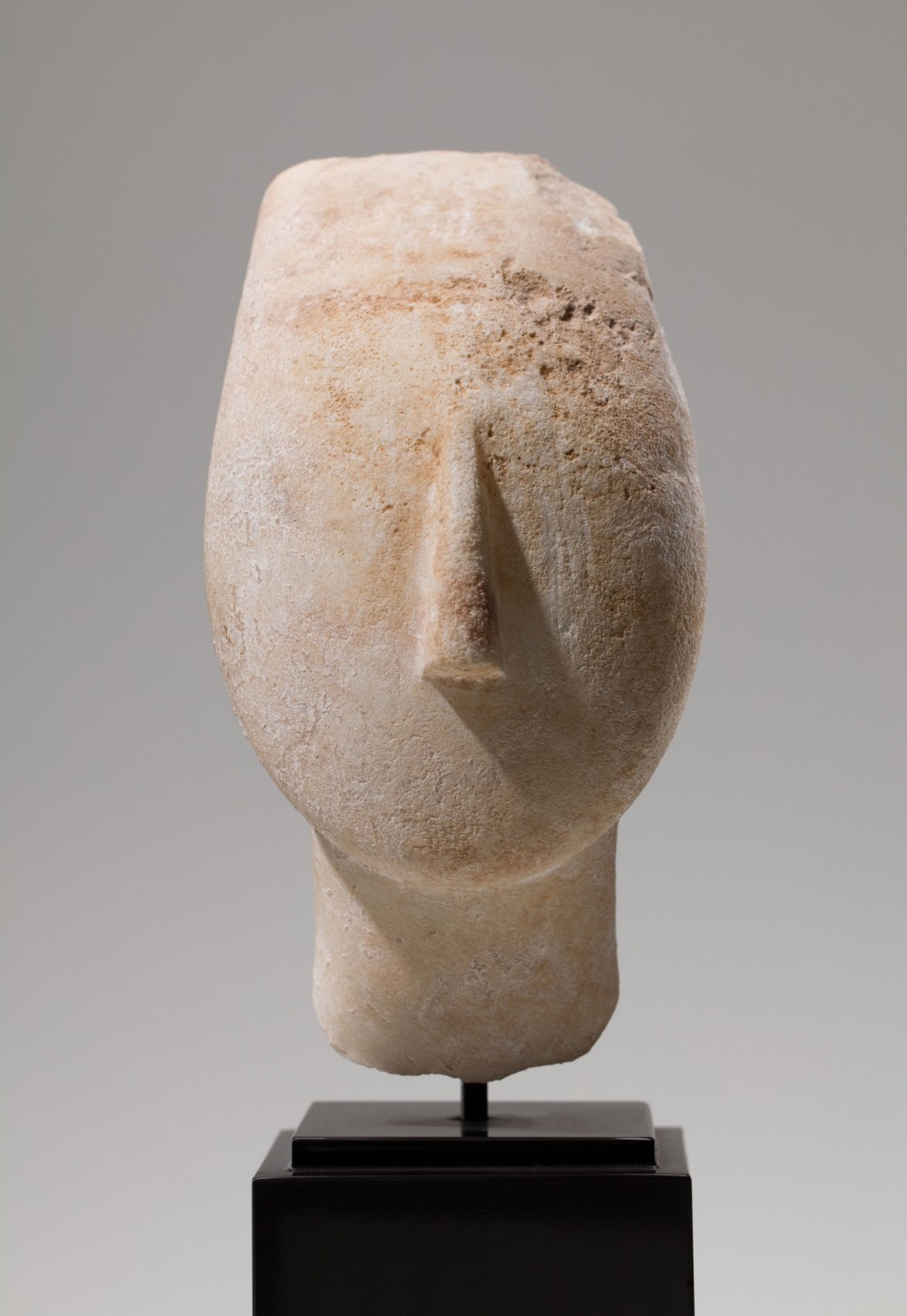
Agriculture, fishing and metalwork were the three mainstays of the culture that developed on the Cyclades Islands in the Aegean Sea in the course of the 3rd millennium BCE. Especially striking is the sophistication of the artefacts made of marble. Among the most characteristic products of Cycladic culture are idols with heavily stylised bodies, some of them almost life-size. They are thought to have been used as part of a grave cult. | Cyclades, 2700–2400 BCE, marble, h. 16 cm, inv. no. 10.58.66
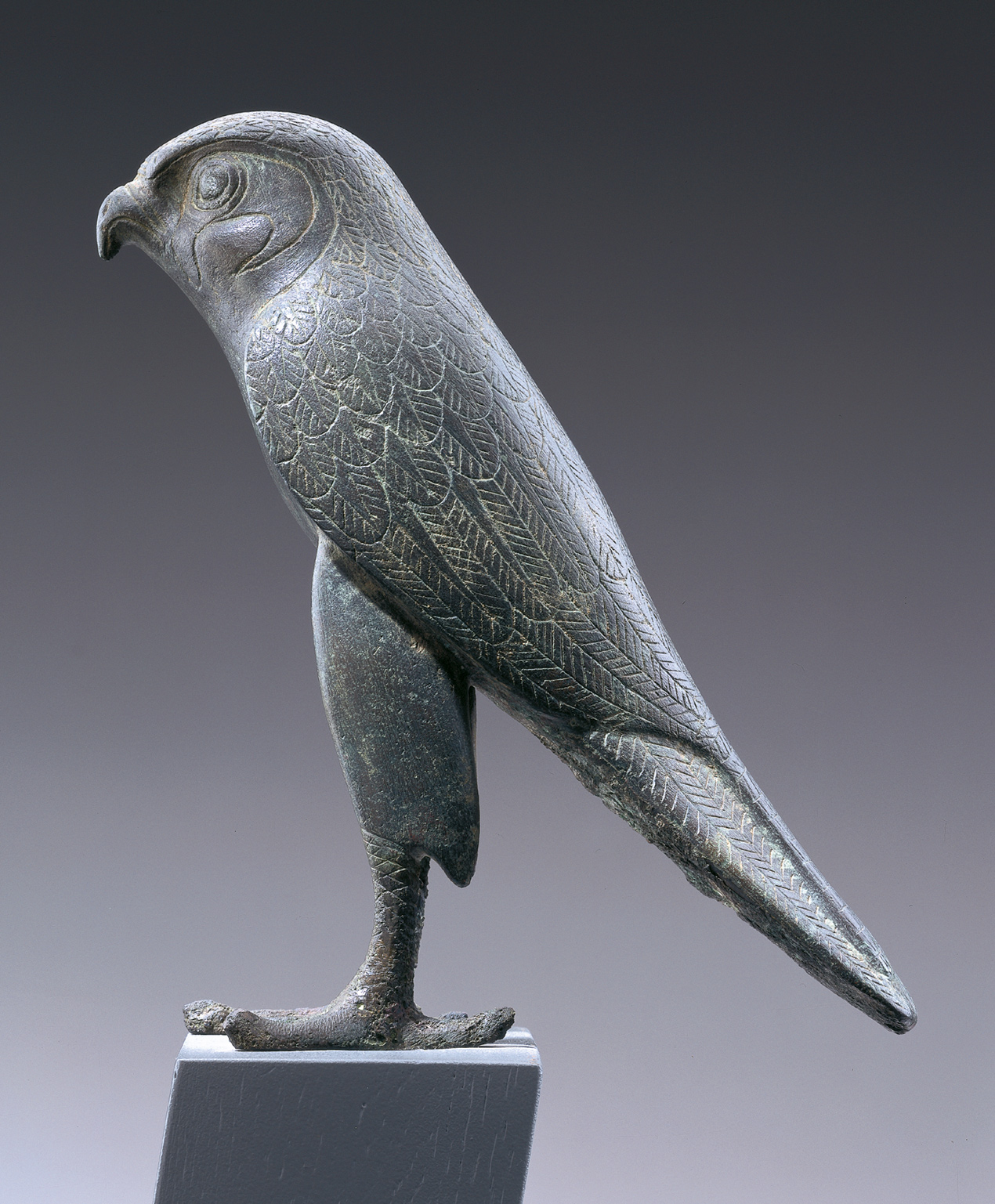
The falcon is one of the most important sacred creatures in Egypt. It embodies both Horus, god of the sky, and the king as Horus’ representative on earth. The cultic veneration of the falcon became very important during the Late Period. The birds were mummified and interred inside burial chambers in special cemeteries, often with bronze statuettes like this one alongside them. | Egypt, 7th–4th century BCE, cast bronze, hollow, engraved, h. 19 cm, inv. no. 10.19.63
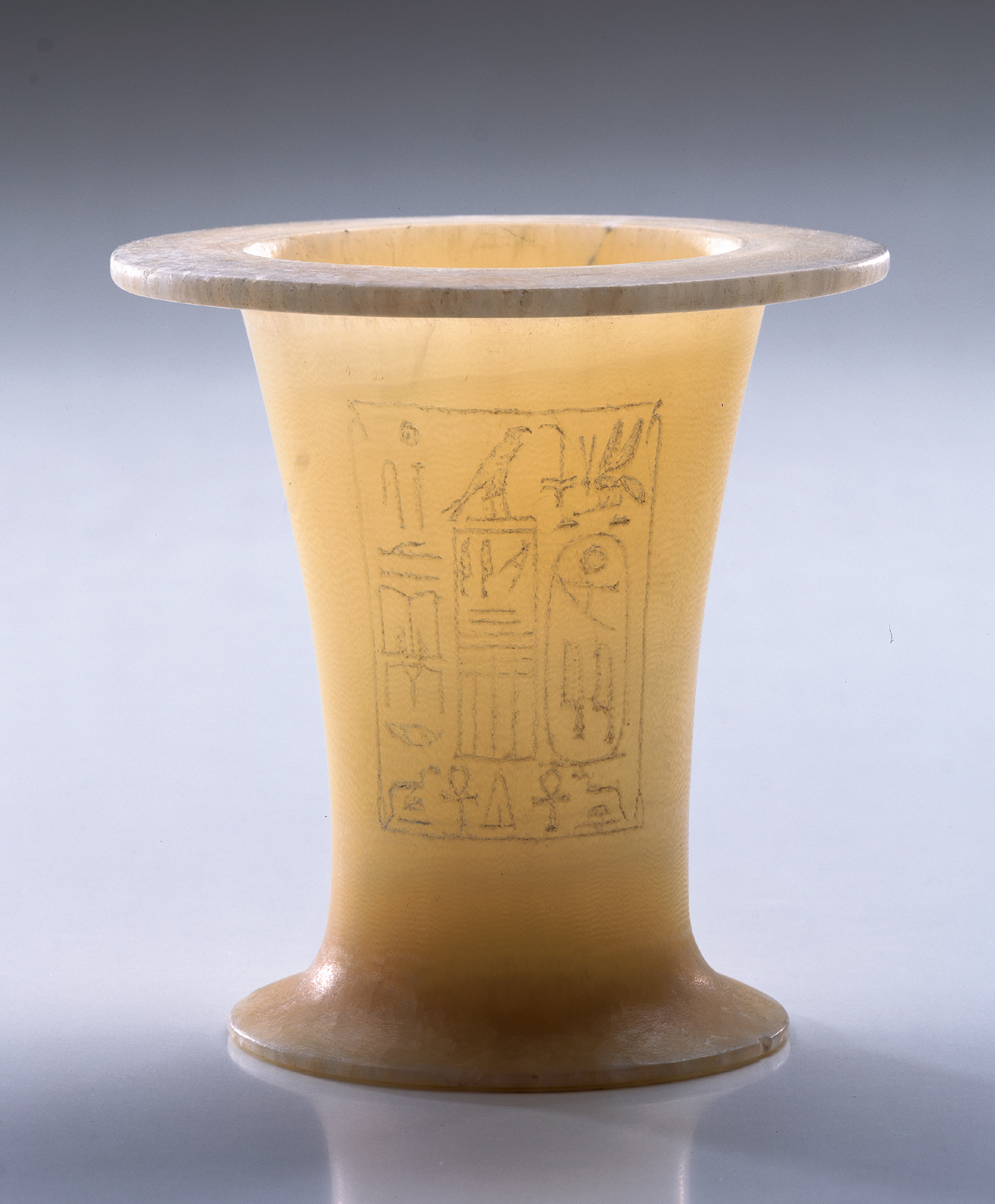
The manufacture of vessels made of stone in Ancient Egypt reached its zenith in the 3rd millennium BCE. The artfully worked jars were for storing costly ointments and essences used for religious, medicinal and cosmetic purposes. Many of these vessels were furnished with inscriptions lending them further significance as mementos or gifts presented on special occasions. The small alabaster jar is inscribed with the name of King Pepi I and was donated on the first anniversary of his reign. | Egypt, ca. 2250 BCE, alabaster, h. 14 cm, inv. no. 6.31.68
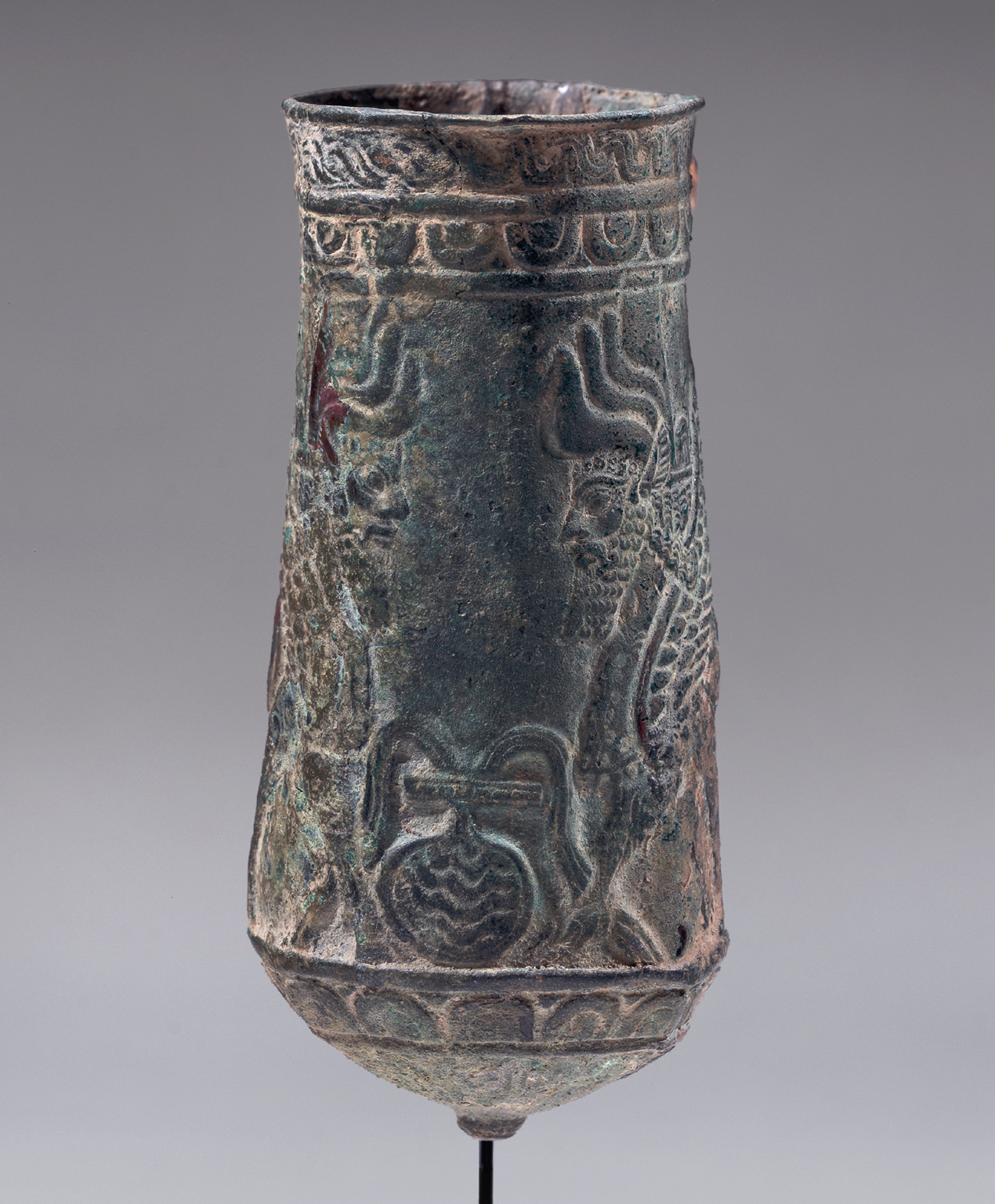
The art of metalworking developed as early as the 3rd millennium BCE in the ore-rich mountains of western and north-western Iran. The large-scale production of bronze and iron artefacts began in the early Iron Age, around 1300 BCE. Local workshops manufactured large quantities of metal goods in a wide range of styles and designs. Iranian knobbed beakers are an especially interesting case as their figural décor points to the influence of Assyrian and Babylonian courtly art. | Iran, 10th–9th century BCE, bronze, embossed, h. 12.5 cm, inv. no. 8.194.72
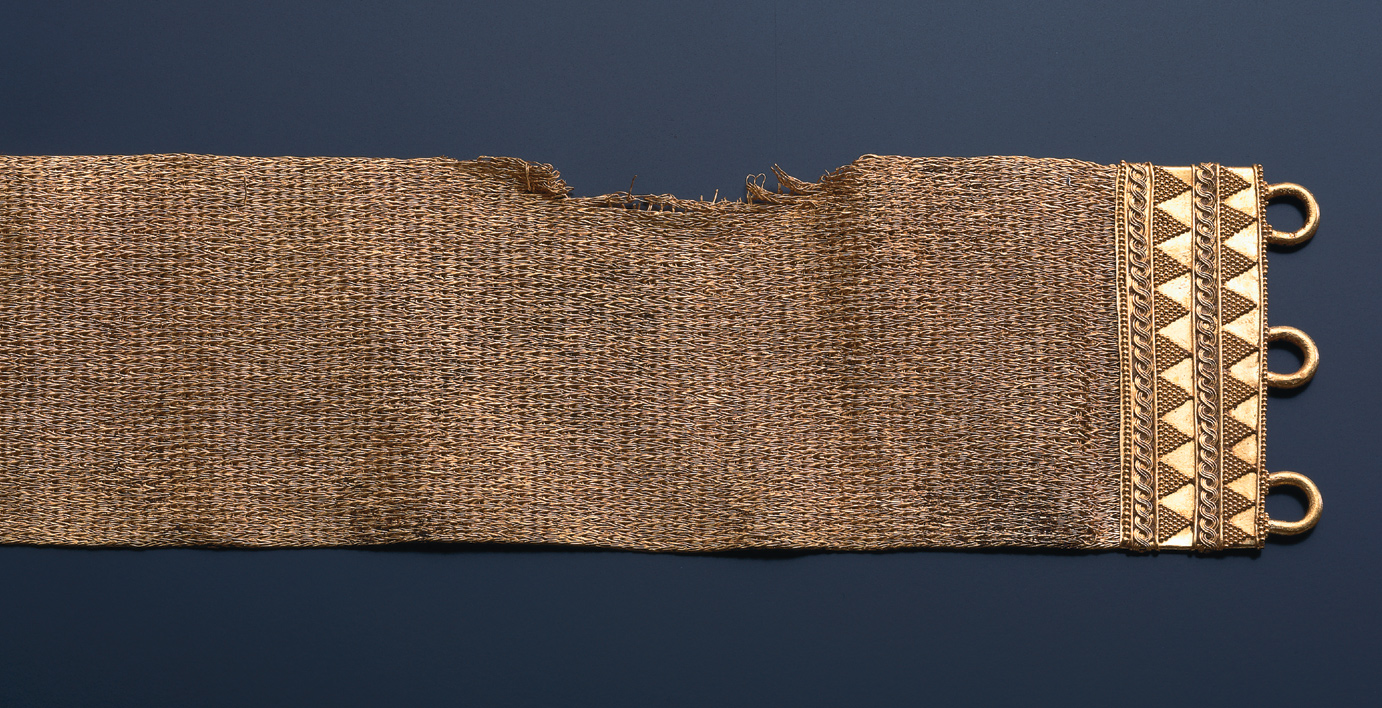
This gold band is made of extremely fine gold wire, bent into double loops and linked together to form long chains. These chains were then laid alongside each other and interlinked with the aid of wire loops running across the grain. The band was probably part of a belt that was fastened using strips of cloth or leather. | North-western Iran (Ziwiyeh), 8th–7th century BCE, gold wire, granulation, l. 49.5 cm, w. 4.5 cm, inv. no. 8.121.65
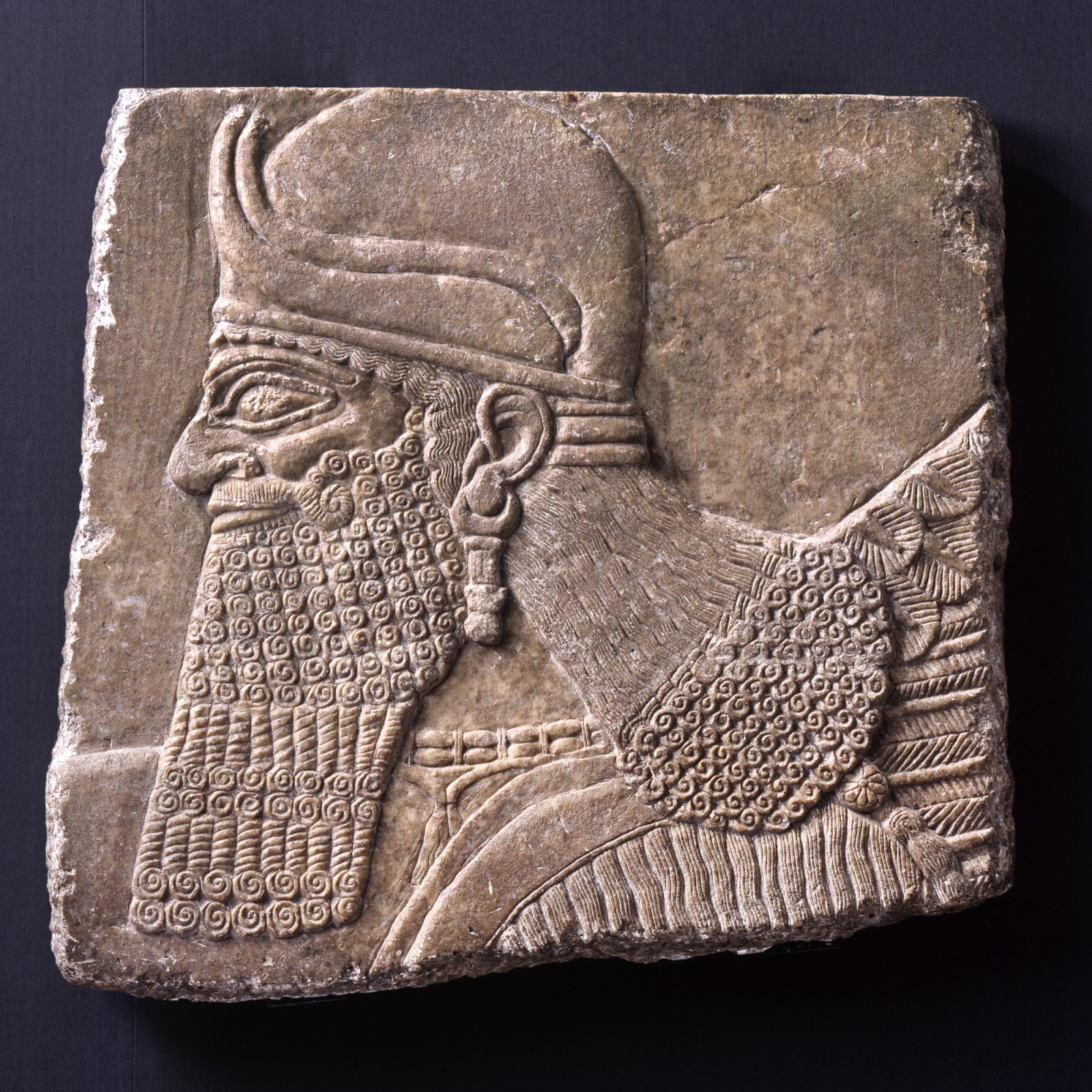
This fragment is part of a relief from the palace of King Ashurnasirpal II (883–859 BCE) in Nimrud in northern Iraq. It shows the head of a guardian spirit like the ones found on depictions of the king performing ritual acts. The spirit has wings and his hair and beard are curled. He wears a horned helmet and a cylindrical earring and neck chain as jewellery. Almost all the palace interiors in Nimrud had alabaster cladding decorated with reliefs or paintings. | Assyrian Empire (Nimrud), 883–859 BCE, alabaster, h. 59 cm, w. 62 cm, inv. no. 12.2.63
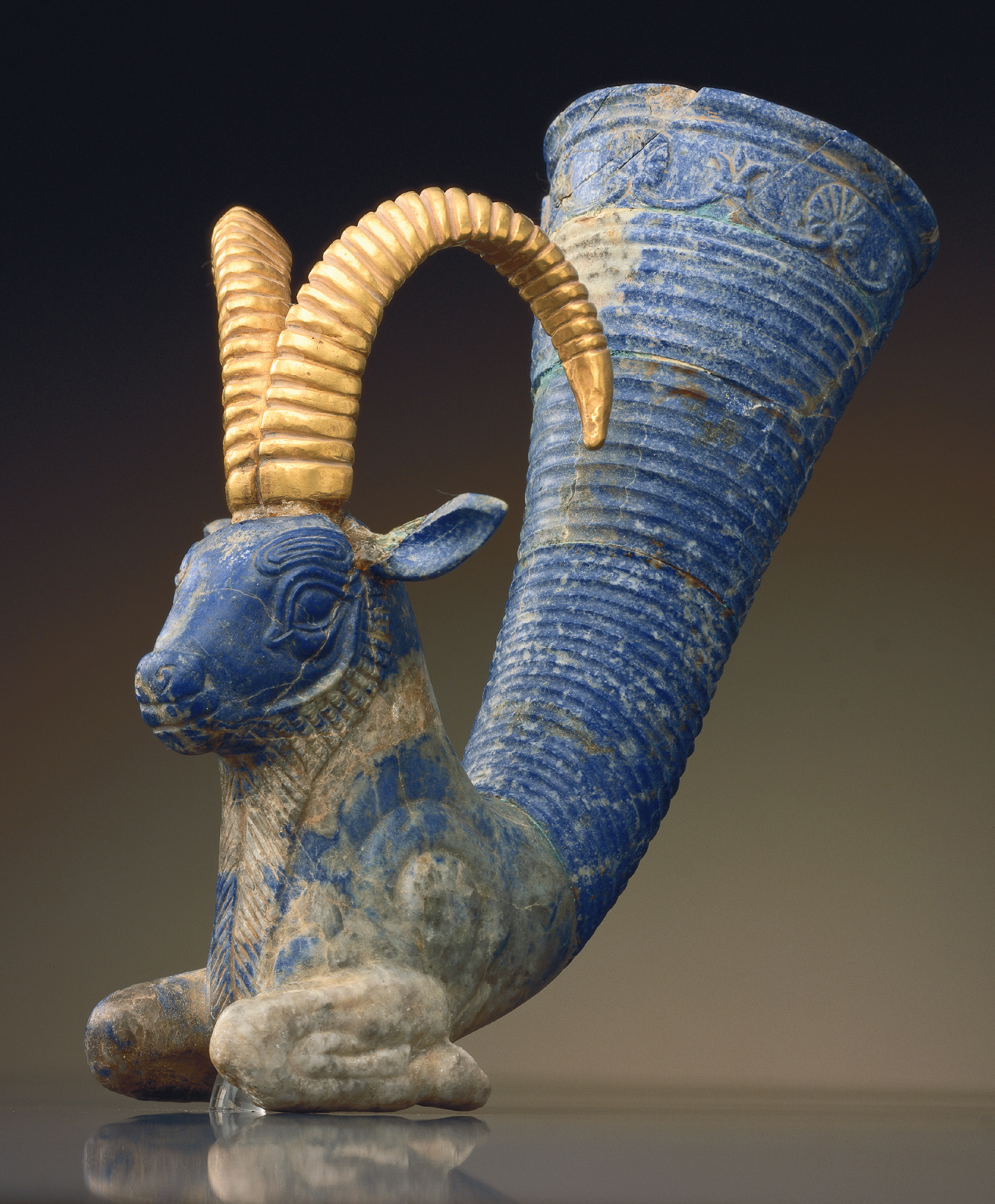
The vessels used at festive banquets or for libations before images of the deity in the Ancient Near East were often very fine indeed. Beakers shaped like animals or animal heads were especially popular. This lapis lazuli decanter is filled through the funnel at the top but has a smaller outlet at the front to allow the contents to be decanted into a bowl. The exquisite material and heavily stylised animal are characteristic of the highly developed courtly culture of the First Persian Empire under the Achaemenids. | Iran, 6th–5th century BCE, lapis lazuli, gold, h. 18 cm, inv. no. 6.7.63
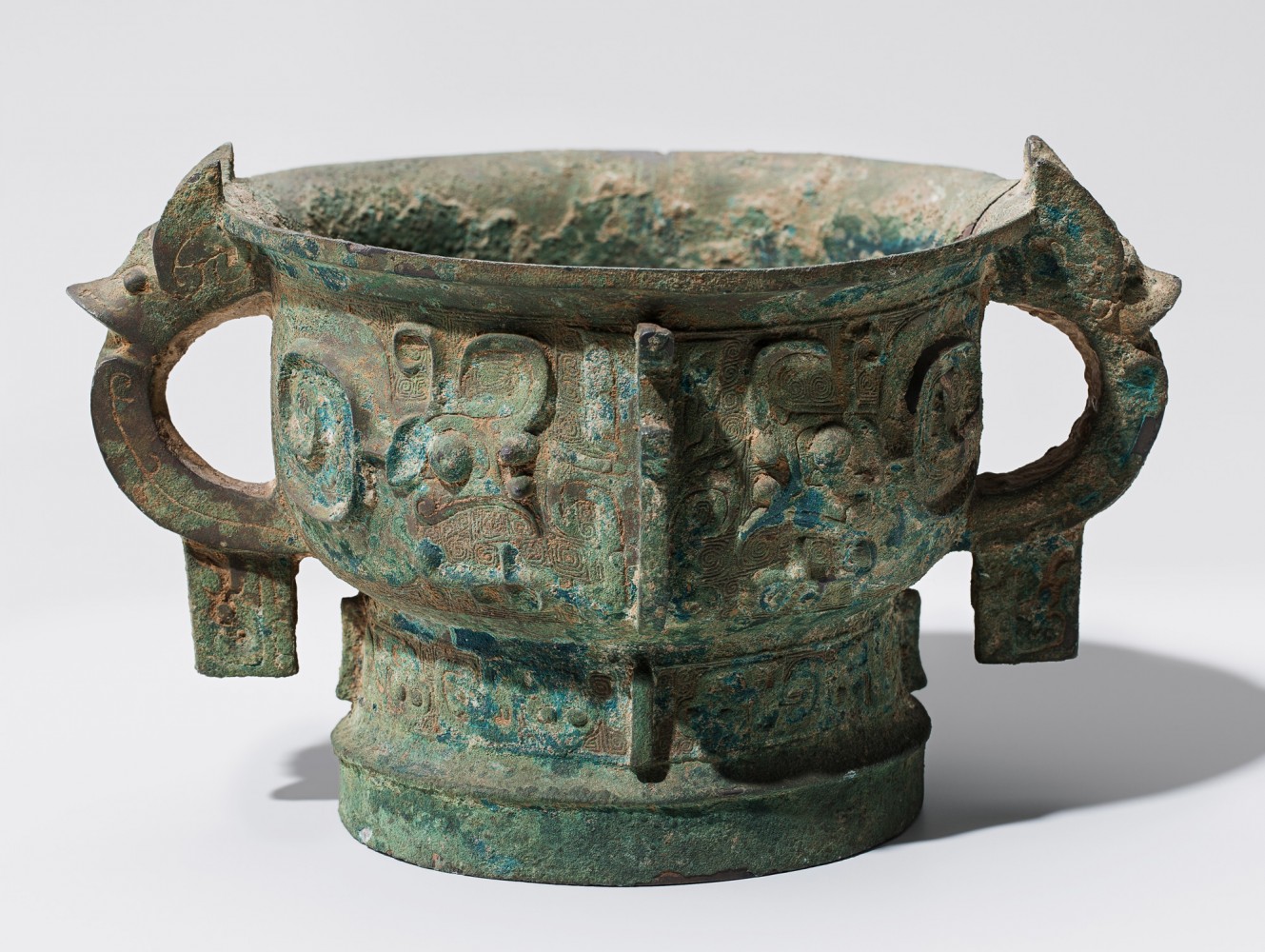
Ancestor worship was the predominant cult in China during the Ancient Era. Rulers and nobles went to extraordinary lengths to venerate their forebears. This costly bronze vessel was designed to hold a food offering for the worshipper’s ancestors. It was intended mainly for boiled rice, millet and other kinds of grain. The two handles are shaped like dragons. The body of the vessel shows stylised animal reliefs on a densely engraved ground. | China, early Western Zhou Dynasty, 11th–10th century BCE, cast bronze, h. 14 cm, inv. no. 8.397.01
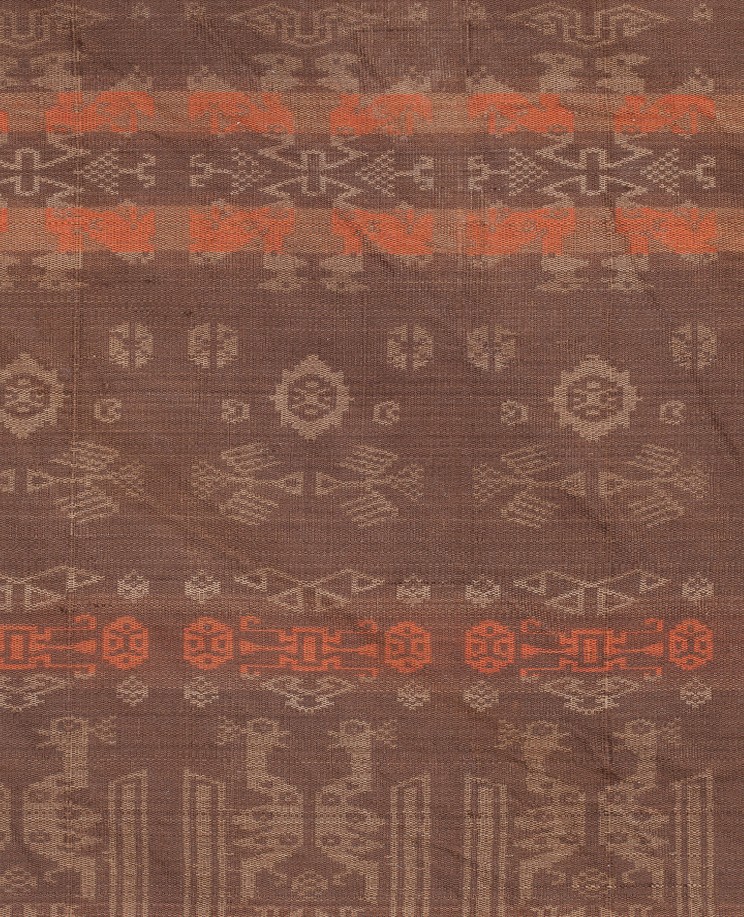
Silk weaving blossomed in China long before the common era. Many silks had intricate patterns featuring stylised dragons, four-legged beasts and birds or variations of the same. The coloured stripes that greatly add to the dynamism of this particular silk were woven with orangey-red threads dyed with cinnabar. The silk is made of several lengths of cloth sewn together and would originally have been padded and lined for use as a blanket. | China, Warring States Period, 4th–3rd century BCE, silk (warp-faced compound weave), pattern repeat h. 4 cm, inv. no. 5302/5304
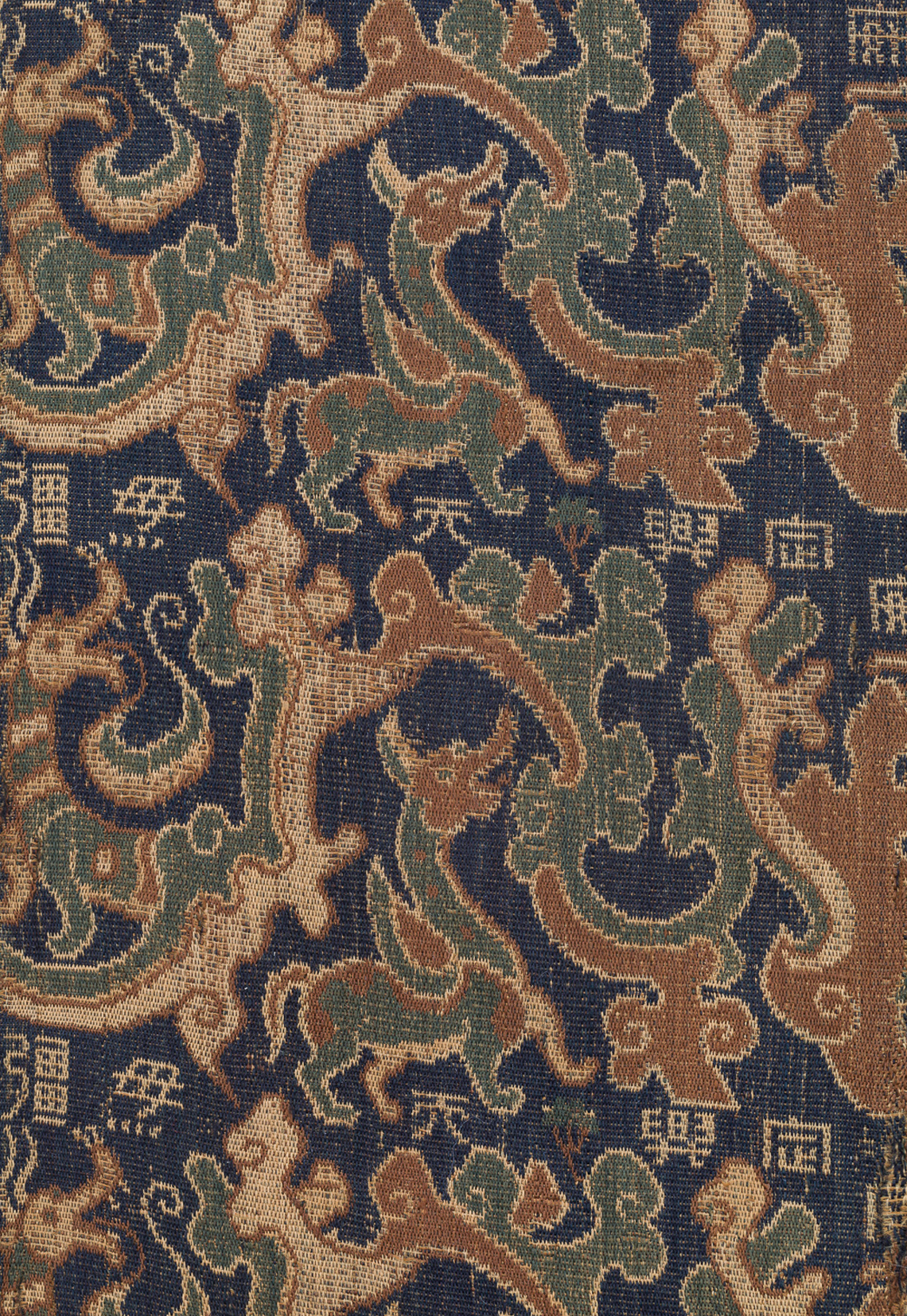
Having survived only in part, the original three-dimensional form of this garment can no longer be reconstructed. The silk is populated by four-footed beasts and birds which inhabit a stylised, paradisiacal landscape of mountains or clouds. The Chinese characters expressing hope and good wishes scattered among the creatures provide a formulaic reinforcement of the visual message of the images. | China, Eastern Han Dynasty, 1st–2nd century, silk (warp-face compound weave), pattern repeat h. 8,5 cm, inv. no. 5301/5303/5336
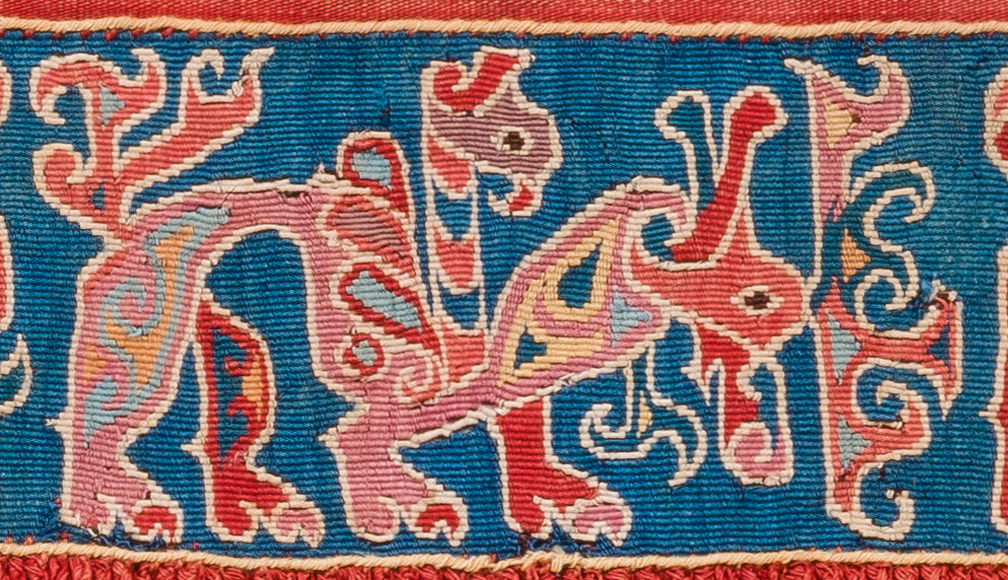
This fragment features a procession of brightly coloured, heavily stylised deer. Every second deer carries a bird on its back – or rather an ambivalent figure which might also be read as a wing with a bird’s head at its tip. Comparable tapestry strips and even whole skirts were found in the tombs of Shanpula on the southern rim of the Taklamakan Desert. | Eastern Central Asia (Xinjiang), 3rd–1st century BCE, wool (tapestry, twill oblique interlacing), h. 51 cm, w. 102.5 cm, inv. no. 5157
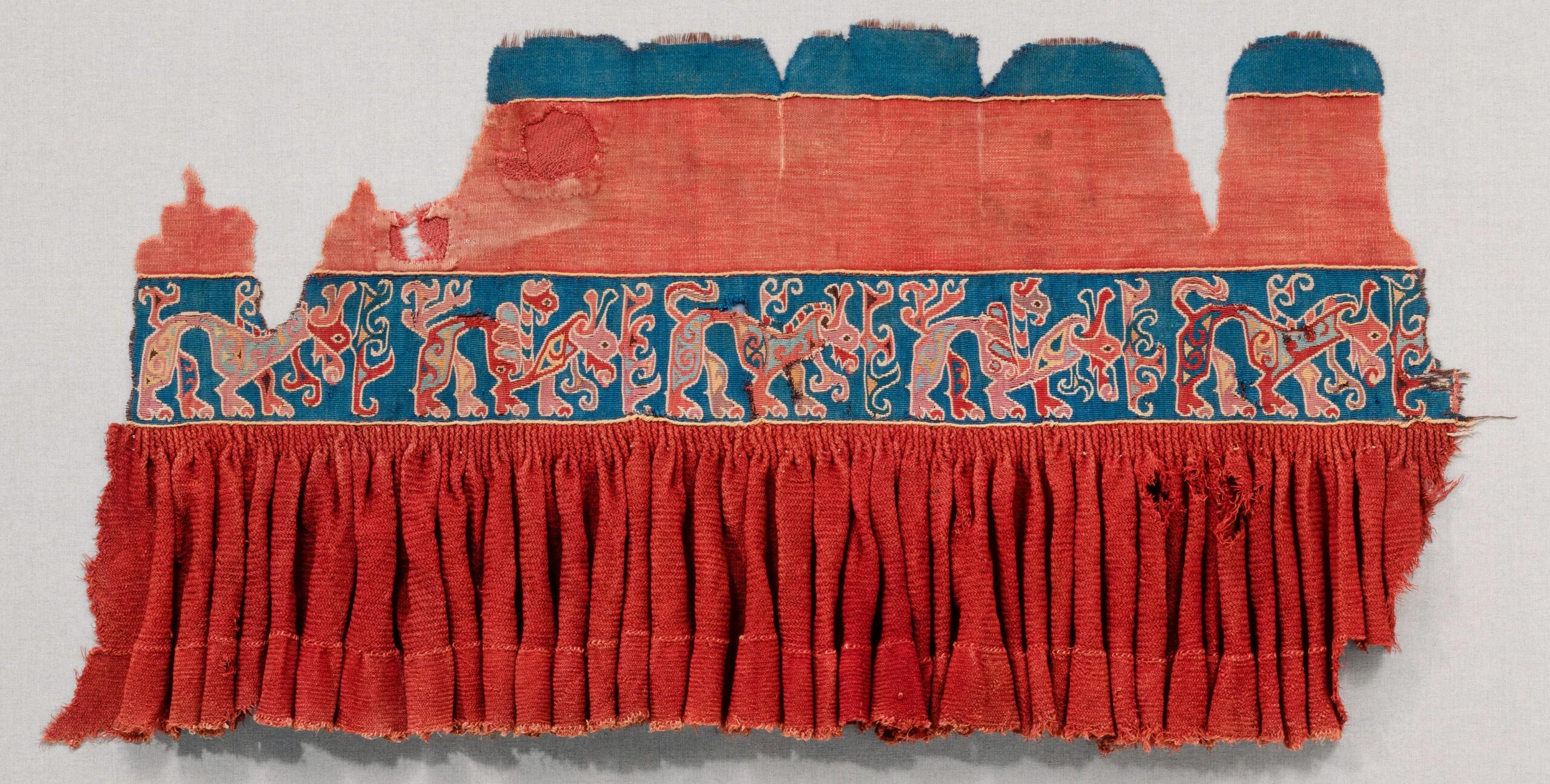
Abegg-Stiftung, Fragment of a skirt, eastern Central Asia, 3rd–1st century, inv. no. 5157

The volume is dedicated to unique textiles thought to come from a burial ground near Shanpula, located on the southern edge of the Taklamakan Desert. It comprises a catalogue section listing all relevant pieces in the Abegg-Stiftung collection.
Riggisberger Berichte 10 | With contributions by E. C. Bunker, J. H. Hofenk de Graaff, D. Keller, R. Knaller, R. M. R. van Bommel, Wang Bo, Xiao Xiaoyong | 256 p., 118 illus, paperbound, 23 x 31 cm, 2001, 2nd printing 2003, ISBN 3-905014-17-3
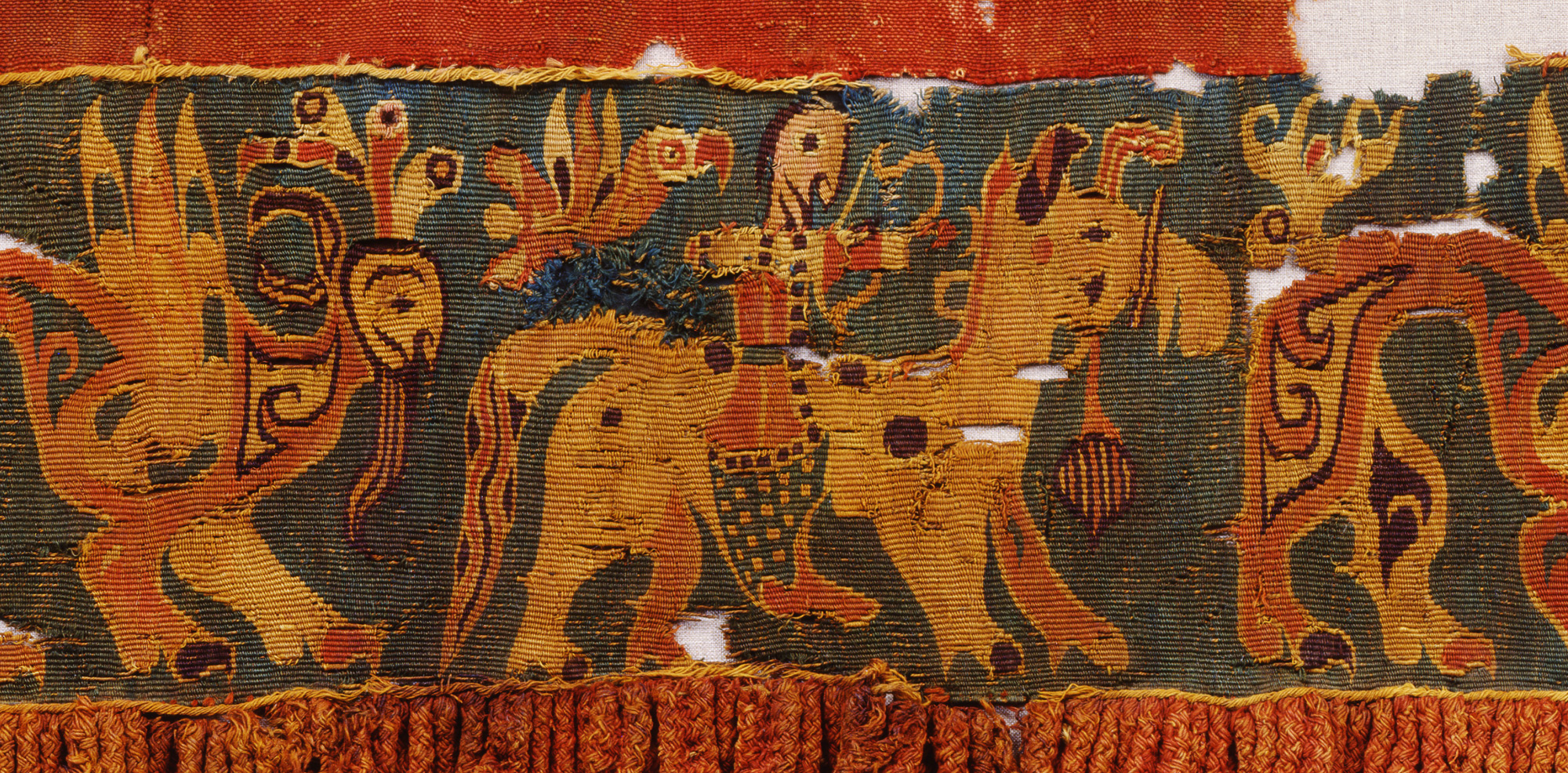
This archer on horseback accompanied by a bird of prey shown in hot pursuit of a winged chimera with the body of a beast and the bearded head of a man is a most unusual motif. The scene rests on the mythological traditions of Western Asia adapted to Steppe culture. Here, expressive stylisation goes hand in hand with an astonishing realism, evident in the horsemen’s attire, for example. | Eastern Central Asia (Xinjiang), 1st–3rd century, wool (tapestry, twill oblique interlacing), h. 47 cm, w. 92 cm, inv. no. 5138
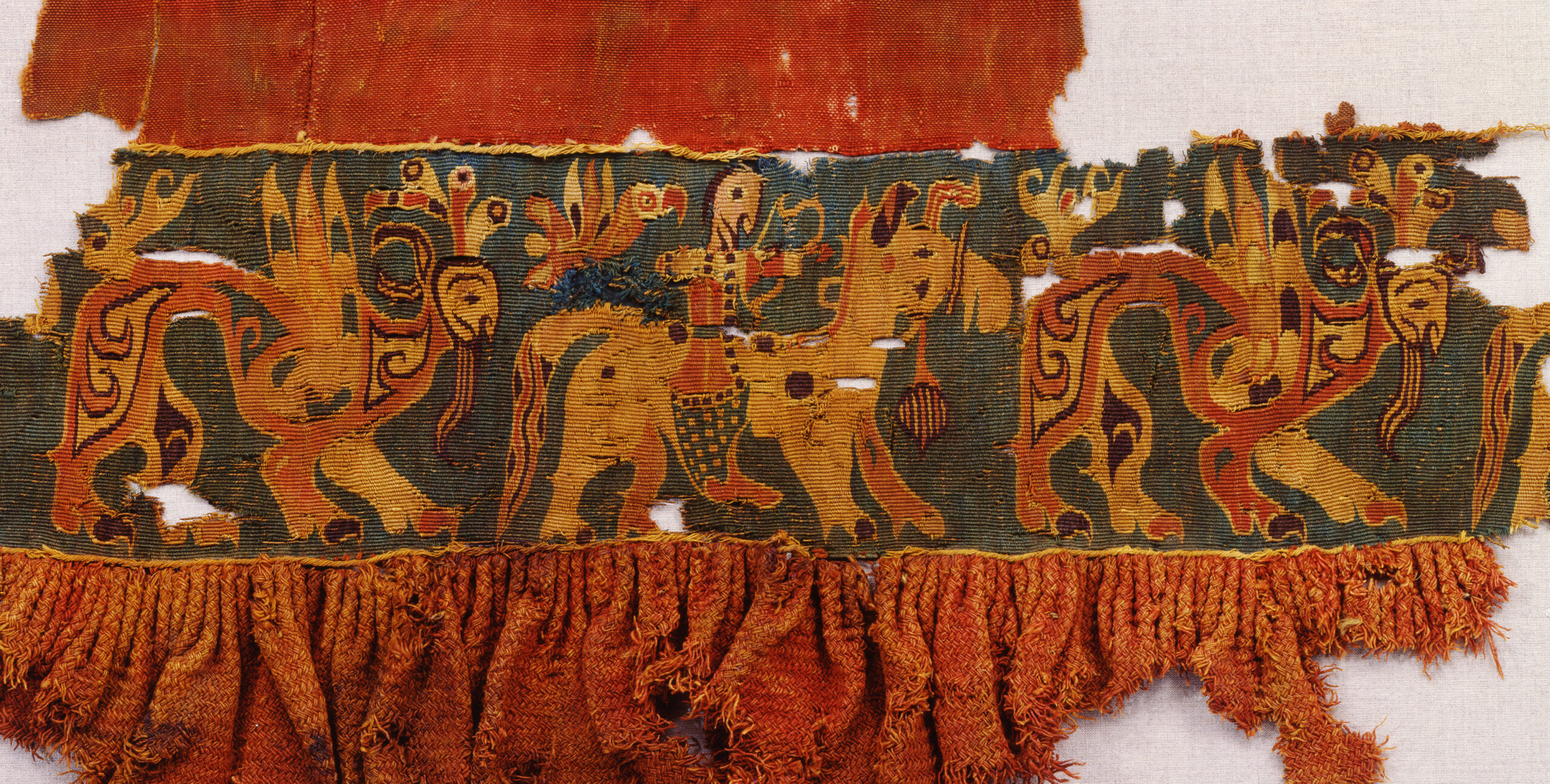
Abegg-Stiftung, Tapestry strip with horsemen, eastern Central Asia, 1st–3rd century, inv. no. 5138
The volume is dedicated to unique textiles thought to come from a burial ground near Shanpula, located on the southern edge of the Taklamakan Desert. It comprises a catalogue section listing all relevant pieces in the Abegg-Stiftung collection.
Riggisberger Berichte 10 | With contributions by E. C. Bunker, J. H. Hofenk de Graaff, D. Keller, R. Knaller, R. M. R. van Bommel, Wang Bo, Xiao Xiaoyong | 256 p., 118 illus, paperbound, 23 x 31 cm, 2001, 2nd printing 2003, ISBN 3-905014-17-3
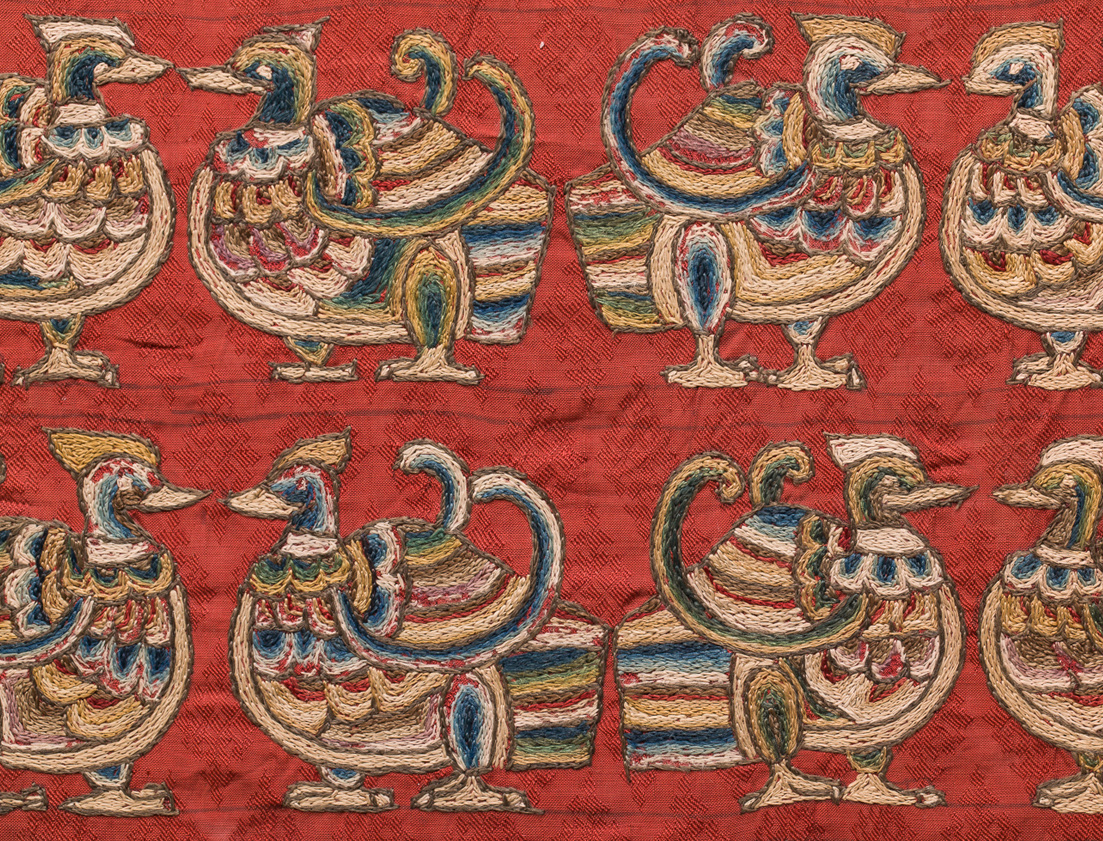
The rows of ducks on this fabric are embroidered onto a tone in tone damask-like ground. Why some of them are turned through 90 degrees is not known. One possible explanation is that the cloth was intended to be cut up into strips to be used either horizontally or vertically. The only other bird, possibly a peacock, is visible on the right selvage, the original edge of the embroidery. | Eastern Central Asia, 7th–8th century, silk embroidery on silk damask, h. 52.5 cm, w. 131.5 cm, inv. no. 4902
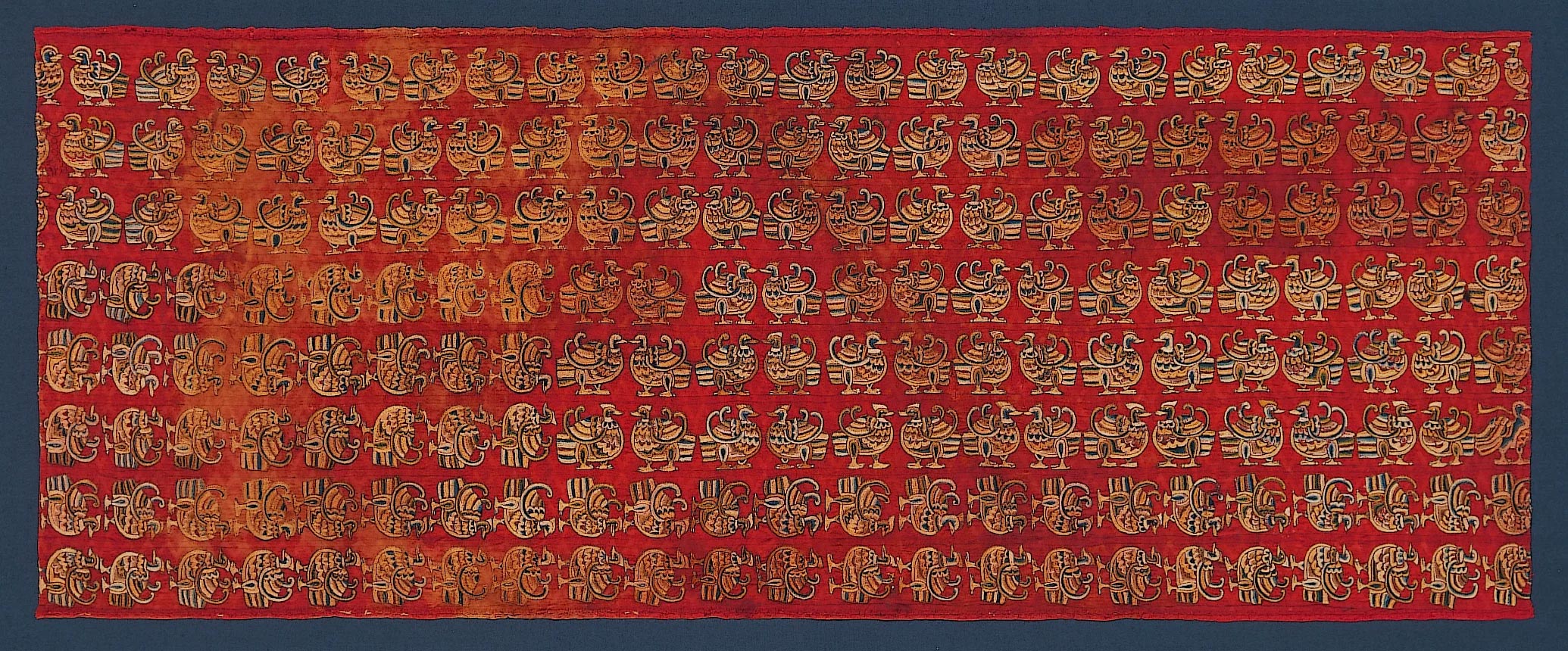
Abegg-Stiftung, Embroidery with ducks, eastern Central Asia, 7th–8th century, inv. no. 4902
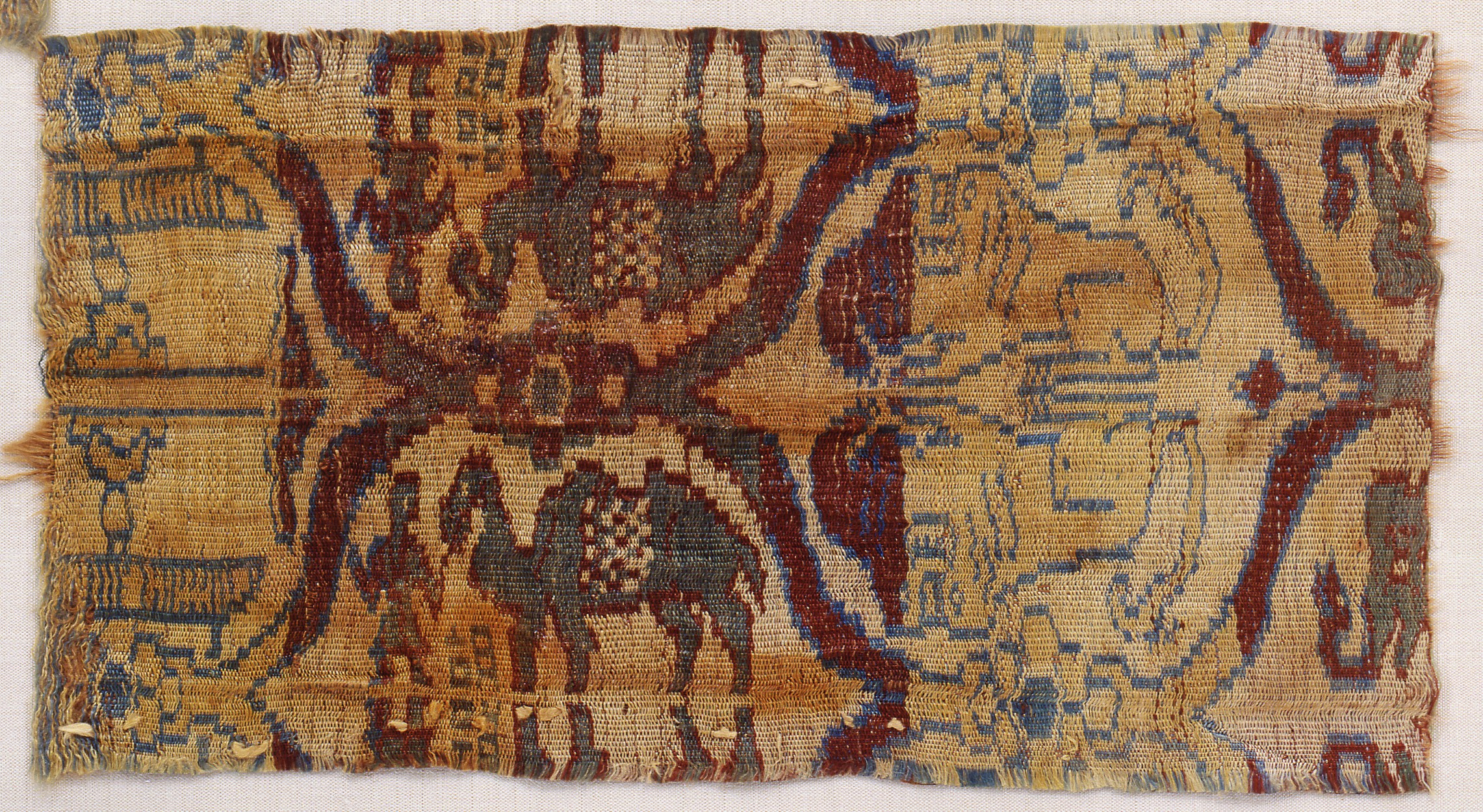
This silk is patterned with lions and elephants at rest and with grooms and their camels. They are labelled with the Chinese ideogram hu, which is generally translated as “Barbarian” but could refer to all the neighbouring peoples to the west. Perhaps the groom is actually a Silk Road trader. Heavily laden camels arriving from the west were synonymous with luxury during the Tang Dynasty. Depicting them on silks was thus a way of rendering the cloth all the more costly. | China, Northern Dynasties or Sui Dynasty, 5th–7th century, silk (warp-faced compound weave), h. 19.5 cm, w. 39 cm, inv. no. 5269 a-c
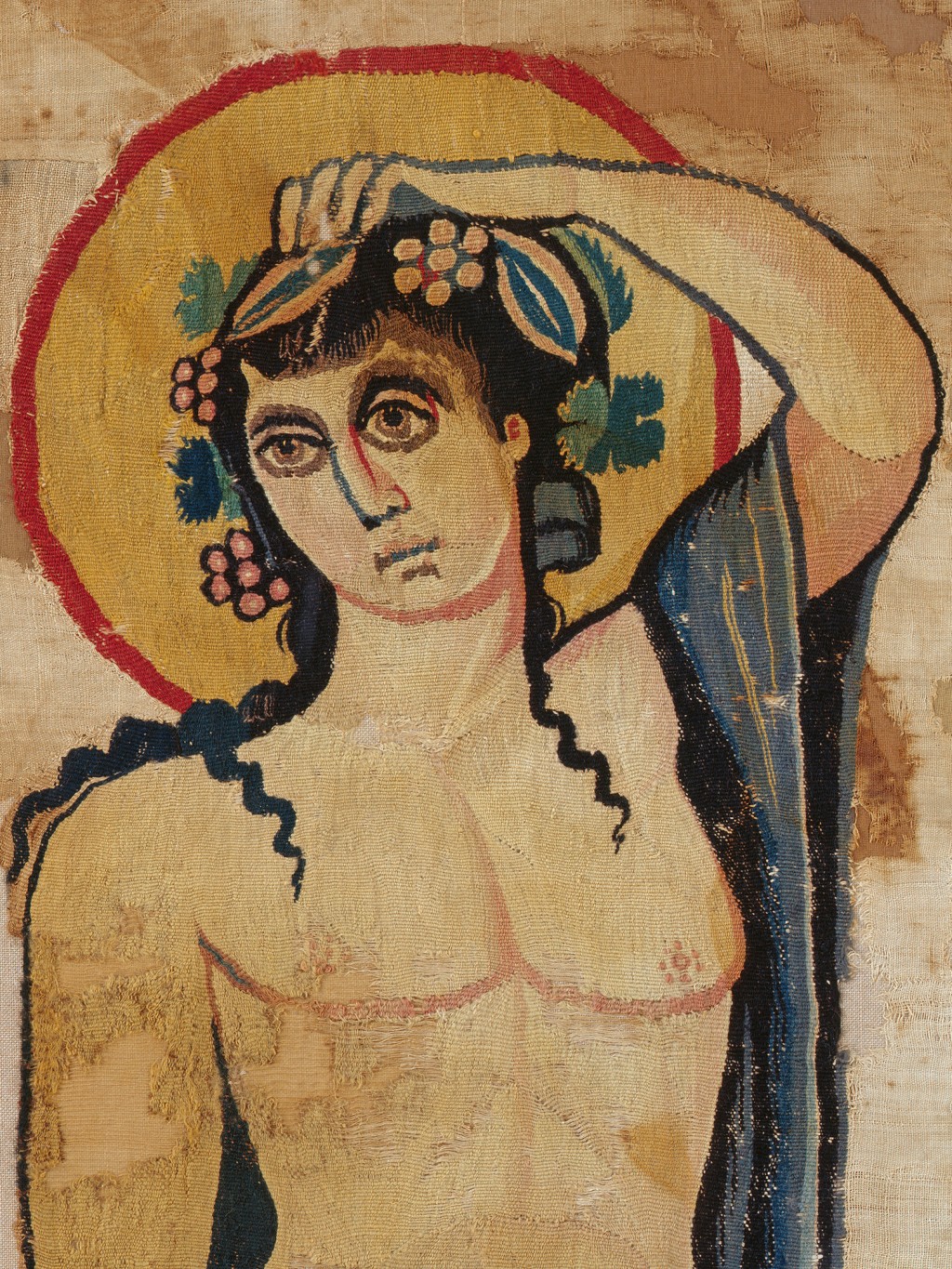
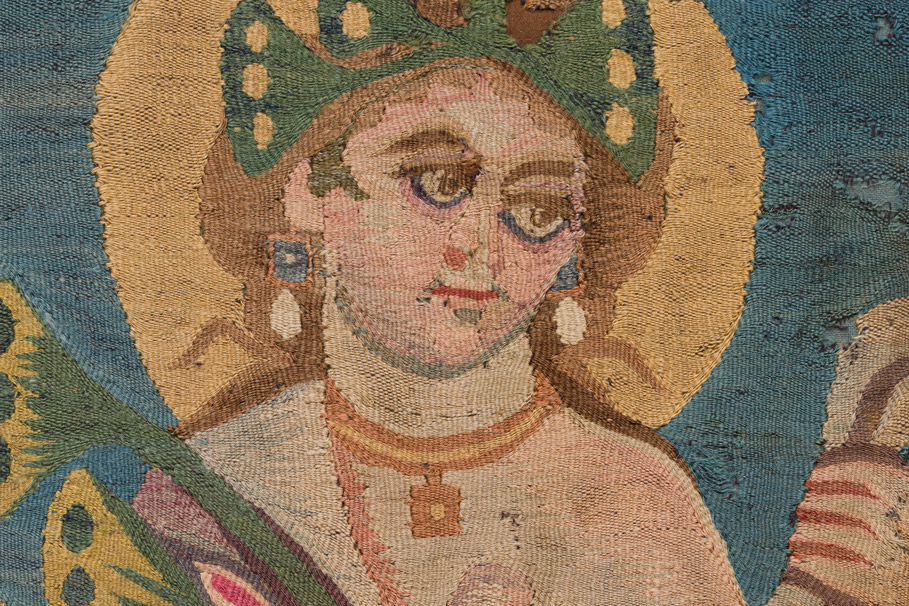
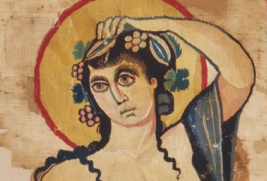
This monumental tapestry originally served as a wall hanging in a Roman private home or cult building. The programme shows Dionysos, the Greek god of wine and ecstasy, and his entourage standing underneath arcades lavishly decked out in climbing foliage and braided ornaments. The cult of Dionysos was widespread in Late Antiquity. It promised its adherents life after death and was an articulation of the desire for a life of happiness and superfluity. | Egypt, 4th century, wool tapestry on a linen ground, h. 210 cm, w. ca. 700 cm, inv. no. 3100a
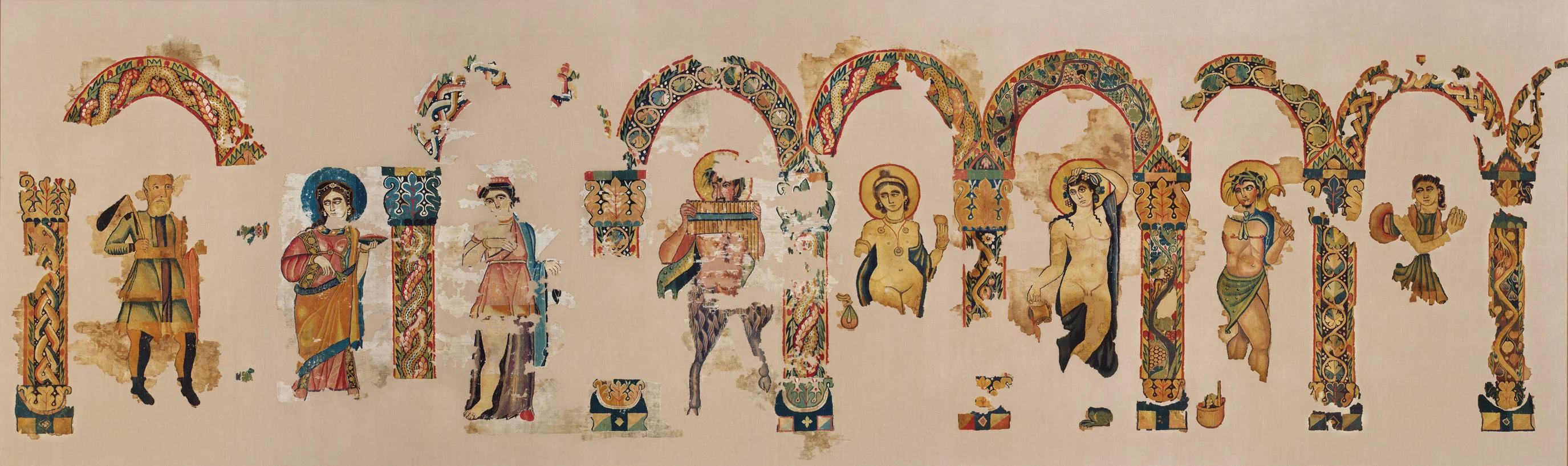
Abegg-Stiftung, Dionysos hanging, Egypt, 4th century, inv. no. 3100a

Der Dionysosbehang der Abegg-Stiftung gehört zu den grössten und bedeutendsten Bildwirkereien, die aus der Spätantike noch erhalten sind. Er wird erstmals in einer umfassenden monographischen Arbeit gewürdigt. Dietrich Willers widmet sich von archäologischer Seite den Darstellungen des Behangs und ihrer Deutung. Bettina Niekamp behandelt grundlegende Fragen zu Technik und Material sowie zum Herstellungsablauf vom Entwurf über die Wirkvorlage bis zur Ausführung. Ausserdem wird die Restaurierungsgeschichte des Behangs vorgestellt.
Riggisberger Berichte 20 | 272 S., 200 Abb., 32 Tafeln, 1 Falttafel, brosch., 23 x 31 cm, 2015, ISBN 978-3-905014-53-2
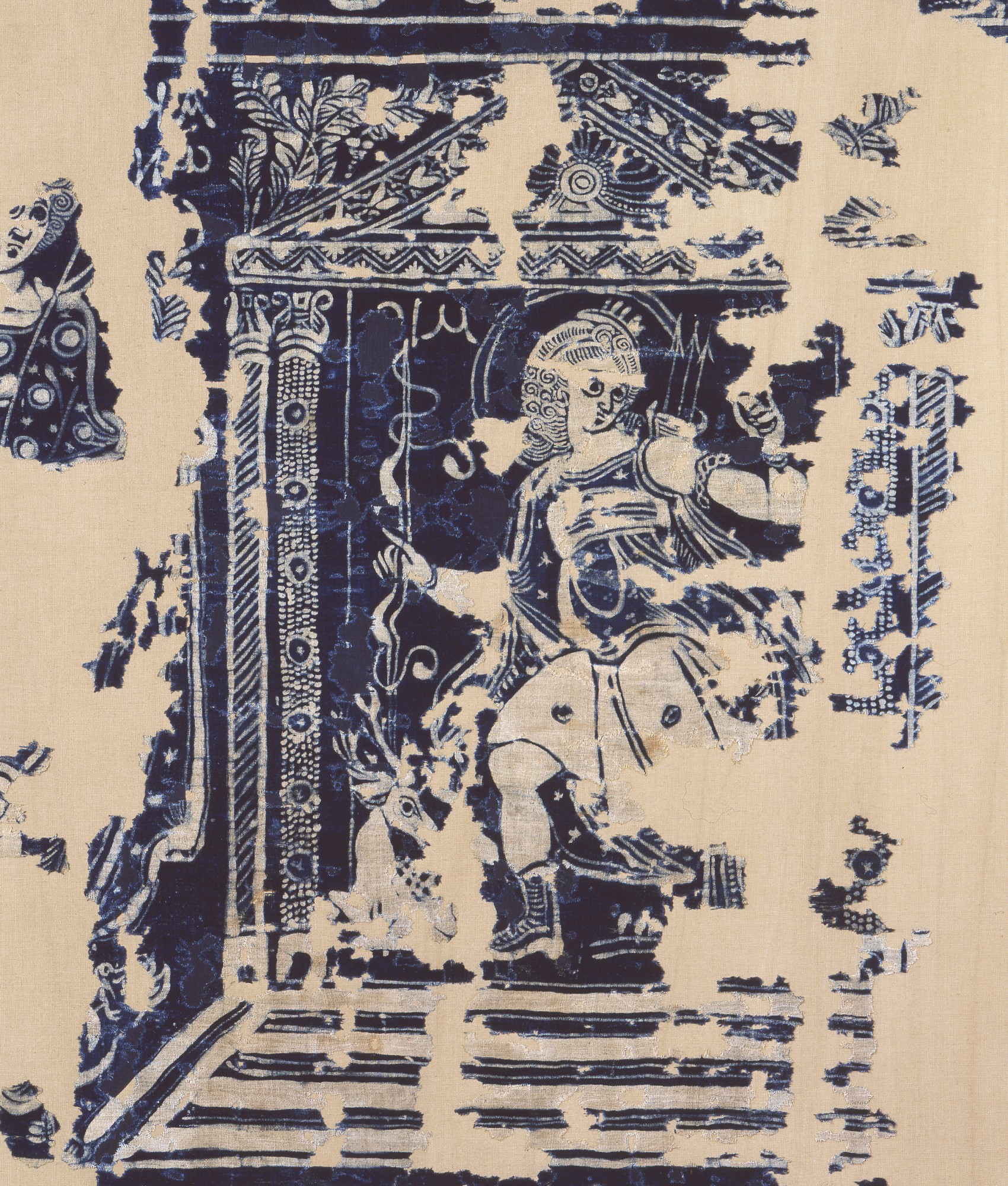
The centrepiece of this monumental hanging is Artemis, goddess of hunting. Armed with bow and arrow, she is shown here in her temple striding ahead in resolute haste. To the left of her are some of the great hunters of Greek mythology: Actaeon, Narcissus, Meleager and Adonis, while to the right are scenes of hunters fighting wild beasts. The images were produced by resist dyeing, a method which entailed painting the motifs onto a light linen cloth in a paste made of resin and wax. The cloth was then immersed in a vat of dye so that when the paste was later removed, the figures and ornaments showed up as much paler than the dyed ground. | Egypt, 4th–6th century, resist-dyed linen, h. 194 cm, w. c. 600 cm, inv. no. 1397
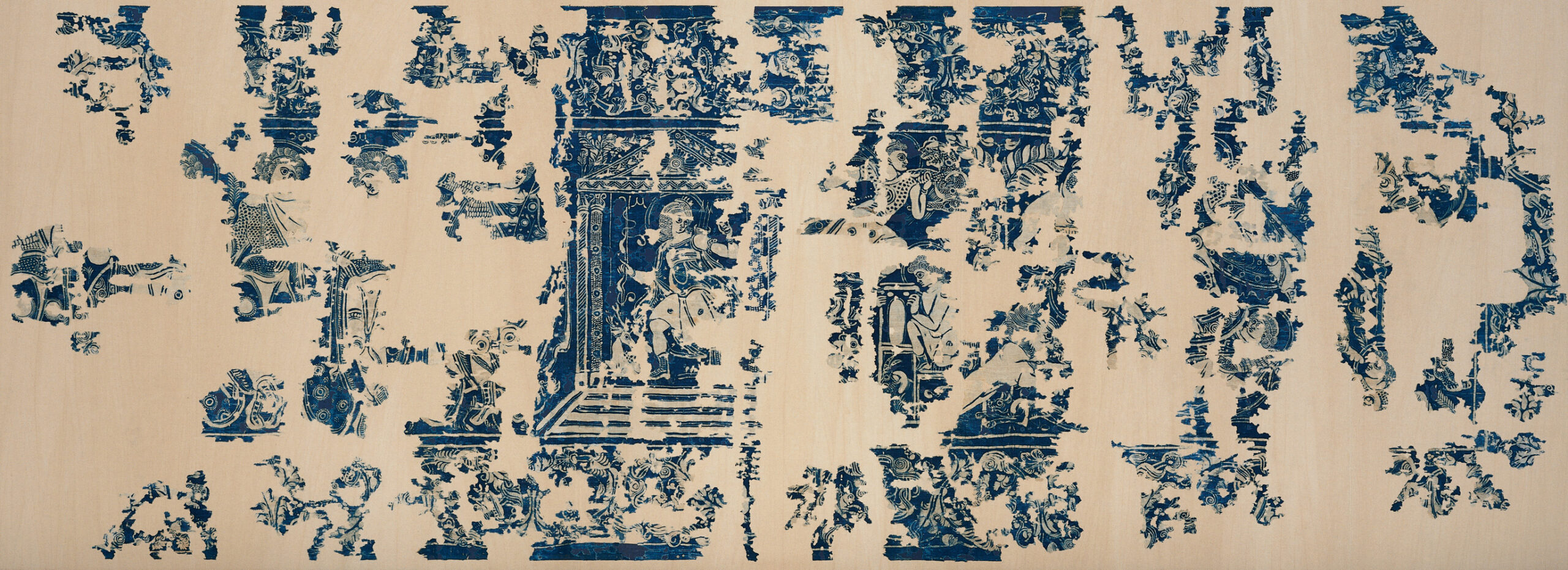
Abegg-Stiftung, Artemis hanging, Egypt, 4th–6th century, inv. no. 1397
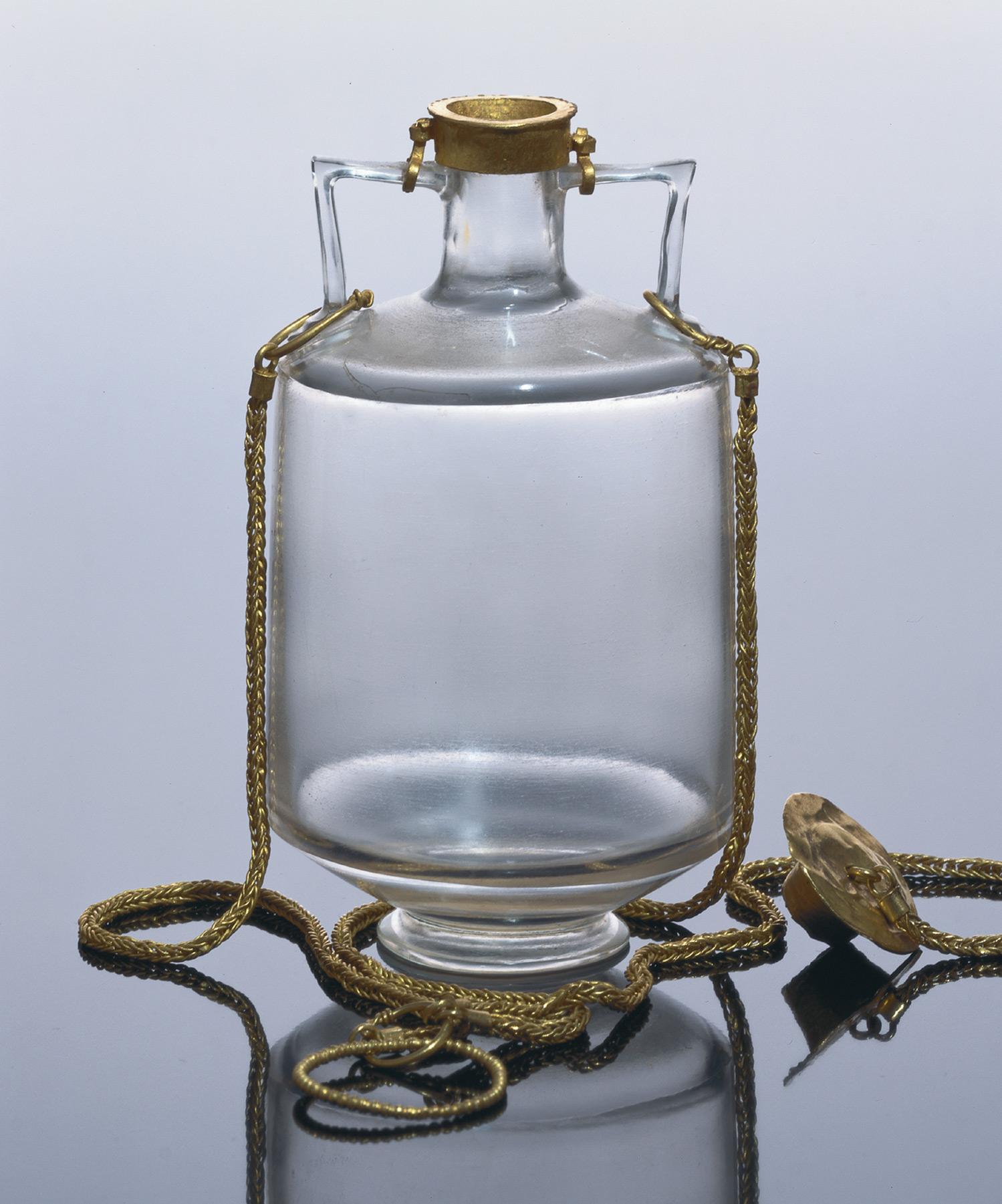
This small, thin-walled jar is cylindrical in shape with a flat foot, narrow neck and fine, angled handles. It was ground out of a block of transparent rock crystal and is fitted with a gold cap and a finely braided gold chain to allow it to be hung up. A costly vessel, it may well have belonged to a wealthy Roman lady originally and was probably made to hold fragrant ointments and essences. | Eastern Mediterranean, 1st half of the 1st century, rock crystal, gold, h. 8.4 cm, inv. no. 9.45.81
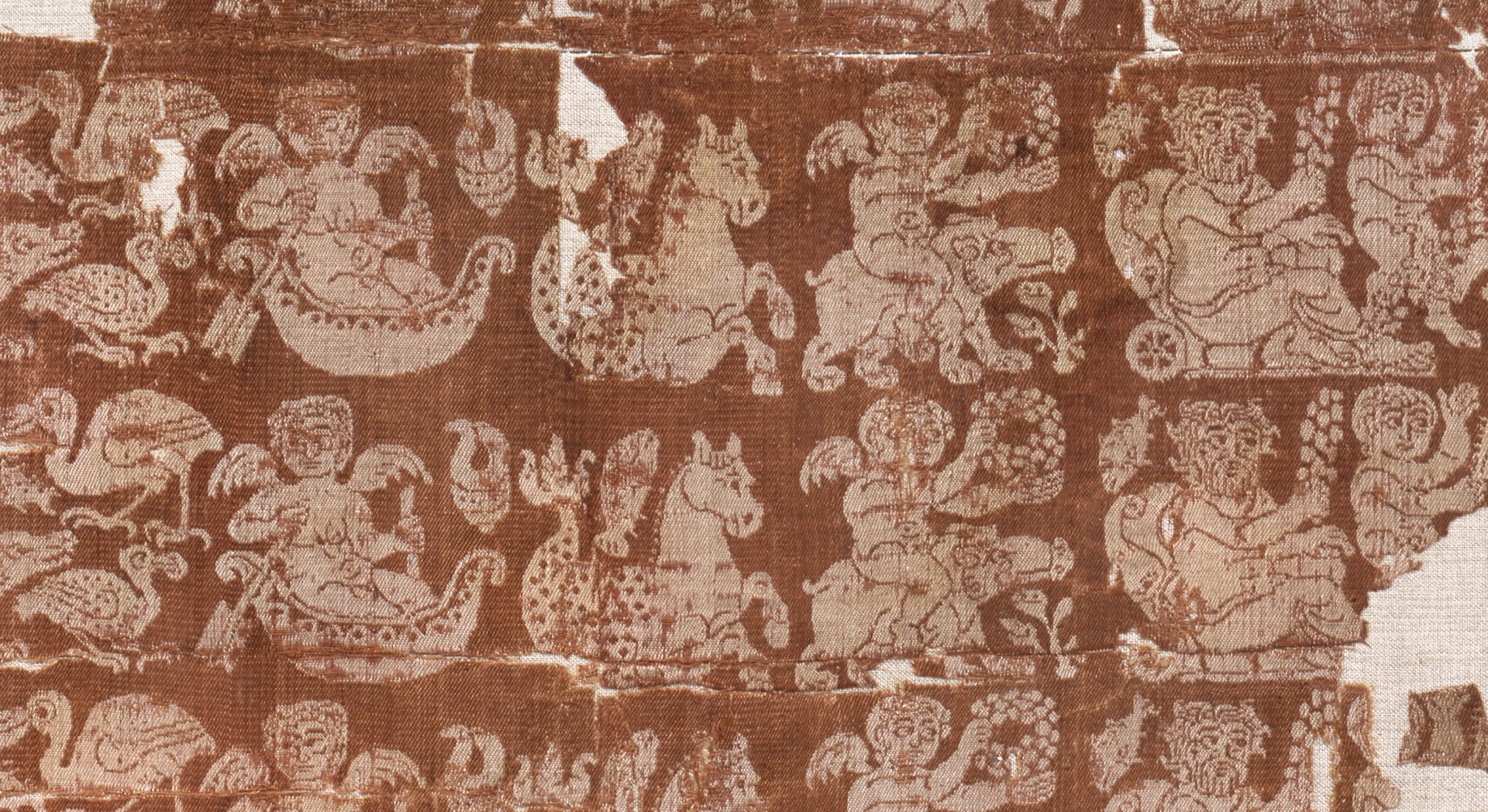
This silk shows the triumphal procession of the Nile, whose annual flooding was cause for great celebration in Egypt. The Nile is personified as a portly, bearded river god, seated in a chariot pulled by little boys. Heading the procession are dolphins, crocodiles and water fowl interspersed with Erotes busy fishing, rowing and riding on hippopotamuses. | Egypt or the eastern Mediterranean, early 4th century, silk (samite), h. 82 cm, w. 111 cm, inv. no. 2187
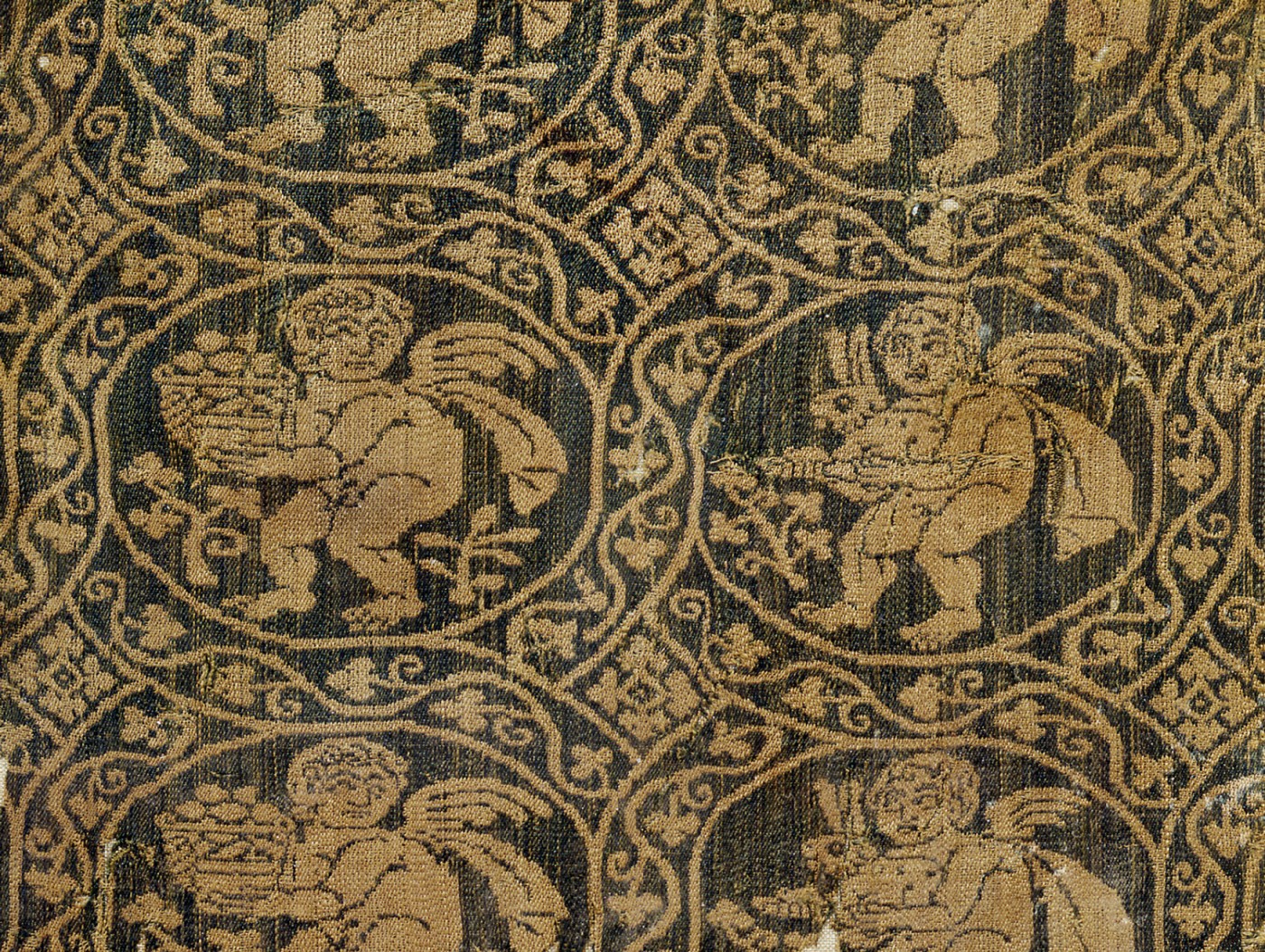
Linen and wool were the two most important fibres for making textiles in Late Antiquity. Silk was a luxury that had to be imported from China right up to the 6th century. These tunic fragments are among the few silk robes from Late Antiquity to have survived. The silk is patterned with medallions containing little Erotes holding baskets of fruit, animals or musical instruments. | Egypt or the eastern Mediterranean, 1st half of the 4th century, silk (samite), h. 154.5 cm, w. 100.5 cm, inv. no. 3945
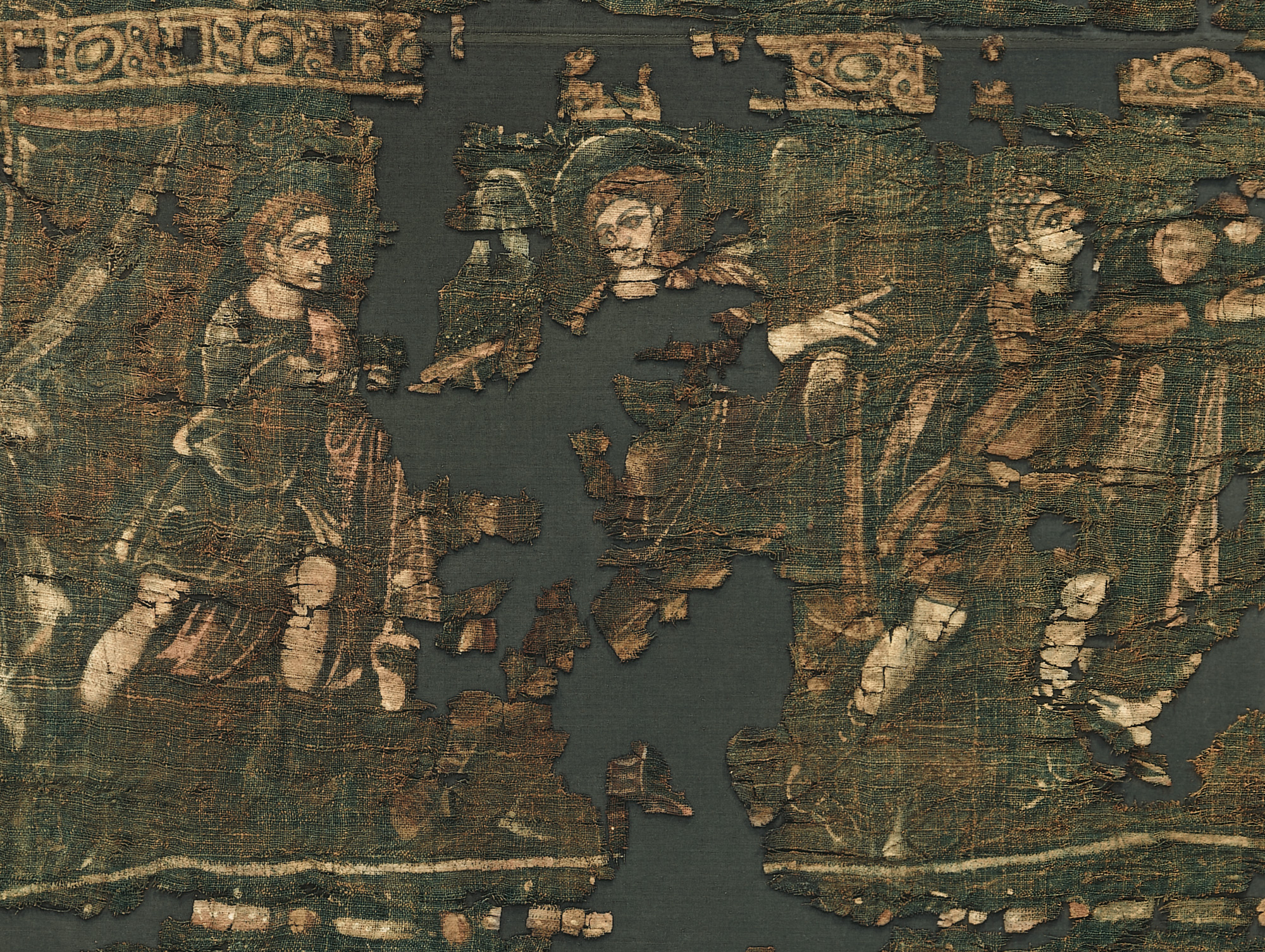
This wall hanging is one of only a few surviving examples of painting on textiles in Late Antiquity. The linen cloth was first dyed dark blue and then painted in white, yellow, red and brown. The dark blue ground was used to mix new colours and for the shading effects needed to model the figures’ bodies and lend them plasticity. The paintings in three registers show scenes from the Old Testament. The sequence begins with the ensoulment of Adam and Eve in Paradise and ends with the Israelites crossing the Red Sea to safety. It is one of the earliest Old Testament picture cycles to have survived. | Egypt, 2nd half of the 4th century, linen fabric, tempera painting, h. 146 cm, w. 436 cm, inv. no. 4185

Der Behang gehört zu den bedeutendsten Zeugnissen früher Bibelillustration. In der Publikation wird er mit einer kunsthistorischen Erörterung sowie mit Beiträgen über die mal- und kunsttechnologische Untersuchung und die Restaurierung vorgestellt.
Riggisberger Berichte 11 | Mit Beiträgen von M. Flury-Lemberg und U. Schießl | 240 S., 180 Abb., brosch., 23 x 31 cm, 2004, ISBN 3-905014-27-0
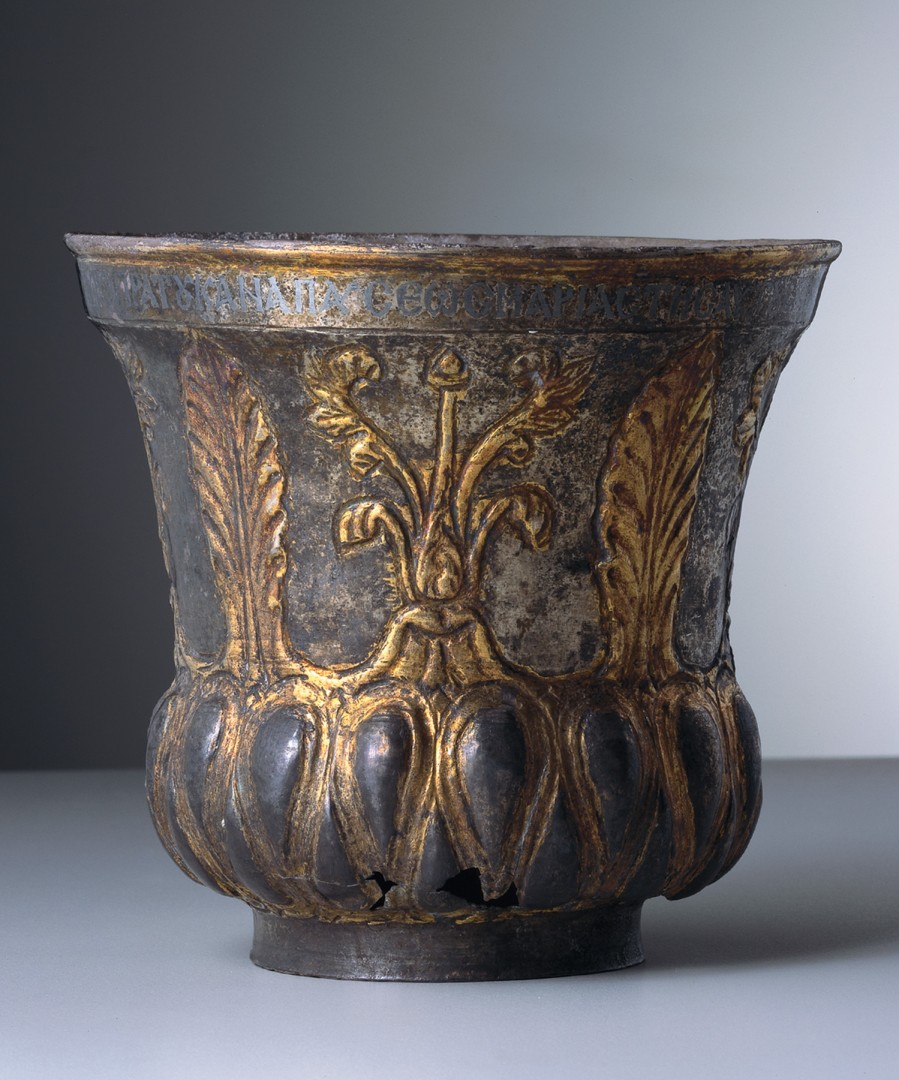
This beaker-like vessel probably served as an altar lamp. It was filled first with water and then with oil and then fitted with a dock attached to a float. The inscription round the circumference names a Roman official by the name of Sergius as the donor. He had the lamp made in honour of a vow for himself and his family. Offerings of this kind were given to the church as a token of thanks for having been saved from adversity. | Syria (Antioch), 574–578, silver gilt, embossed, niello, h. 14.5 cm, inv. no. 8.114.64
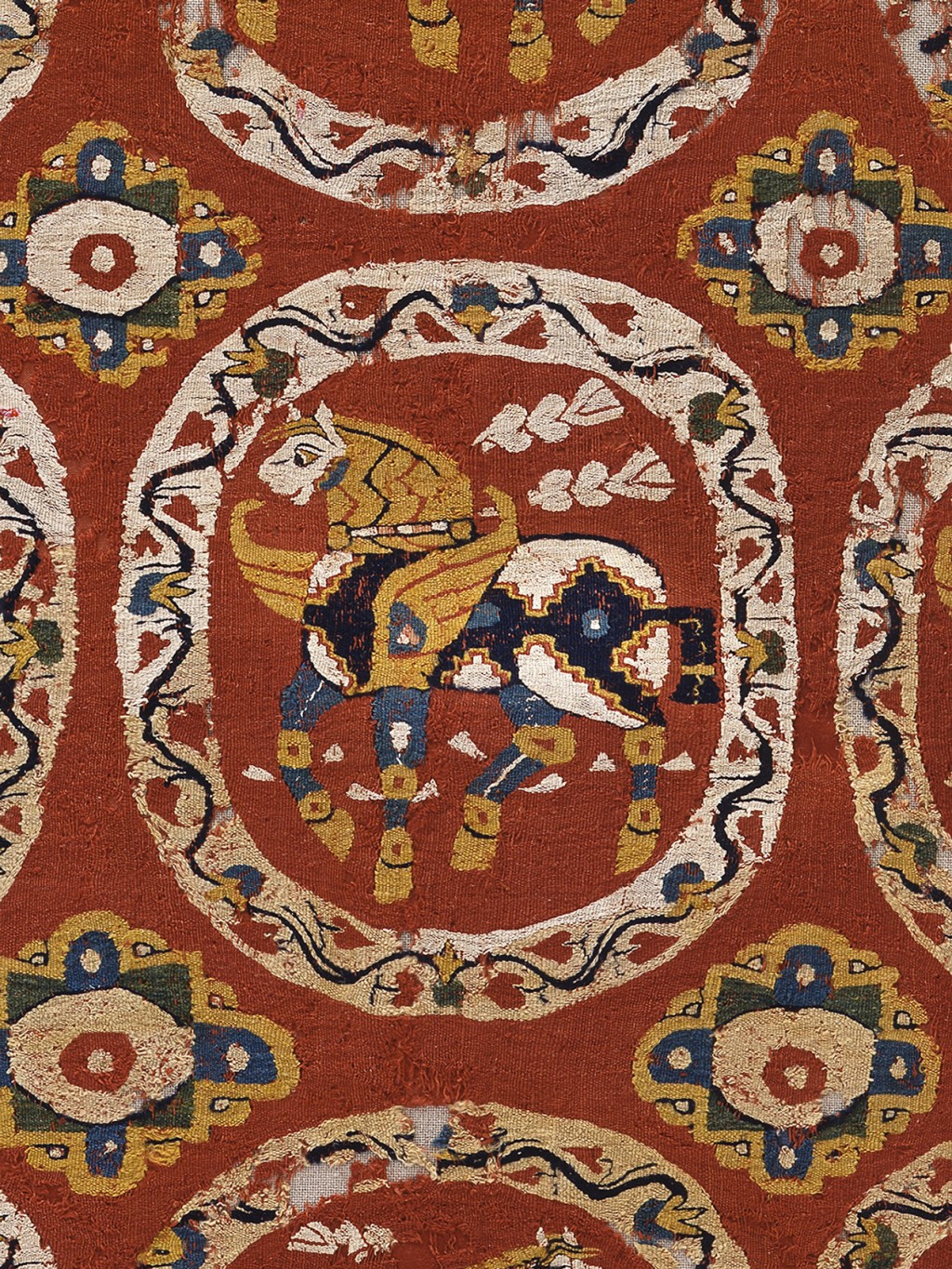
This wall hanging is patterned with circular medallions containing winged horses, each with rigorously geometrical coat markings and fluttering white ribbons attached to the neck and fetlocks. Both the pattern itself and the individual motifs were derived from existing silks, especially those made in Persia in Late Antiquity. The Sasanid Dynasty that came to power in the 3rd century presided over the ascendancy of a great empire, whose arts and culture made waves throughout the Orient. |
Egypt or the eastern Mediterranean, 4th–6th century, wool tapestry, h. 250 cm, w. 158 cm, inv. no. 2191
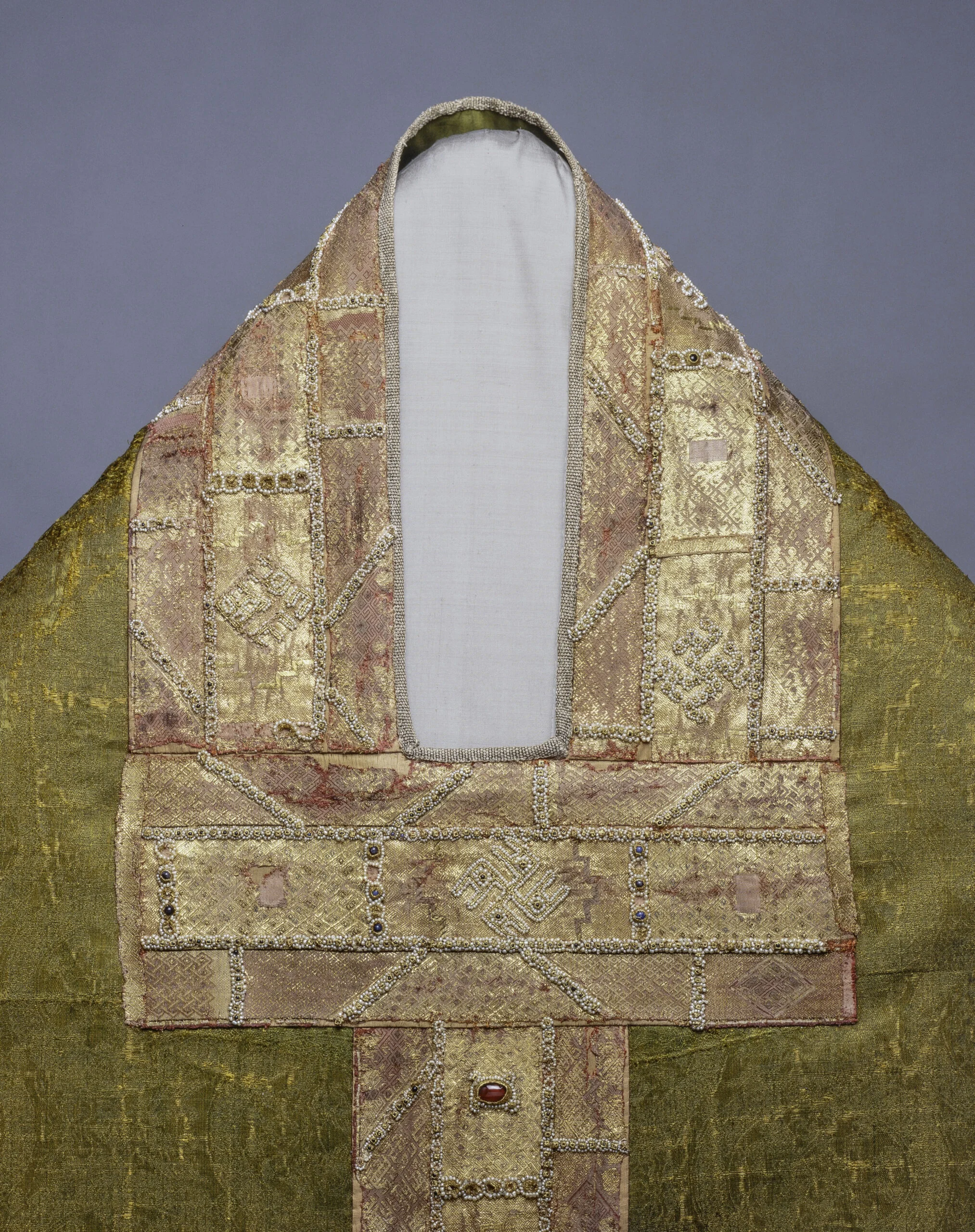
The chasuble comes from St Peter’s Abbey in Salzburg, where it was venerated as a vestment of the canonised Bishop Vitalis. The green silk is finely patterned with circular medallions, each containing either a pair of griffins or a pair of panthers. The gold orphreys on the neck and central seam are embellished with semi-precious stones and pearls. The artistry and faraway origins of oriental silks such as these made them treasured items in the West. Made up into vestments, they endowed their wearers with dignity, rank and prestige. | Byzantium or the Orient, 1st half of the 11th century, silk (samite), tablet weaving, pearls, semiprecious stones, h. 152.5 cm, inv. no. 232
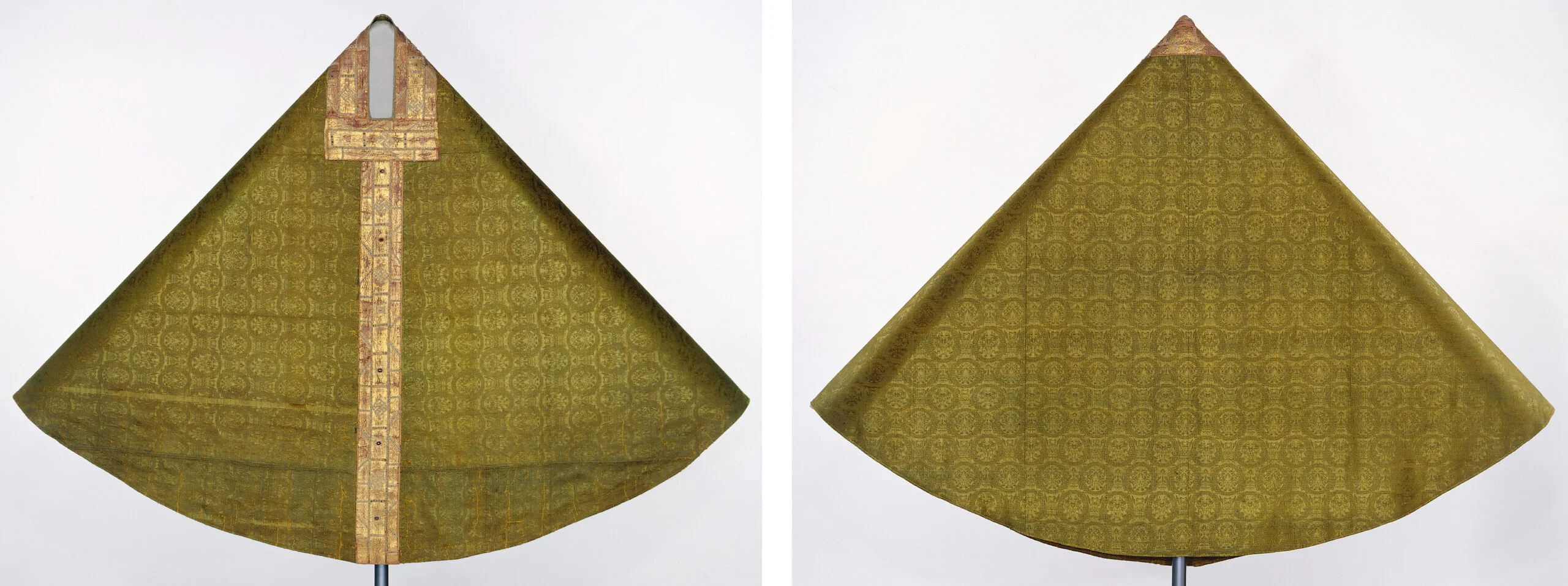
Abegg-Stiftung, The Chasuble of St Vitalis, Byzantium or the Orient, 1st half of the 11th century, inv. no. 232
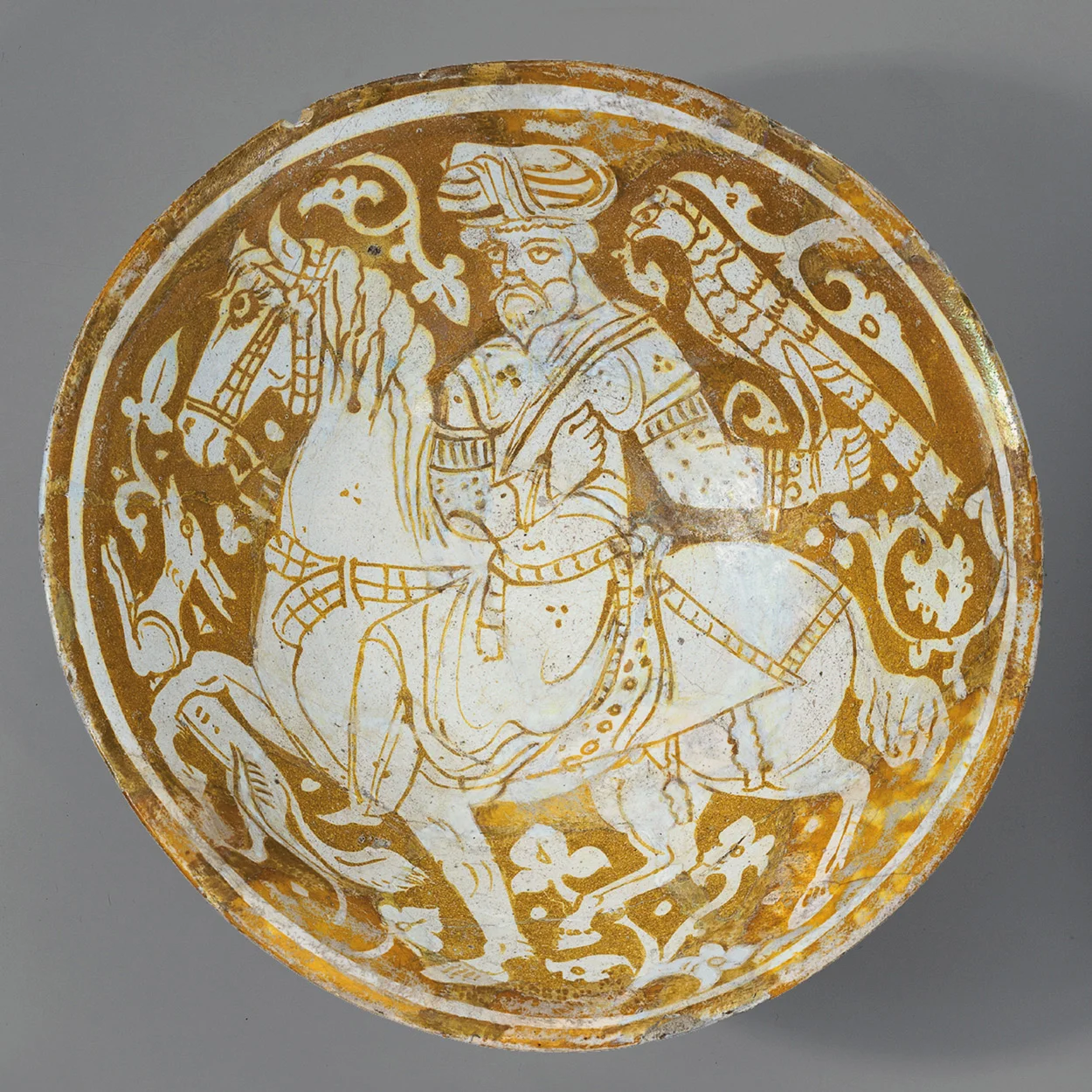
Among the most exceptional artefacts produced under the new Fatimid Dynasty in Egypt (969–1171) was lustreware decorated with figural scenes, of which this bowl is an excellent example. Remarkable for its vitality and expressiveness, the motif done by reserve technique was drawn with free-flowing brushstrokes against a lustre-coloured ground. Its theme – falconry – reflects life at the Fatimid court. | Egypt, 10th–11th century, earthenware, lustred decoration, diam. 24 cm, inv. no. 3.101.68
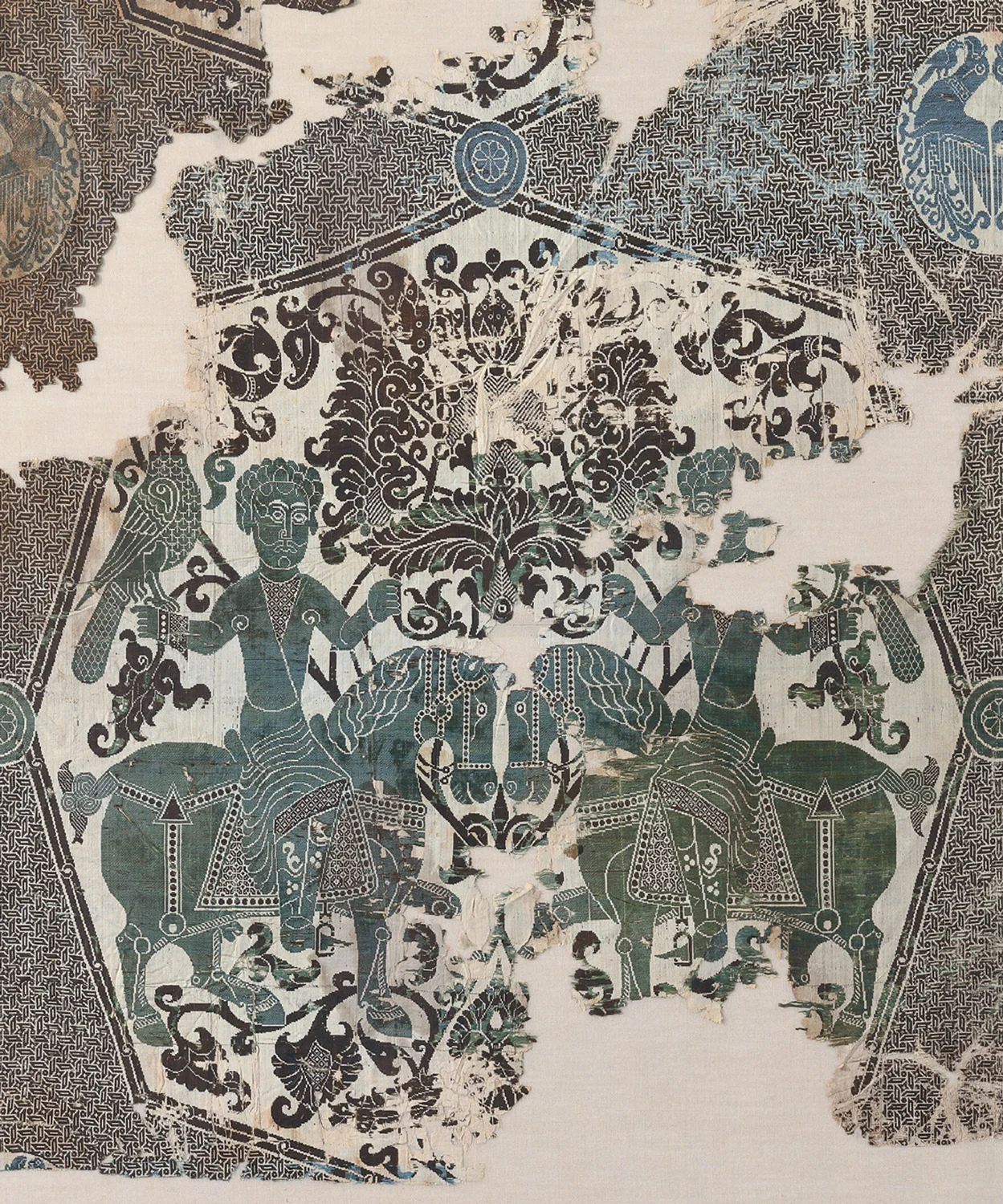
This beautiful silk is patterned with large octagonal medallions, each of which contains two falconers on horseback, their falcons perched on their arms, flanking an extravagant tree. The motif is remarkable for its intricacy and finely drawn lines. The falconers’ robes, highly ornate boots and saddlecloths and the superbly decked out horses are all reproduced in lavish detail. | Iran, 11th century, silk (double-weave lancé silk), h. 152 cm, w. 117 cm, inv. no. 1143
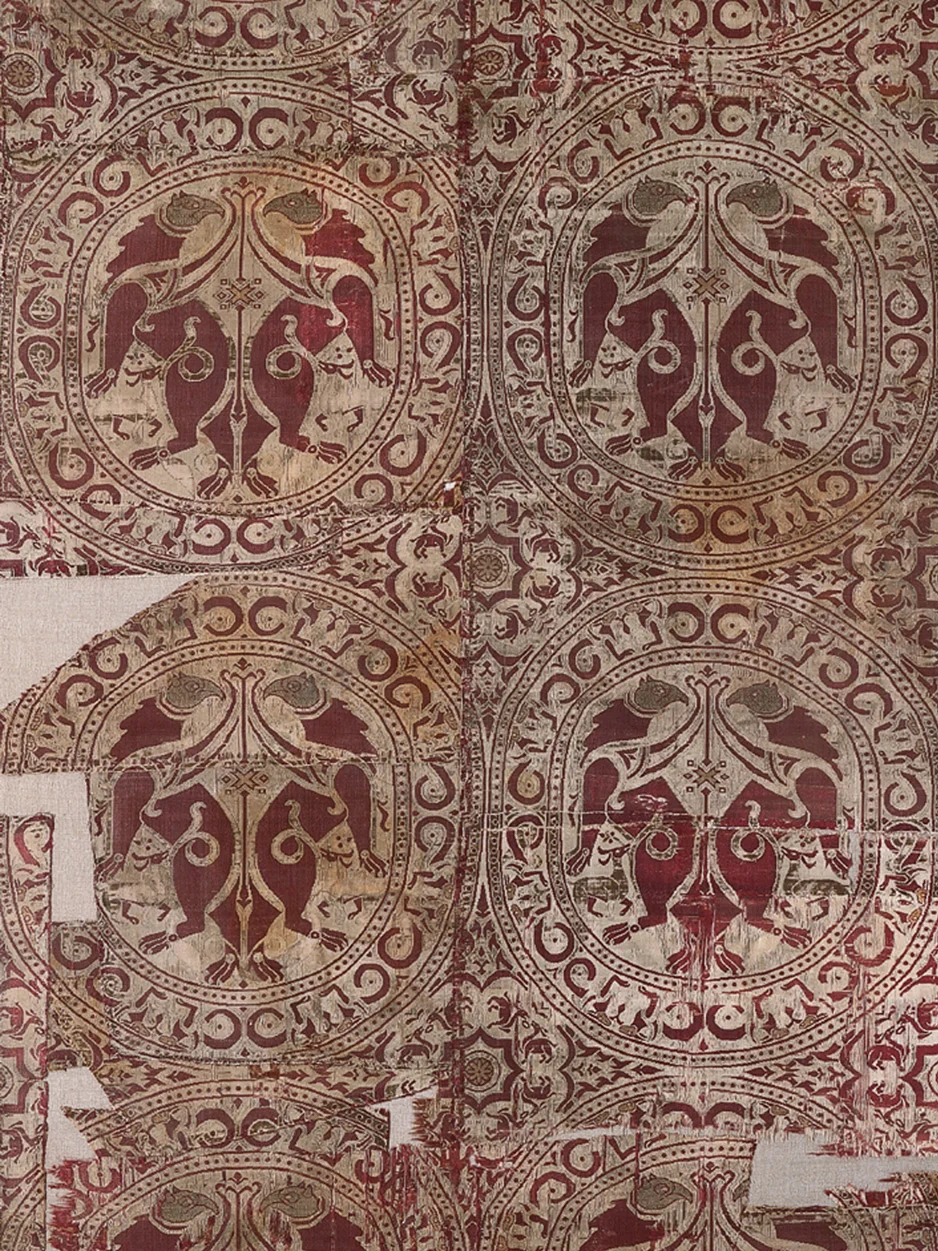
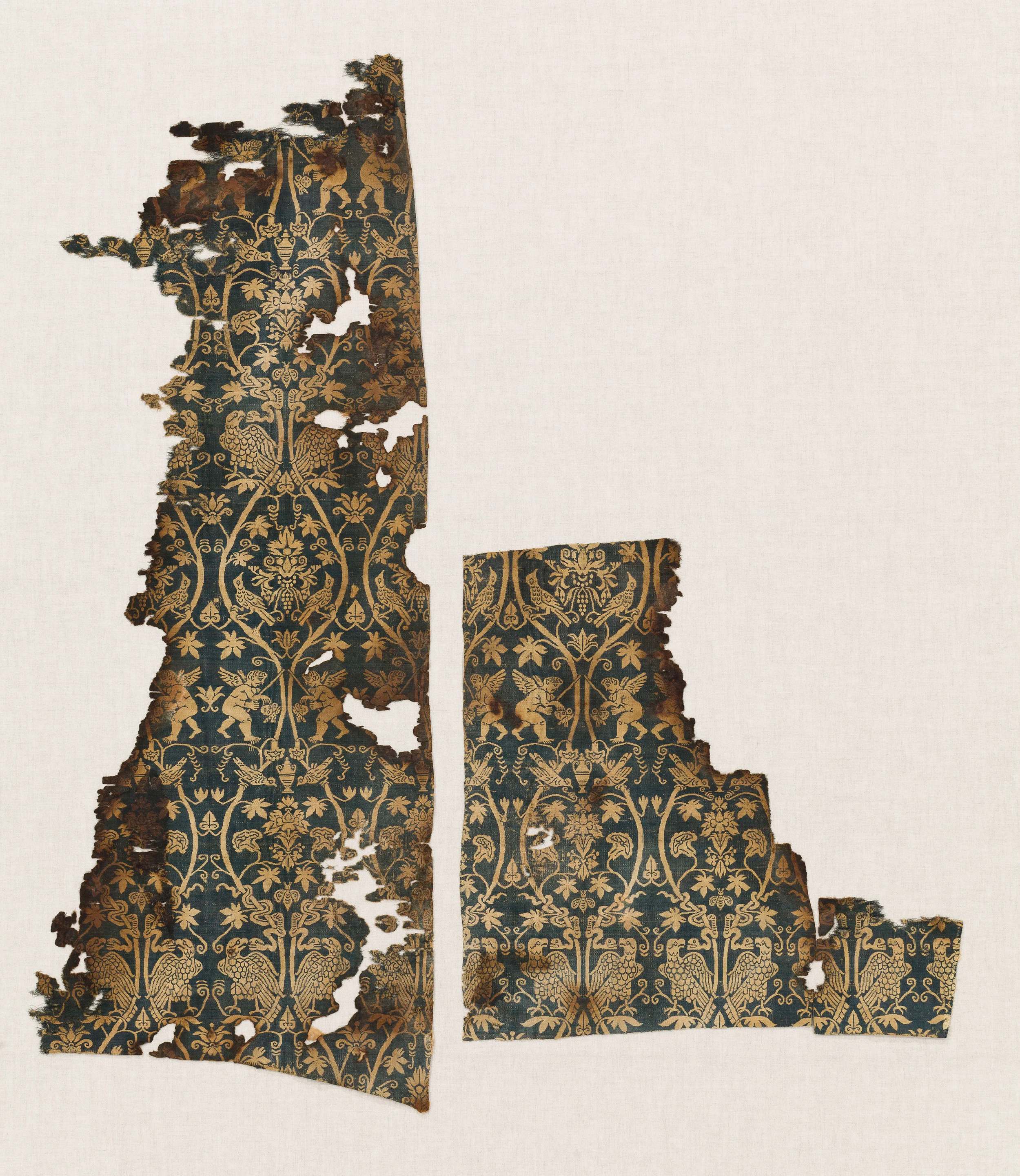
Islamic Spain was another important centre of medieval silk weaving after Byzantium and the Orient. Workshops in Almería, Granada, Córdoba and other such cities produced sumptuous fabrics of the very highest quality that were highly prized even in the Christian parts of Spain. This griffin silk comes from the shrine of Saint Liberata in Siguenza (Central Spain). The saint’s relics were transferred from the Islamic to the Christian part of Spain between 1147 and 1157. Among the costly fabrics used to wrap them was this magnificent silk. | Spain, 1st half of the 12th century, silk (lampas), h. 137 cm, w. 59 cm, inv. no. 2656/2660
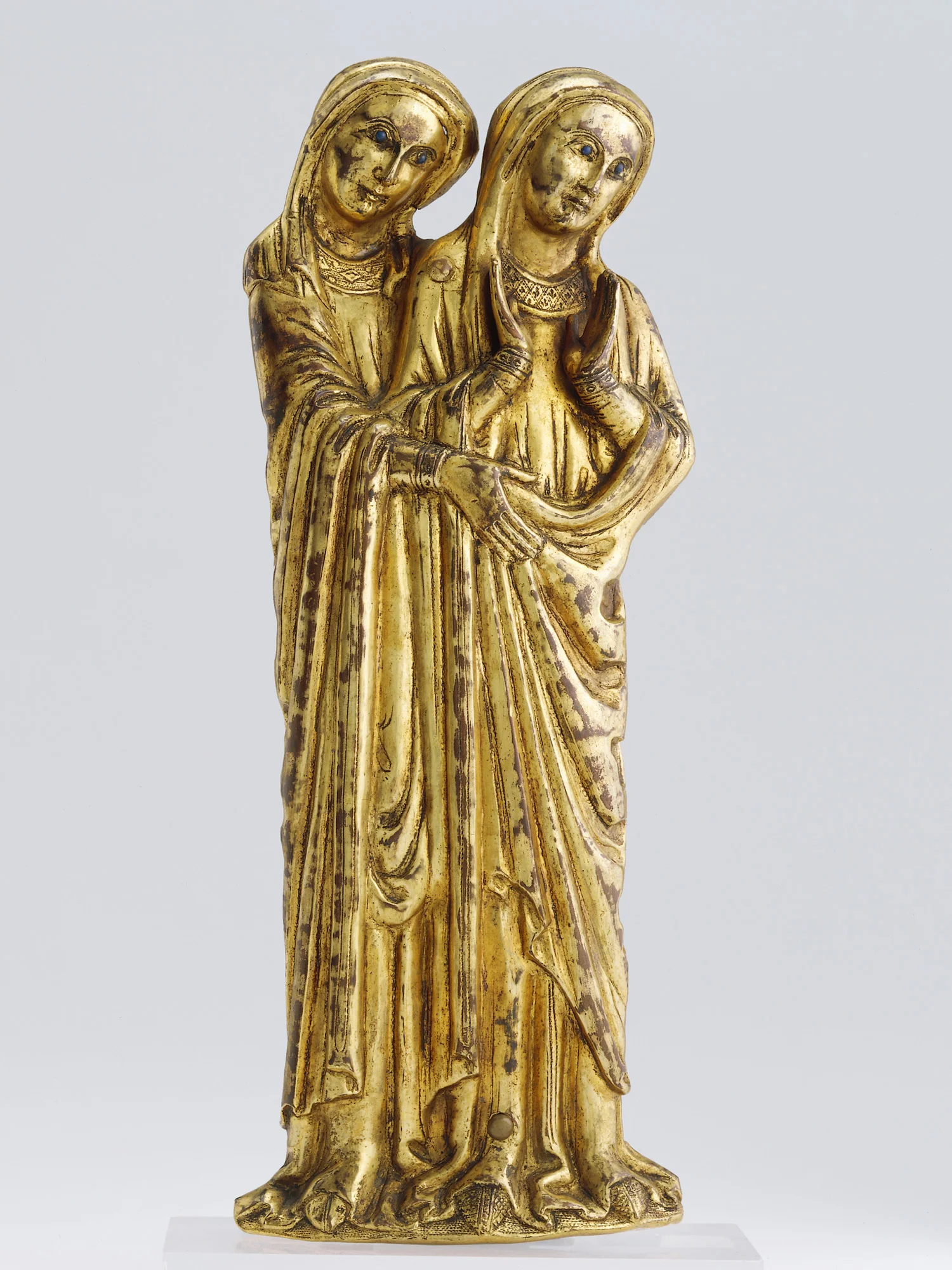
Limoges was a thriving centre for the manufacture of enameled liturgical plate in the High Middle Ages. Its workshops produced not just small items but also monumental reliquary shrines and altar frontals. This relief of the two grief-stricken Marys originally belonged to a larger crucifixion scene which also showed the Apostle John at the foot of the cross. Probably, it was part of a Passion cycle mounted on a shrine or altar frontal with enamelled ground plates. | Limoges, 1240–1250, copper gilt, embossed, h. 24.1 cm, inv. no. 8.59.63

Der reich bebilderte Band behandelt die kleine, aber künstlerisch hochrangige Sammlung Limousiner Emailarbeiten in der Abegg-Stiftung. Die Gruppe vereint nahezu alle Techniken, die der Limousiner Goldschmiedekunst des 12. und 13. Jahrhunderts vertraut waren. Vorgestellt werden unter anderem drei Kästchen, zwei Krummstabspitzen, eine Pyxis sowie figürliche Reliefs und zwei Beschlagplattten eines Kreuzes.
Monographien der Abegg-Stiftung 16 | 126 S., 37 Abb., brosch., 18 x 22,5 cm, 2011, ISBN 978-3-905014-47-1
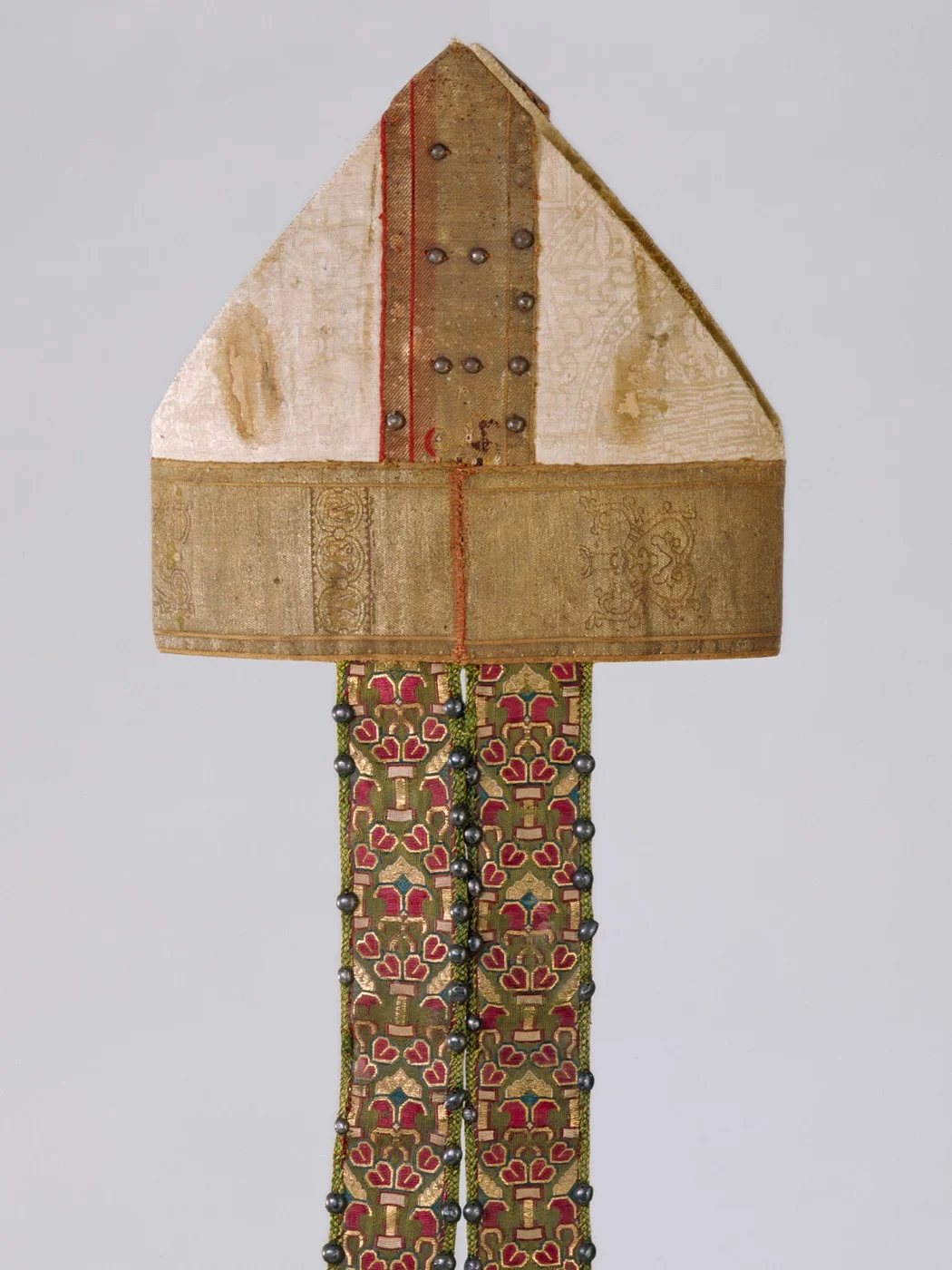
The Abbot of the Benedictine Abbey of St Peter’s in Salzburg was granted the right to wear a mitre as a sign of his high office in 1231. The choice of textiles that already counted as old and venerable for the manufacture of this mitre seems to have been deliberate. This is true not only of the white cloth used for the ground, but also of the two sorts of very fine gold orphreys and above all the hangings made of a brightly coloured tablet-woven silk of Central Asian origin. | Salzburg, c. 1231, silk, tablet weaving, silver pearls, h. 77 cm, inv. no. 233

Rund einhundert Mitren des 12. bis 14. Jahrhunderts haben sich in den kirchlichen Schatzkammern Europas sowie in öffentlichen Sammlungen und Museen weltweit erhalten. Die Studie stellt die historische Entwicklung der Mitra und ihre charakteristischen Schmuckelemente vor. Ihre künstlerische Ausstattung erlaubt es in vielen Fällen, sie aufgrund technologischer Übereinstimmungen einem bestimmten Produktionszentrum zuzuweisen. Der reich bebilderte Katalogteil stellt die einzelnen Werke ausführlich vor, ordnet sie kunsthistorisch ein und verzeichnet die nach textiltechnologischen Kriterien aufgenommenen verwendeten Gewebe, Borten und Stickereien.
396 S., 273 Abb., leinengeb., 23 x 31 cm, 2012, ISBN 978-3-905014-51-8
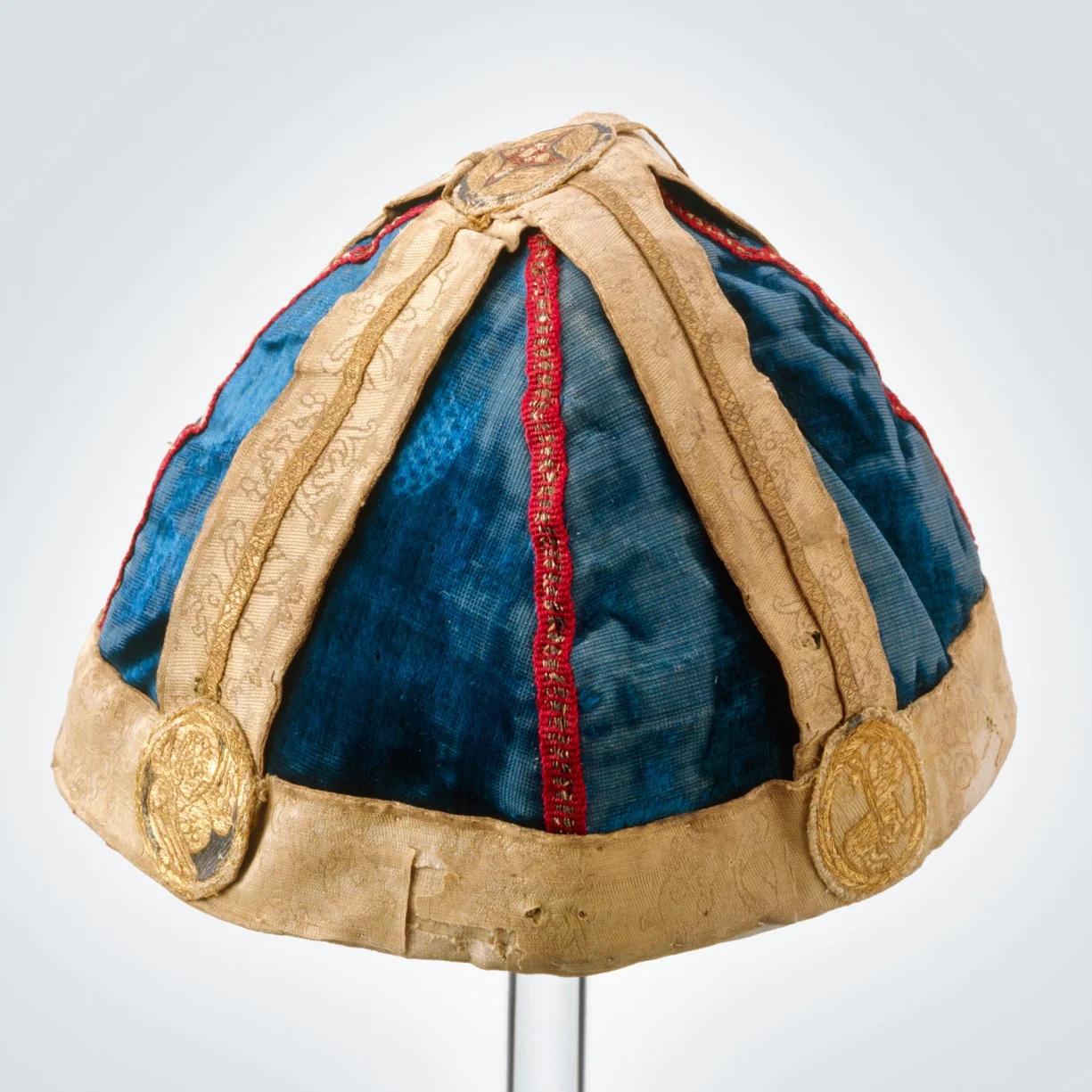
The crown is made up of bands of white silk with embroidered medallions. These show a Lamb of God, two angels, a king and, on the top of the crown, an allegory of the Trinity. In her writings Hildegard von Bingen describes the headdresses with which the nuns adorned themselves as having just such images. They were worn over the veil. The nun’s crown shown here is the only one from the Middle Ages to have survived. It is mounted on a more recent blue velvet cap so that the textile coronet, regarded as a relic of Saint Hildegard von Bingen, could be displayed and worshipped by the devout. | Silk band crown: Kloster Rupertsberg, 1170s; blue velvet cap: Trier, early 17th century, silk bands, gold trim, gold, silver and silk embroidery, h. 17 cm, inv. no. 5257

Schon seit dem Frühmittelalter wurde Nonnen bei der Jungfrauenweihe nicht nur der Schleier, sondern auch ein Kranz oder eine Krone übergeben. In ihrem grossen Visionswerk Scivias beschreibt Hildegard von Bingen Mitte des 12. Jahrhunderts einen Kopfschmuck der Jungfrauen. Sie entwirft ein umfassendes Bildprogramm, das sich in den kostbaren Stickereien einer Bortenkrone in der Abegg-Stiftung unmittelbar wiederfindet. Es handelt sich dabei um jene Reliquie, die in Trier als Krone der Visionärin verehrt wurde. Die Monographie zeichnet die Geschichte dieser einzigartigen textilen Krone nach. Zugleich bietet sie Einblick in die Vorstellungswelt einer der bedeutendsten Denkerinnen des Mittelalters.
Monographien der Abegg-Stiftung 21 | 135 S., 40 Abb., brosch., 18 x 22,5 cm, 2019, ISBN 978-3-905014-70-9
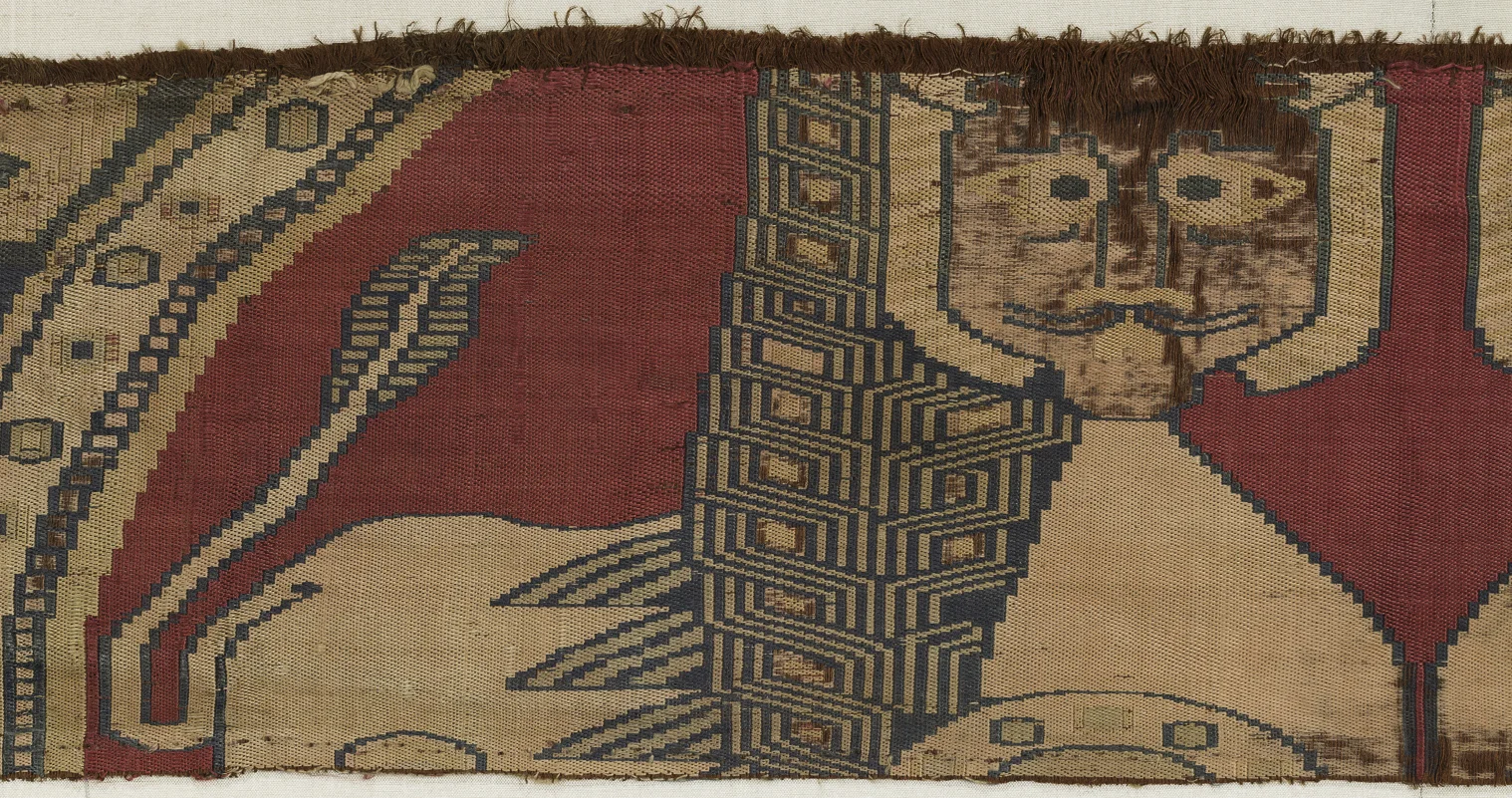
This silk is patterned with majestic lions standing inside large medallions, their heads turned to face the viewer. The semicircles framing each medallion were probably intended to show hunting scenes with beasts of prey and hoofed beasts alternately giving chase and fleeing. A cursory inscription in Old Tibetan written onto the silk in ink allows us to surmise that it was used in connection with a burial. | Central Asia, mid-8th–mid-9th century, silk (samite), diameter of the medallions c. 79 cm, inv. no. 4864
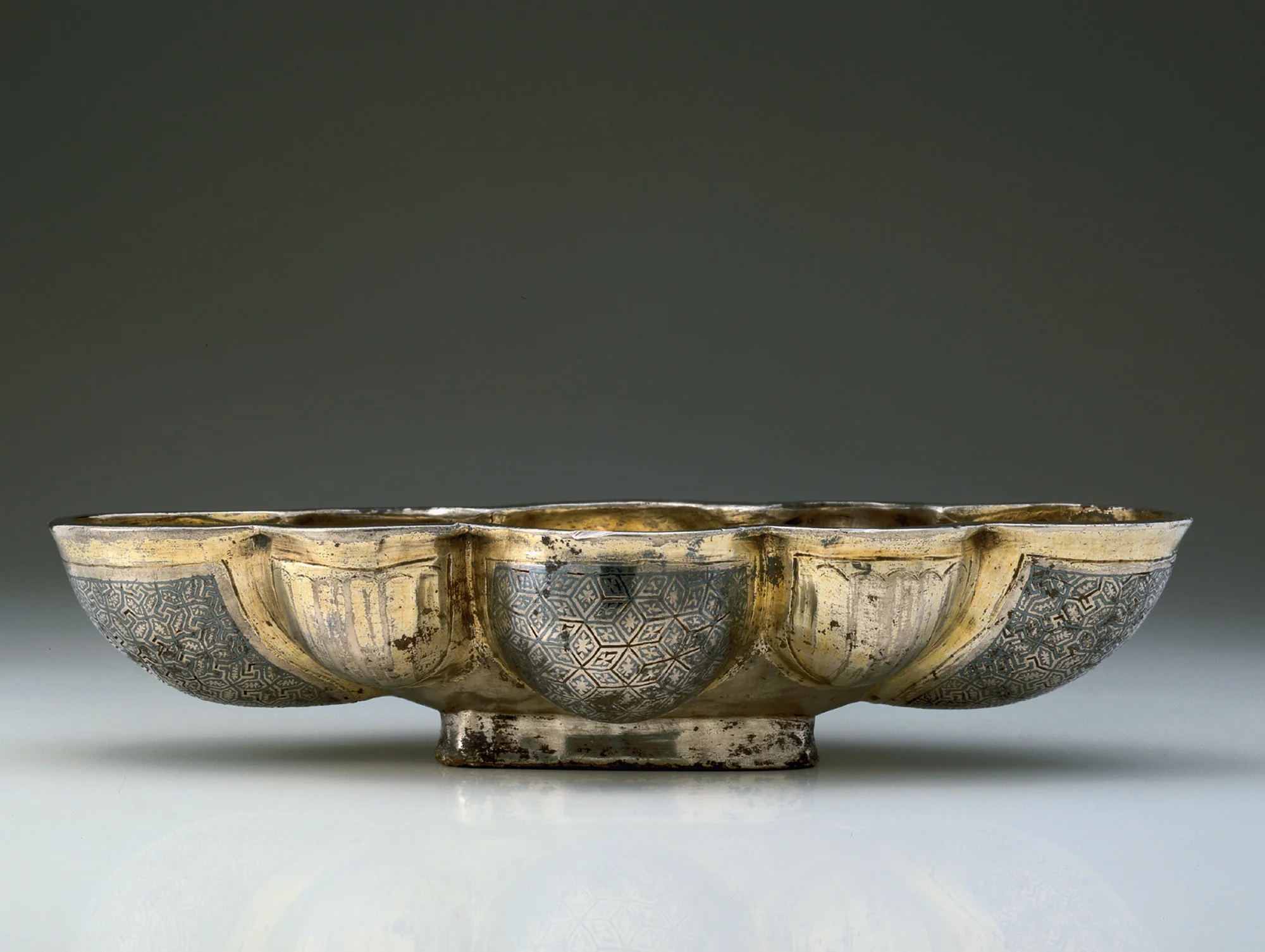
The courtly culture that developed under the Sasanids, the dynasty that ruled Persia in Late Antiquity (224–642), produced some outstanding silks, fine metalwork and glassware. This shallow, lobed bowl shows the Sasanid art of goldsmithing at its zenith. Adorned with fine ribbing and black niello ornaments on the outside, the well is decorated with a running boar. | Iran, 5th–6th century, silver gilt, embossed, niello, l. 24.6 cm, inv. no. 8.123.65
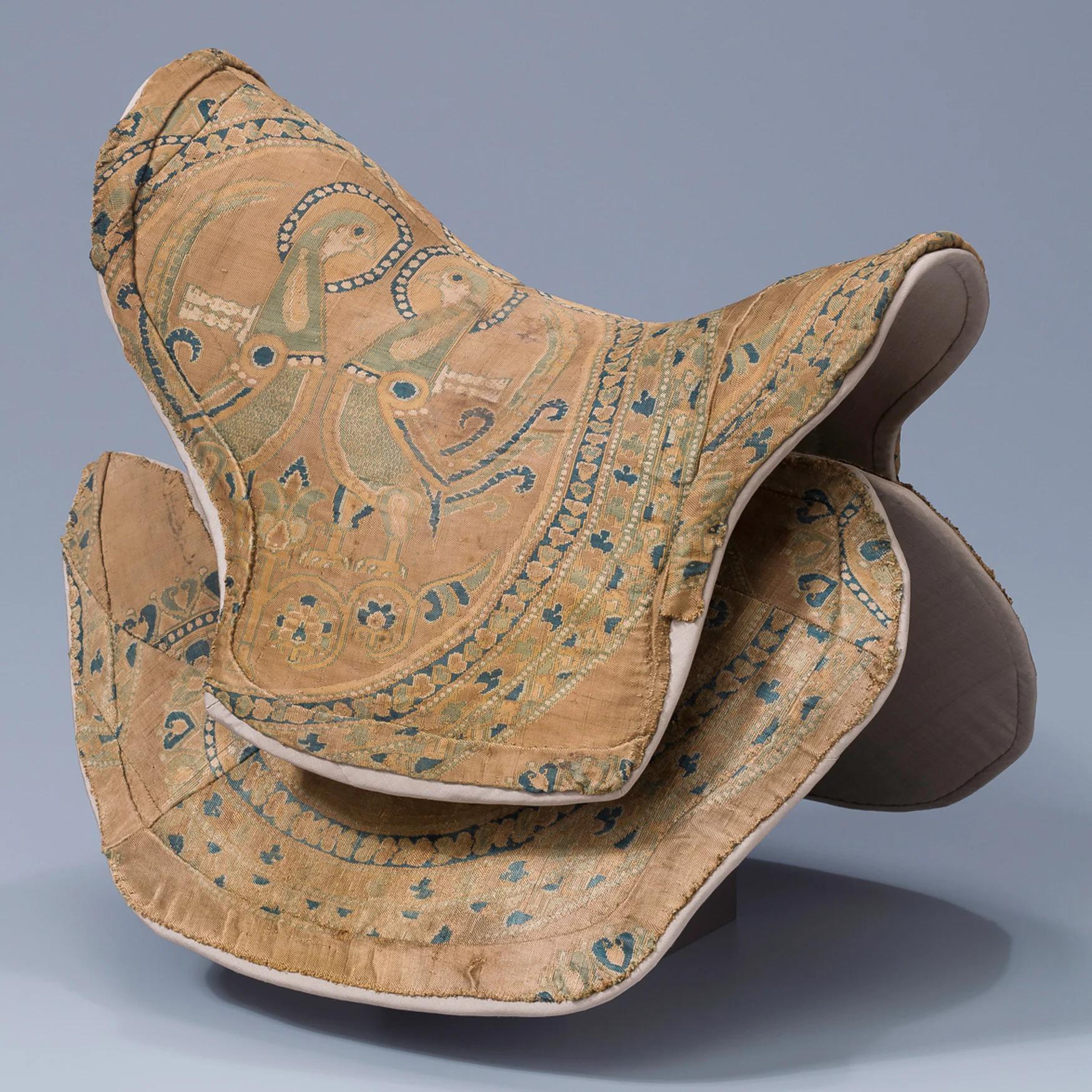
This heavy silk saddle cover was woven out of eight different colours of thread. Originally brightly coloured with a red ground, it has now paled to beige owing to the instability of the dyestuffs. The saddle itself was made of wood and the pommel and cantle would have had metal trimmings. | Central Asia, late 8th–mid-9th century, silk (samite), l. 64 cm, inv. no. 4866/4870/4906/4922
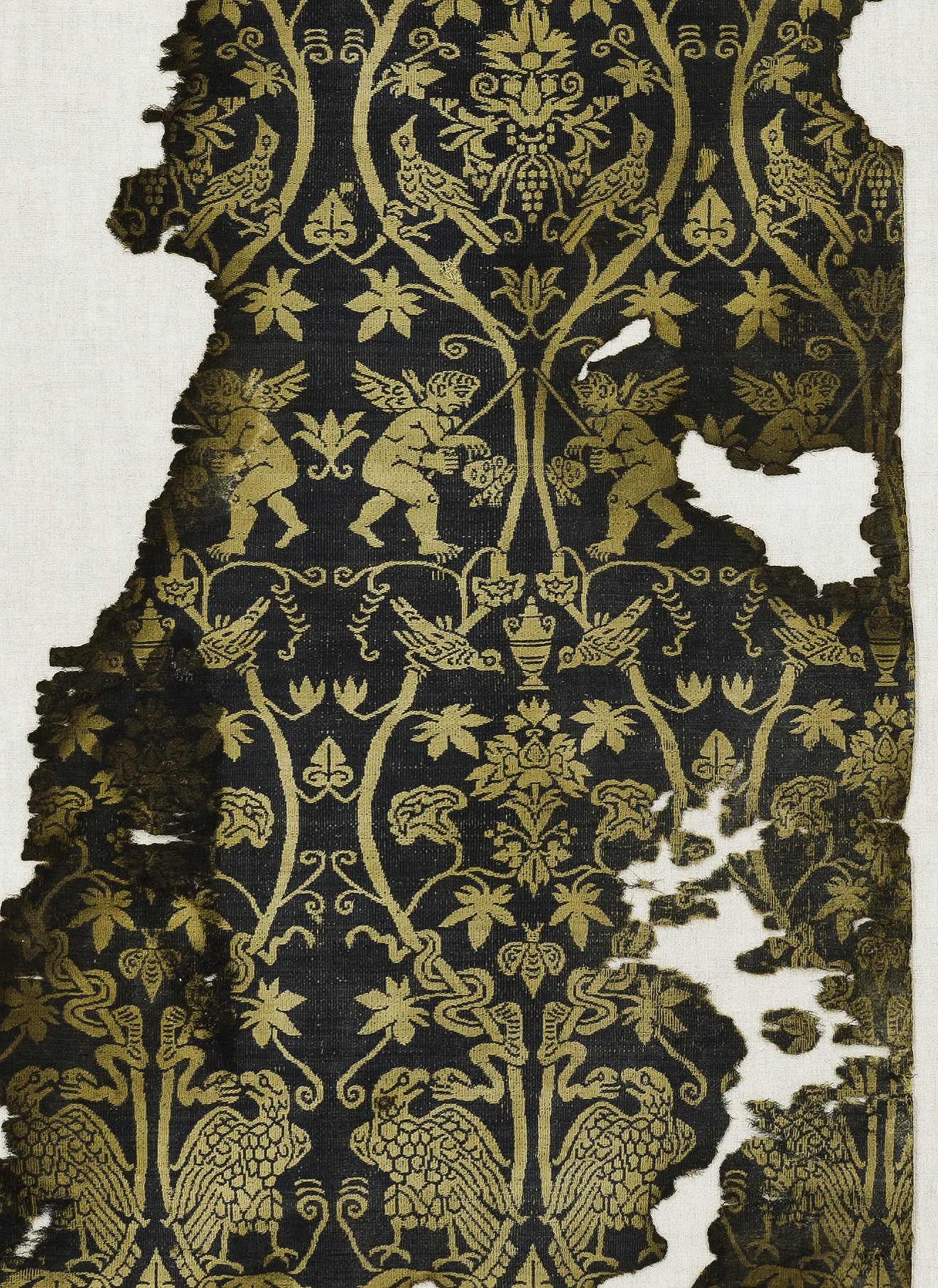
These two fragments of the front of a robe were found in the cemetery of Yingpan (Xinjiang, China). The Hellenistic influence of Late Antiquity is apparent in the style and choice of motif, although the pattern features a number of Central Asian elements as well. The symbolism of the Erotes chasing butterflies and the duel between the eagle and the serpent has to do with the afterlife and overcoming death. | Eastern Central Asia, 5th–6th century, wool (taqueté), h. 114.5 cm, w. 44 and 54 cm, inv. no. 5073/5175
Abegg-Stiftung, Woollen fabric with putti, eastern Central Asia, 5th–6th century, inv. no. 5073/5175
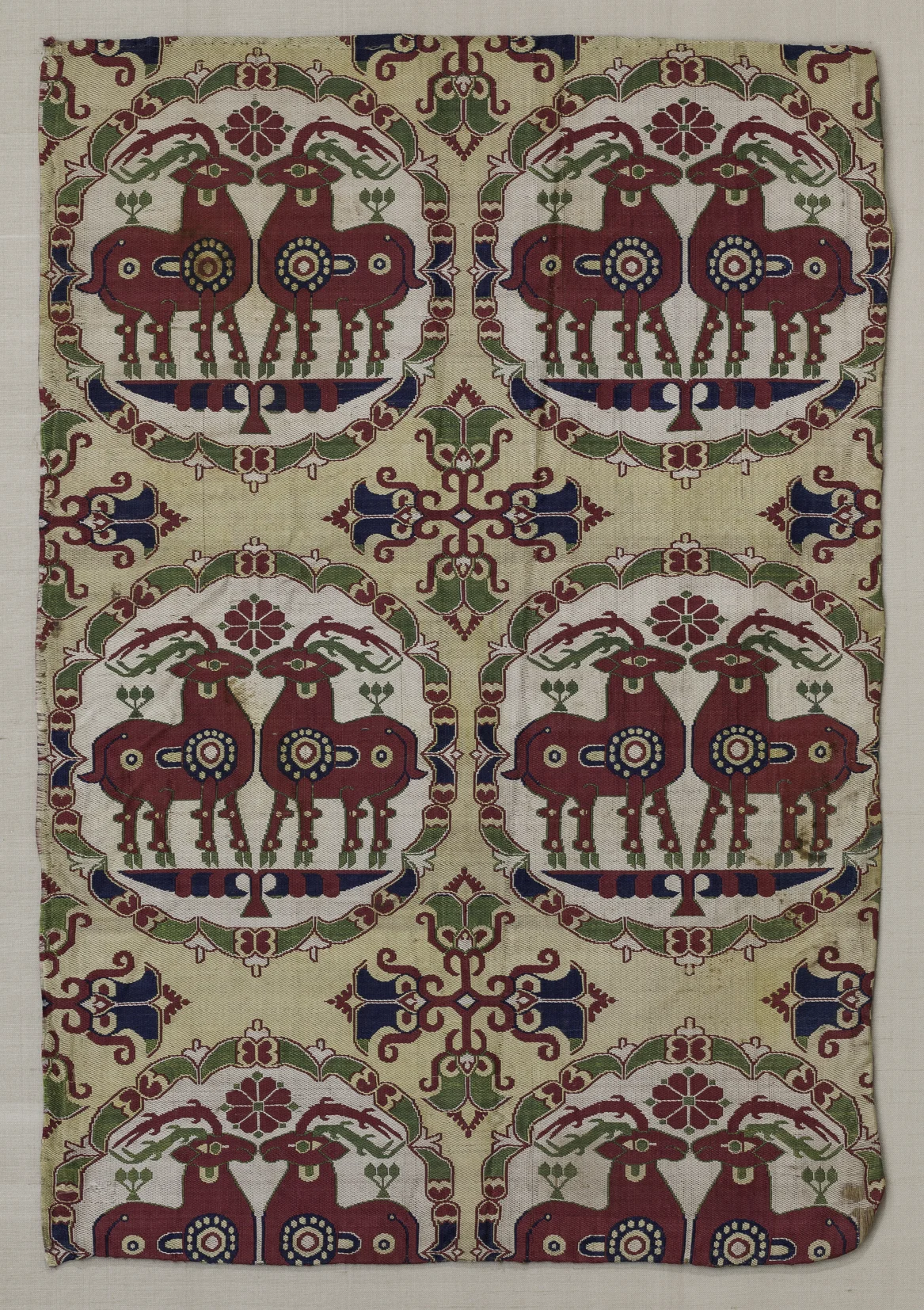
Circular medallions, classically framed by beads, count as the most important and most distinctive design element of Persian silks. Variations of such medallions influenced silk weaving from China to Byzantium for several centuries. This particular silk shows pairs of heavily stylised deer inside flower-bud medallions. The brightly coloured, almost naïve design is exceptionally well preserved. | Central Asia, 7th–8th century, silk (samite), h. 52 cm, w. 35.5 cm, inv. no. 4901
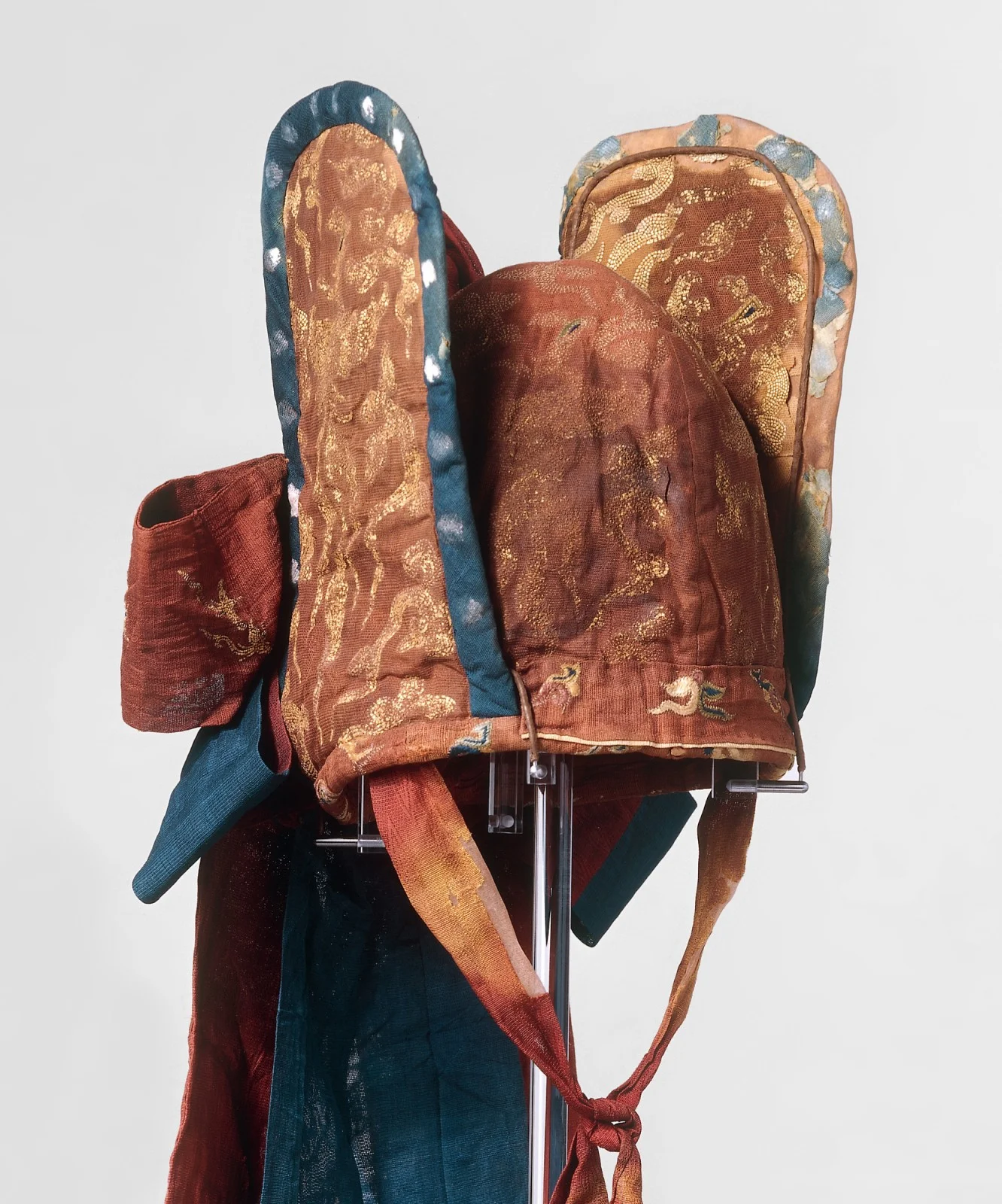
This headdress with side pieces like wings originally retained its shape with the aid of inner stiffening and ribbon ties only. It is embroidered with phoenixes chasing after a flaming pearl. The phoenix has been identified with the red bird, the Bird of the South which stood for the empress, although it was not reserved for her alone at the time of the Liao Dynasty. The crown was undoubtedly worn by a woman and was adorned with still more red and blue silk ribbons that have likewise been preserved. | Northern China, Liao Dynasty, 1st half of the 11th century, silk gauze, embroidered with strips of gilt paper and silk, h. 72 cm, inv. no. 5250

The richly illustrated exhibition catalogue presents unique silk garments and accessories of the Liao-dynasty (907–1125). Questions regarding the coherence of the group of garments, their manner of wear and the person for whom they were originally intended are addressed. A separate chapter is devoted to the extensive conservation work and the insights gained from it. The significance of textiles of Liao culture and the present state of research are discussed in individual essays.
With contributions by A. Bayer, L. S. Gremli, J. C. Y. Watt | 314 p., 270 illus, soft binding, 24,5 x 31 cm, 2007, ISBN 978-3-905014-31-0
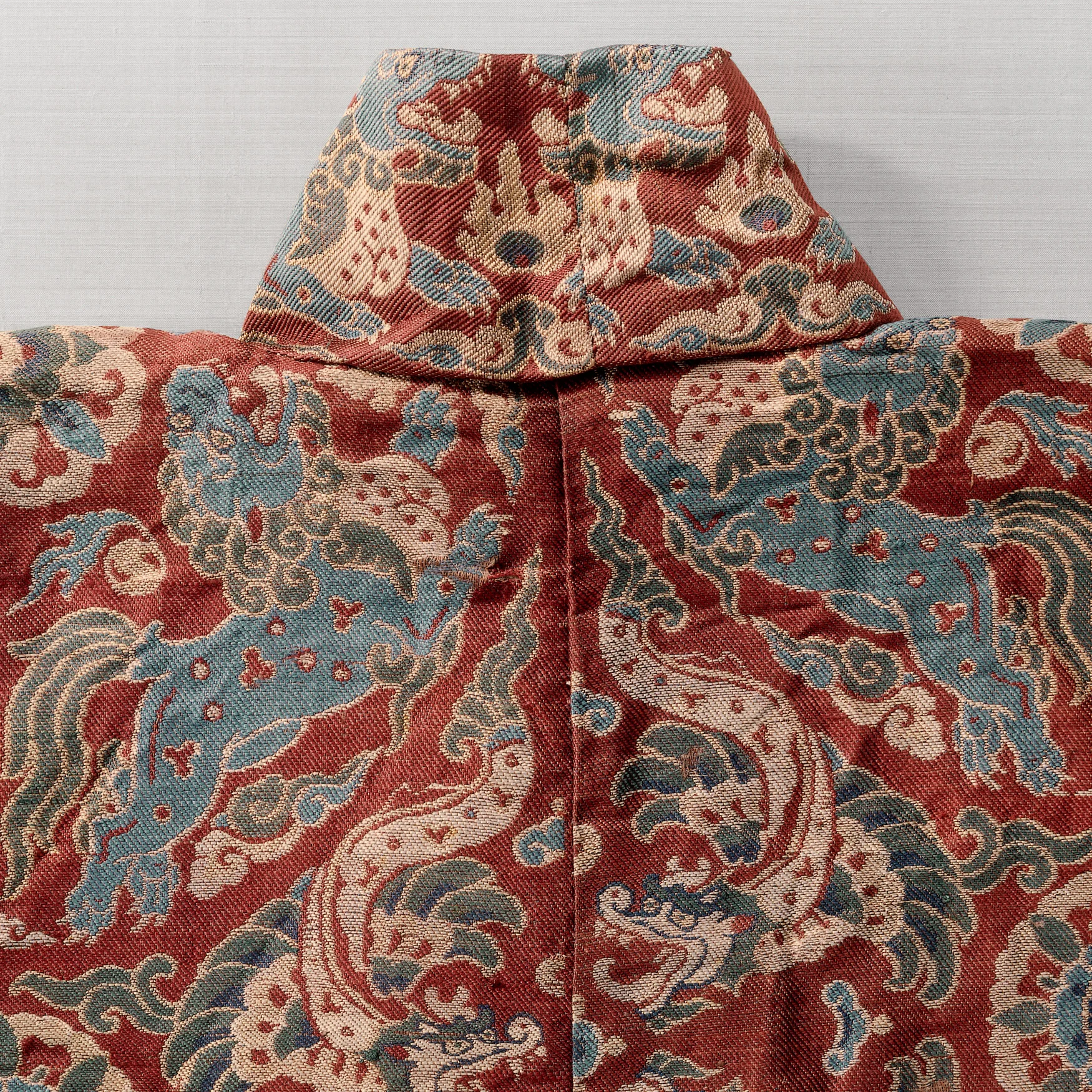
This robe is known to have been the outer garment worn on top of several other layers. Perhaps this helps explain its size, which seems far too wide for a woman. The robe was probably tied at the waist with a belt. Such belts were often made of precious metal and like jewellery counted as status symbols. The medallions are formed by four lions chasing a flaming pearl, while four dragonfish facing a diamond-shaped ornament occupy the spaces in between. | Northern China, Liao Dynasty, 1st half of the 11th century, silk (samite, weft-faced on both sides), padded and lined, h. 148 cm, inv. no. 5239
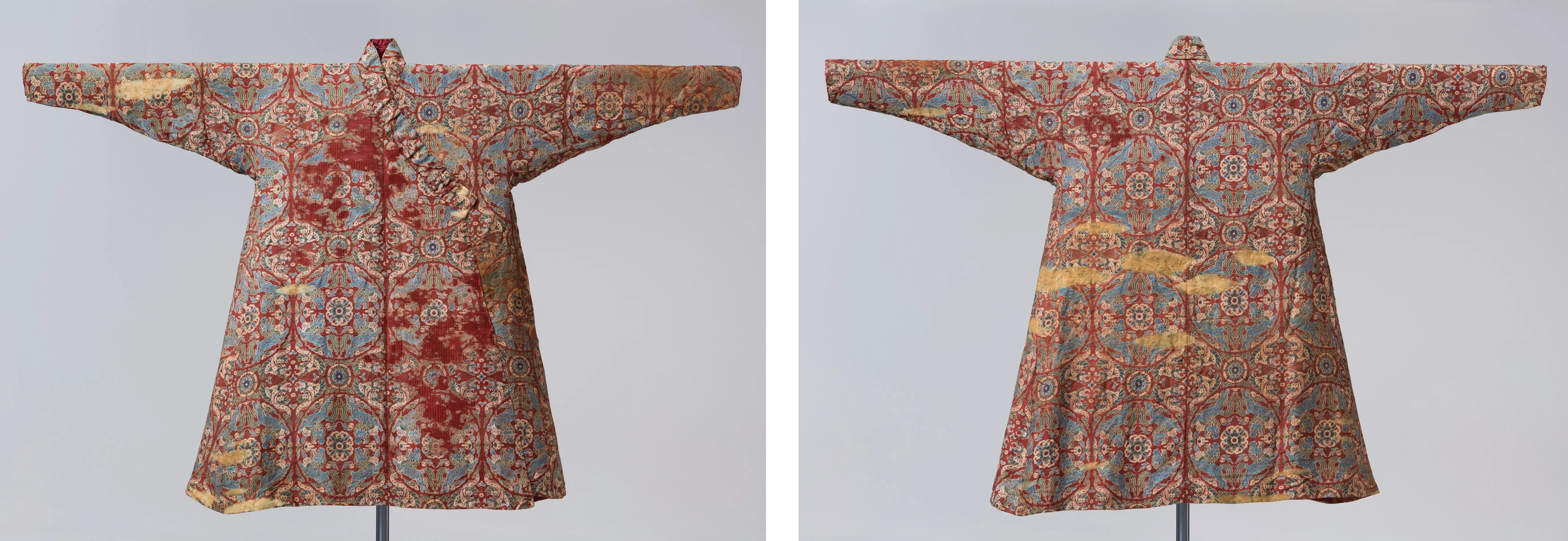
Abegg-Stiftung, Robe with lions and dragonfish, northern China, 1st half of the 11th century, inv. no. 5239
The richly illustrated exhibition catalogue presents unique silk garments and accessories of the Liao-dynasty (907–1125). Questions regarding the coherence of the group of garments, their manner of wear and the person for whom they were originally intended are addressed. A separate chapter is devoted to the extensive conservation work and the insights gained from it. The significance of textiles of Liao culture and the present state of research are discussed in individual essays.
With contributions by A. Bayer, L. S. Gremli, J. C. Y. Watt | 314 p., 270 illus, soft binding, 24,5 x 31 cm, 2007, ISBN 978-3-905014-31-0
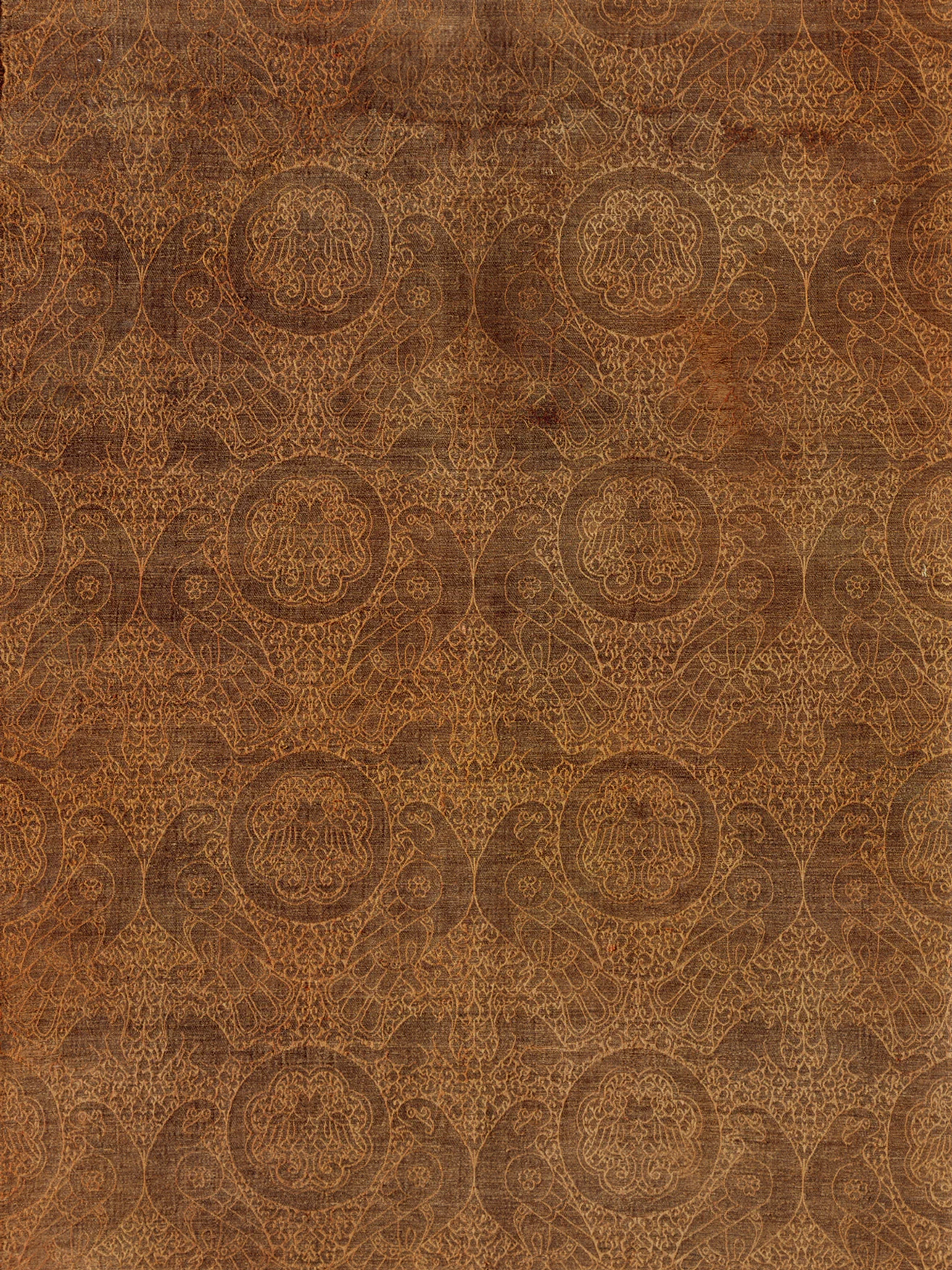
For the Mongols who starting in 1206 forced first China, then Central Asia and Persia under their yoke, gold was not just an extremely valuable material but also the colour of their ruler, which meant that it had deep cosmological significance. Intricate outlines of the pattern are all that remains of the red ground, indicating that the silk was almost entirely golden in appearance originally. | Eastern Iran or Central Asia, late 12th – 1st half of the 13th century, gold-patterned silk (lampas), h. 127 cm, w. 84 cm, inv. no. 4905
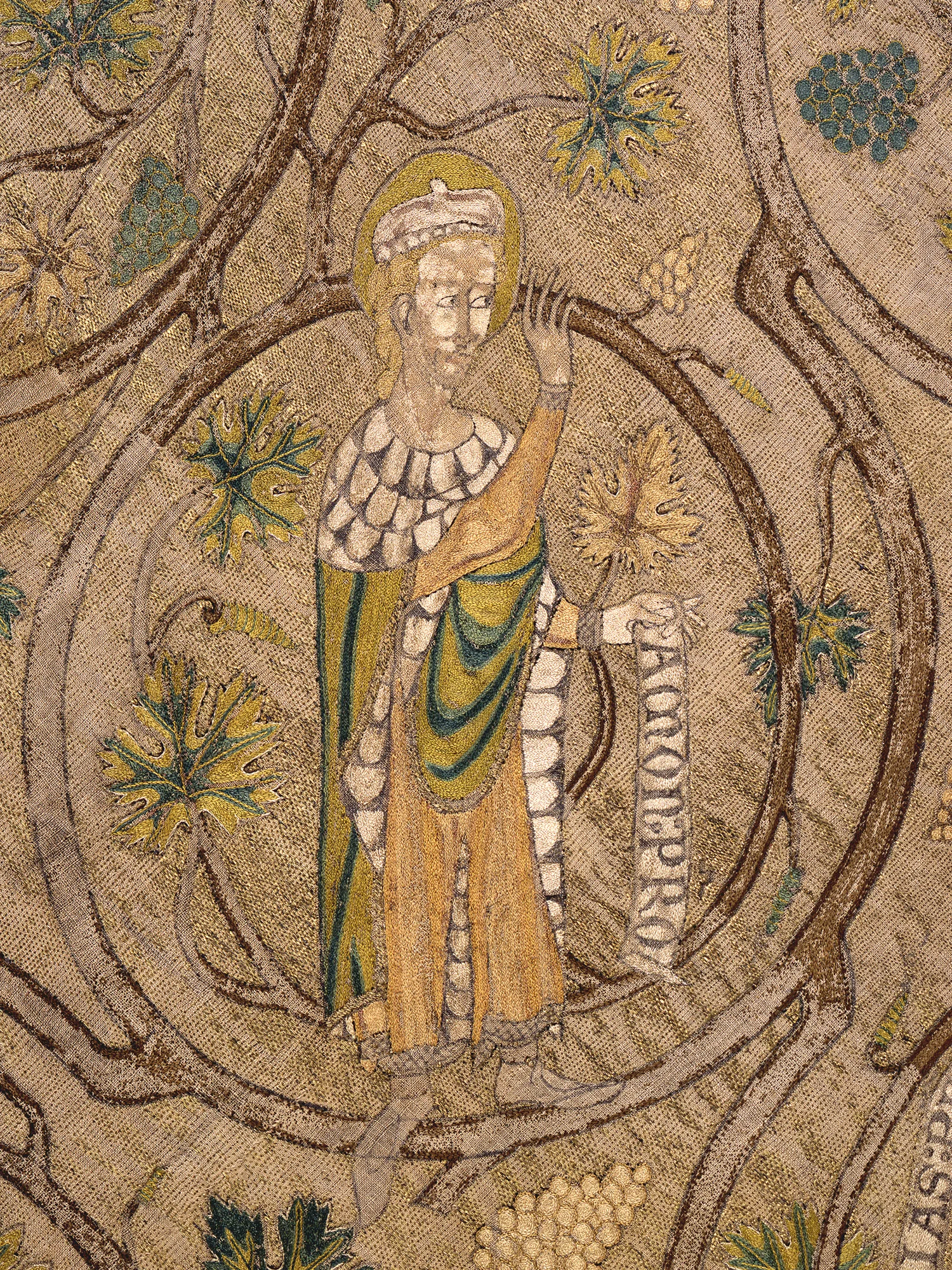
This cope was worn for processions and consecrations. It shows Old Testament prophets and kings inside medallions formed by curled vine tendrils. The root of the tree – Christ’s family tree – on the back of the pluvial was cut out at some point, but would have shown Jesse, fast asleep and dreaming. Such splendid vestments, embroidered with gold and coloured silks creating some very painterly effects, were a speciality of English embroiderers, who supplied several popes and numerous European church dignitaries, including the Archbishop of Salzburg, Conrad IV of Fohnsdorf (1291–1312). | England, ca. 1290–1300, gold and silk embroidery on linen, h. 137 cm, inv. no. 231
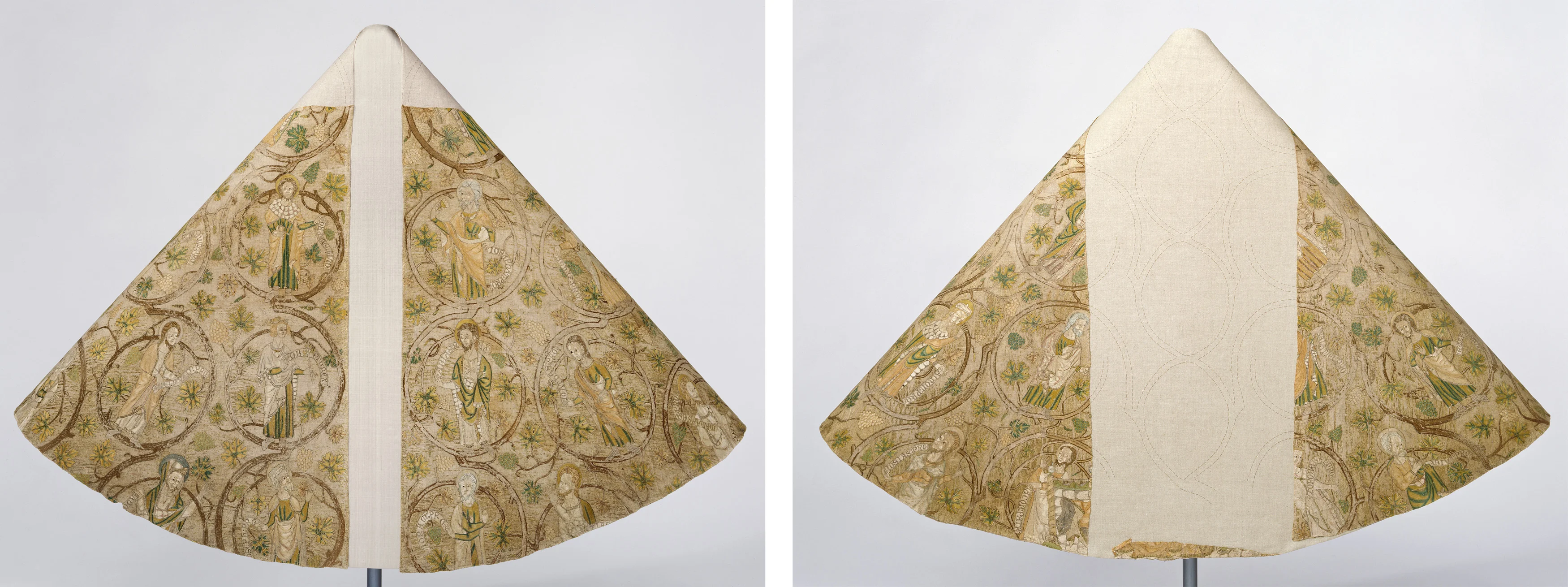
Abegg-Stiftung, Cope with Tree of Jesse, England, c. 1290–1300, inv. no. 231
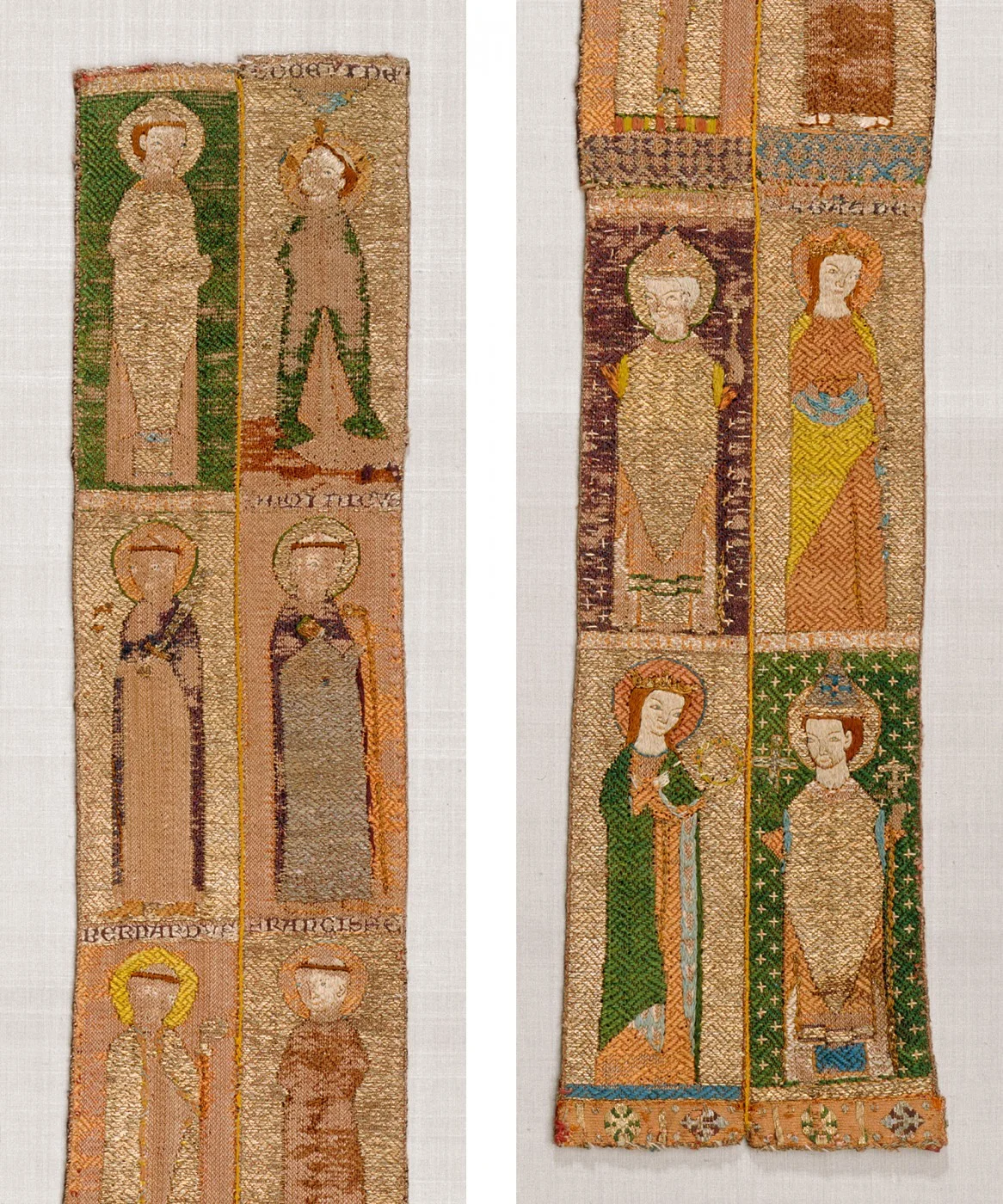
This orphrey owes its appearance to a combination of tablet-weaving and embroidery. It shows Saints Lawrence and Stephen, followed by the saints of the great medieval orders, namely Peter the Martyr and Dominic, Bernhard of Clairvaux and Francis of Assisi, all of whom are named by name. Especially remarkable is the depiction of saints from several different orders, some of whom had not been venerated for very long. This suggests that the orphrey was made in a convent, possibly to propagate the cult of the convent’s own patron saint. | Rhineland (?), late 13th to early 14th century, tablet weaving, embroidered, h. 90 cm, w. 15 cm, inv. no. 5542
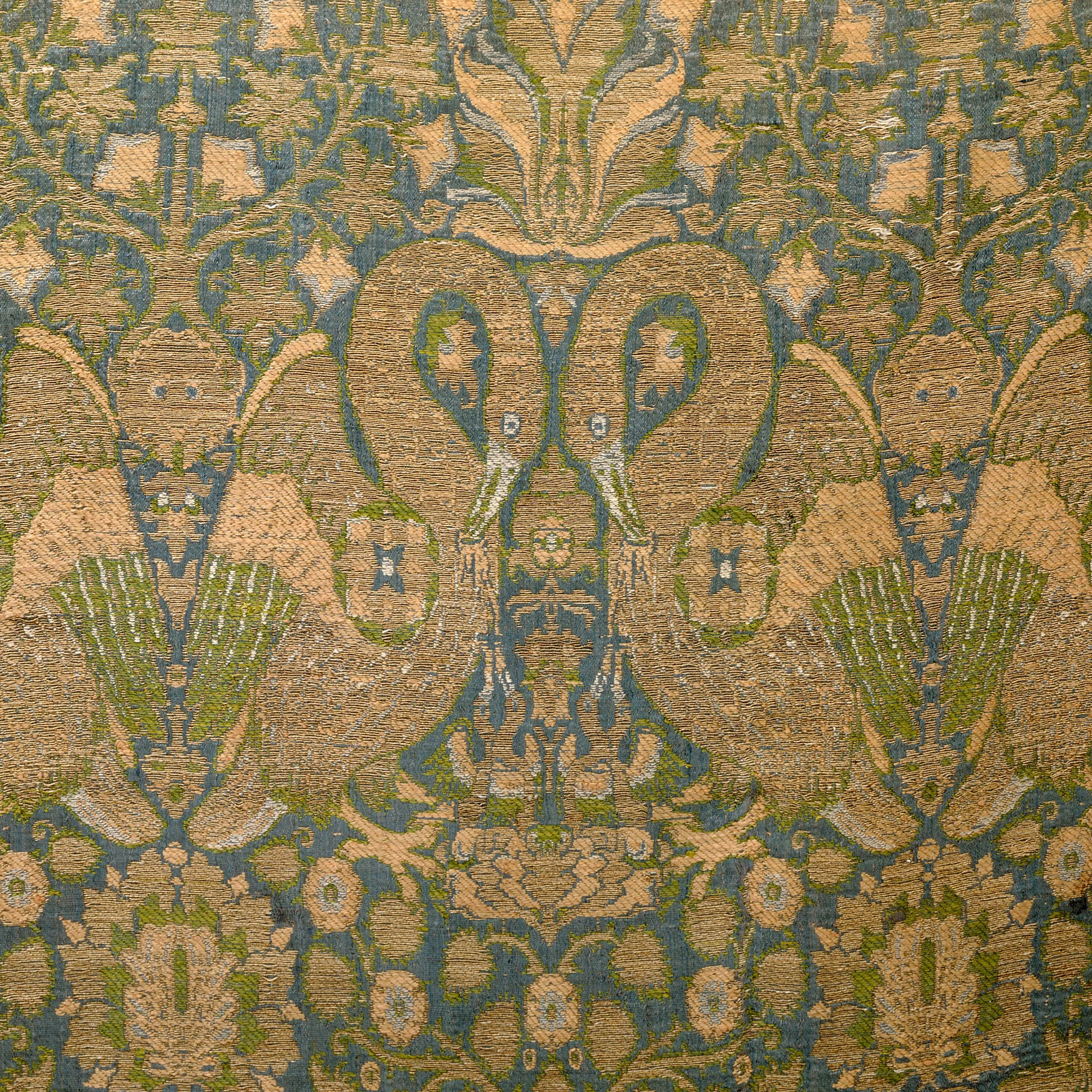
The sumptuous fabrics used to make this deacon’s vestment come from several different countries. The main fabric is an Italian lampas silk patterned with dogs and the Christological motif of the pelican feeding its own blood to its young. The sleeves are made of a Spanish silk patterned with a courtly device, while a Chinese or possibly Persian silk was used for the side pieces. The matching vestment worn by the subdeacon is to be found in the Hanseatic city of Stralsund in northern Germany, which is home to a large collection treasure of costly medieval vestments. | Stralsund, 15th century, fabrics from Italy, China or Persia, Spain and Germany, 13th–14th century, silk (lampas, samite), tablet weaving, h. 120 cm, w. 142 cm, inv. no. 152
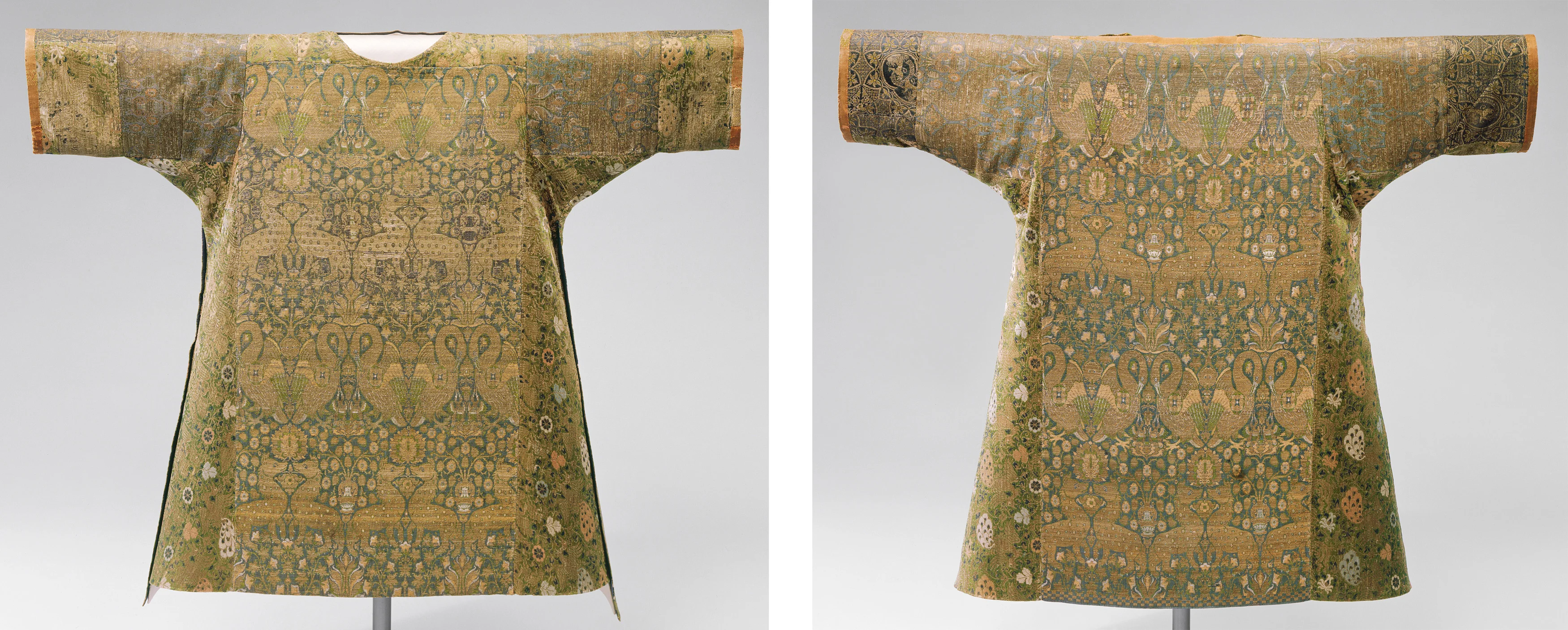
Abegg-Stiftung, Dalmatic from Stralsund, Stralsund, 15th century, fabrics 13th–14th century, inv. no. 152
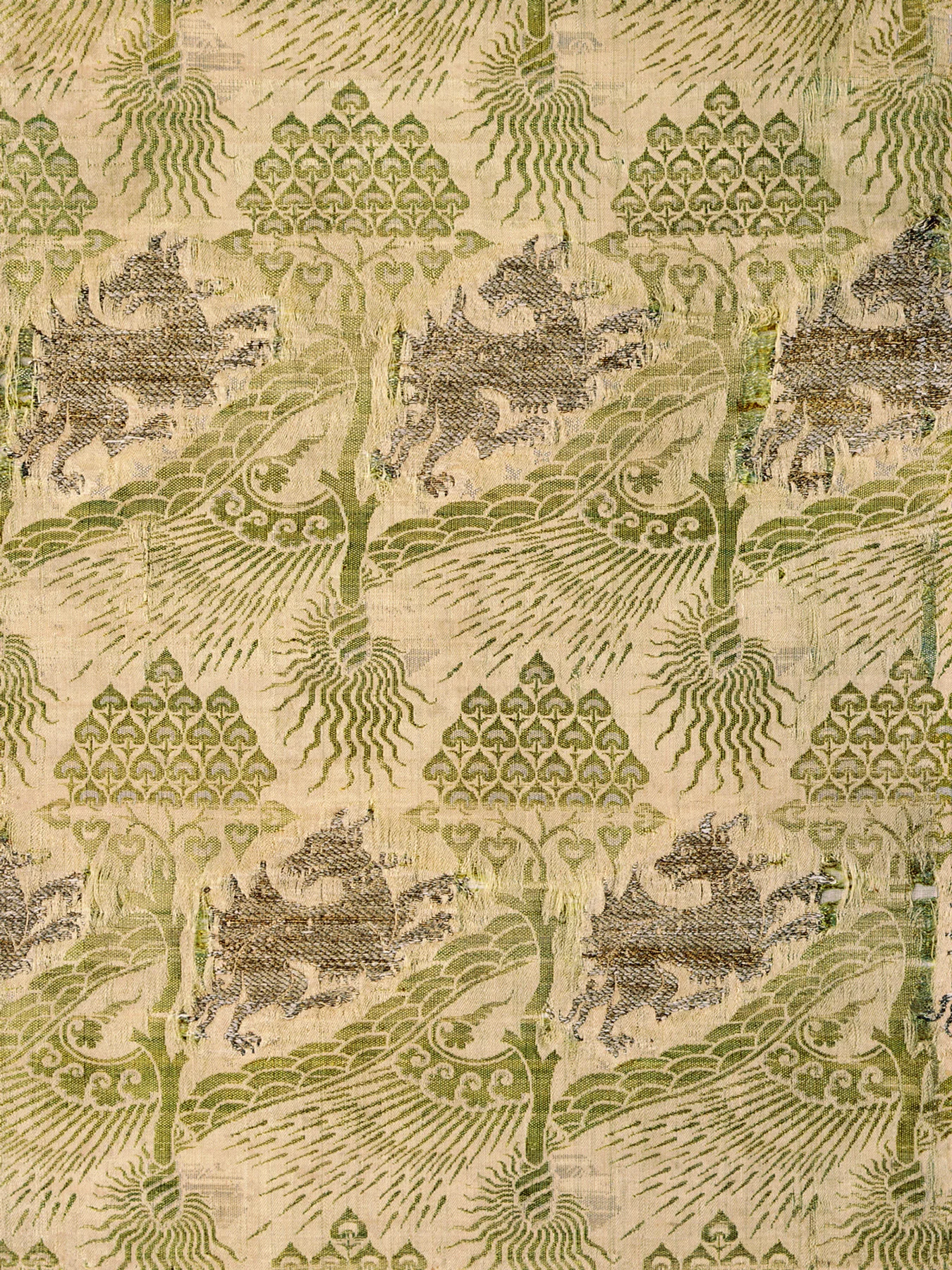
This silk shows a mythical creature with pointed ears, forked tail and scales cavorting between stylised landscape motifs. While the staggered clusters of trees with heart-shaped leaves recall conventional pointed-oval patterns, the diagonal arrangement of a stream and sunbeams radiating from a band of cloud lend the pattern a powerful upward dynamic. The creature’s jagged silhouette recalls Chinese models, while the landscape motifs seem to be drawn from Persian book illumination. | Italy, 2nd quarter to the 2nd half of the 14th century, silk (lampas), h. 42 cm, w. 32 cm, inv. no. 456
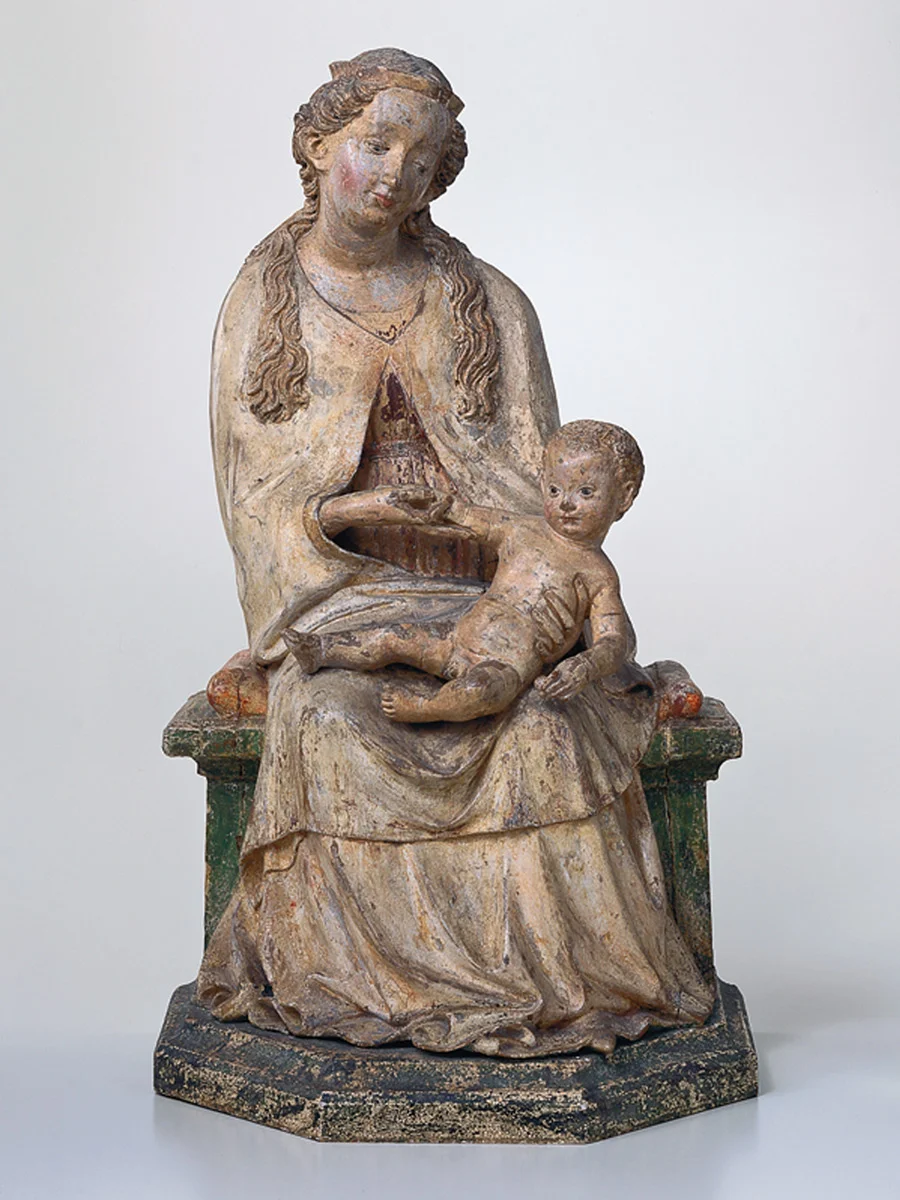
With her head bowed slightly to one side, Mary gazes at the unclothed Christ Child in her lap, tenderly holding his right hand in her own, in a gesture of betrothal. The fingers of her left hand pressing into his pliant flesh can be read as a subtle allusion to what will be his sacrificial death on the cross. The sculpture attributed by some scholars to Hans Multscher (1400–1467) combines the soft palette and elegance of International Gothic style around 1400 with restrained but no less affecting modelling. | Middle Rhine, ca. 1425–1430, walnut and soft wood, polychromy, h. 67 cm, inv. no. 11.44.75
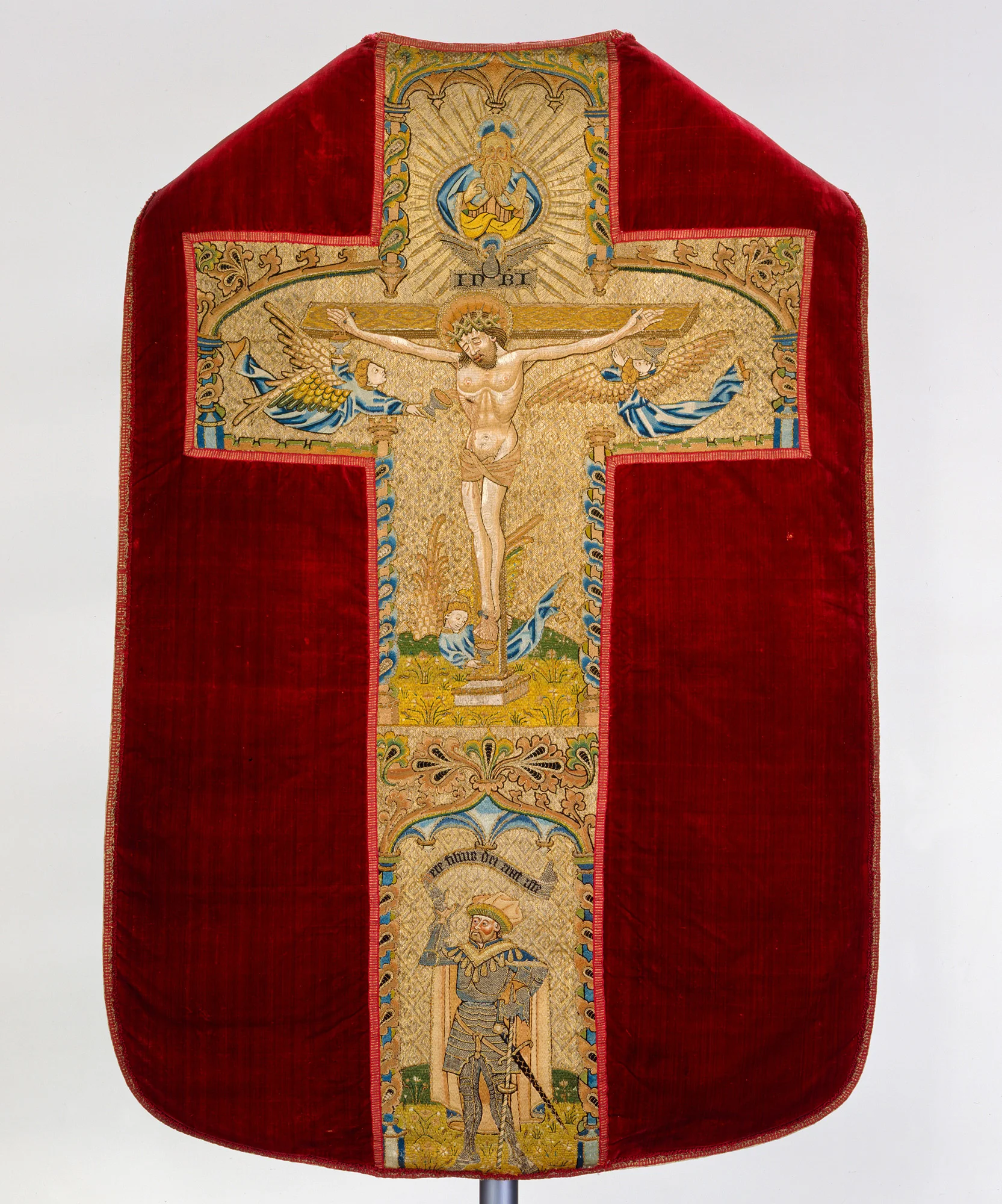
In keeping with the function of the chasuble as a liturgical vestment to be worn while celebrating Mass, this orphrey is decorated with a crucifixion scene. It shows Christ hanging on the cross, mourned over by God the Father inside a radiant mandorla and surrounded by angels holding out chalices to catch the sacrificial victim’s blood. The man depicted below this scene is the centurion, who according to the Gospel recognized Jesus as the Son of God. The exceptionally fine embroidery done in gold, silver and silk thread produces some remarkable glazing effects, thus showing the influence of Burgundian embroidery of the 15th century. | England, 3rd quarter of the 15th century, gold and silk embroidery on linen, h. 115 cm, w. 61 cm, inv. no. 5527
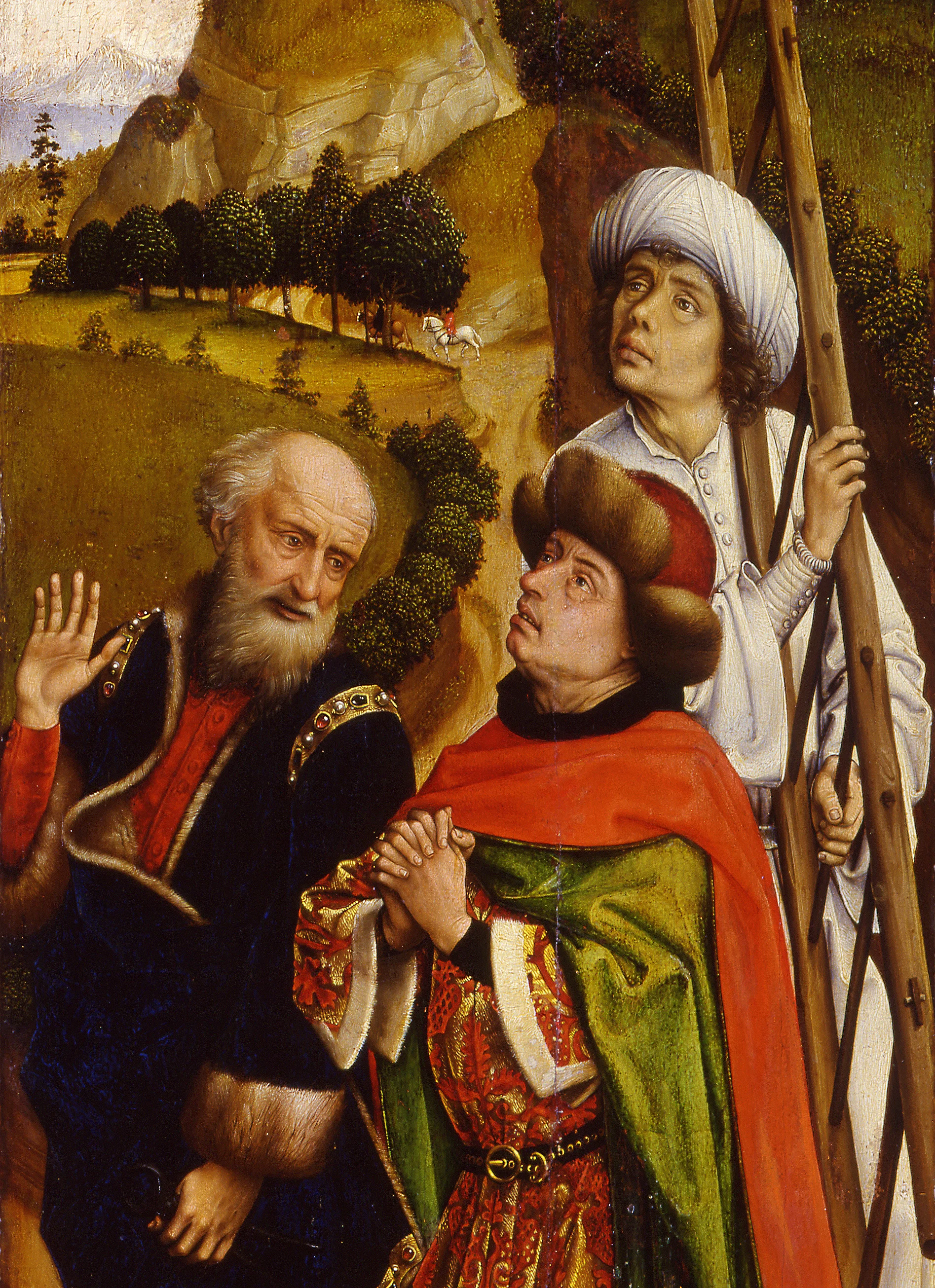
Rogier van der Weyden, workshop, ca. 1440–1445
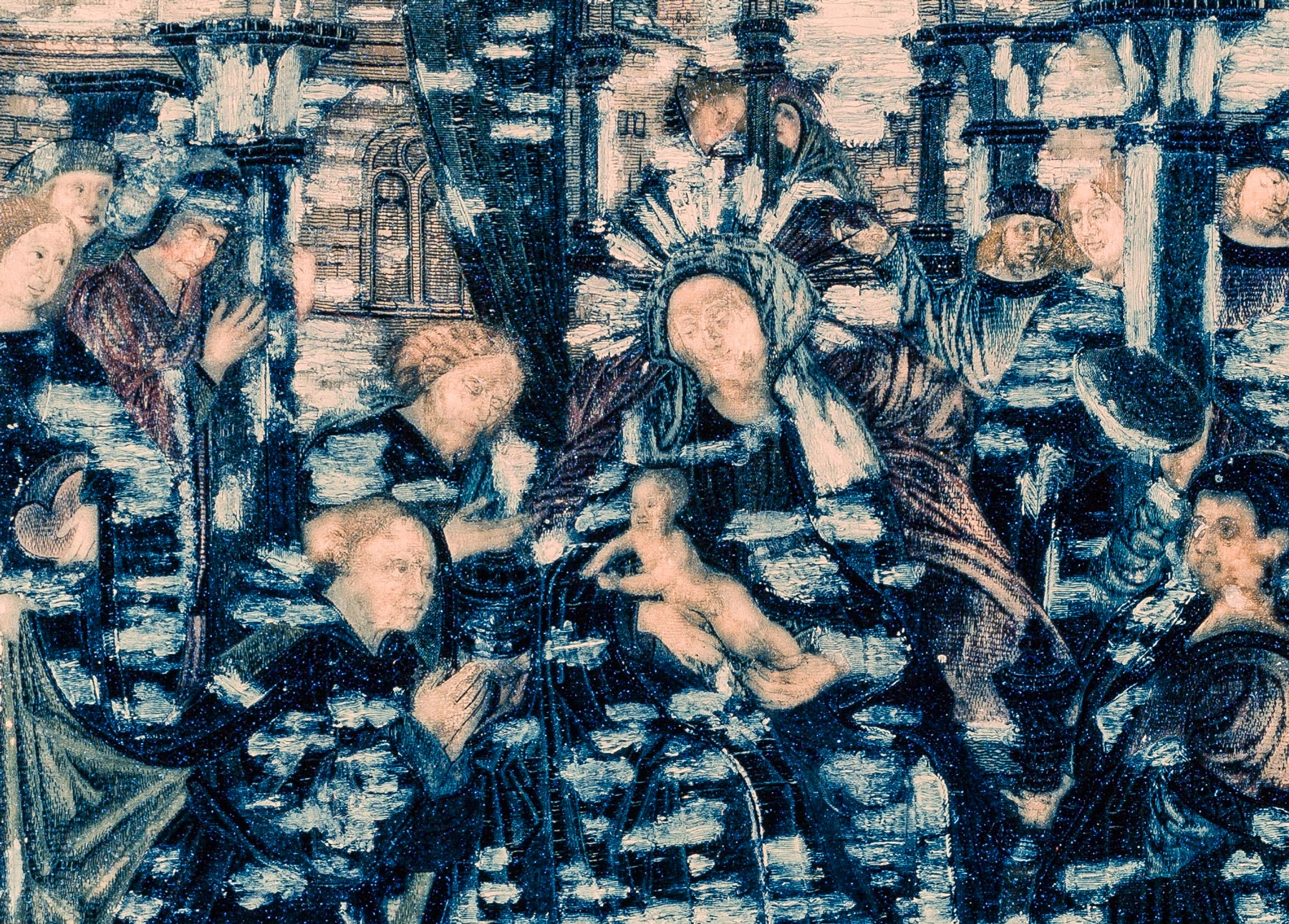
The crucifixion group on the central panel reuses motifs from earlier works by Rogier van der Weyden. The figures’ expressive gesturing greatly adds to the drama of the scene. The drapery includes robes made of sumptuous Italian velvet and fine Netherlandish linen. The winged altarpiece used to hang in the Dominican church of Chieri in Piedmont. It was commissioned by a member of the De Villa family of bankers, whose crest adorns the window on the left wing. | Oil on oak, h. 103.5 cm, inv. no. 14.2.63
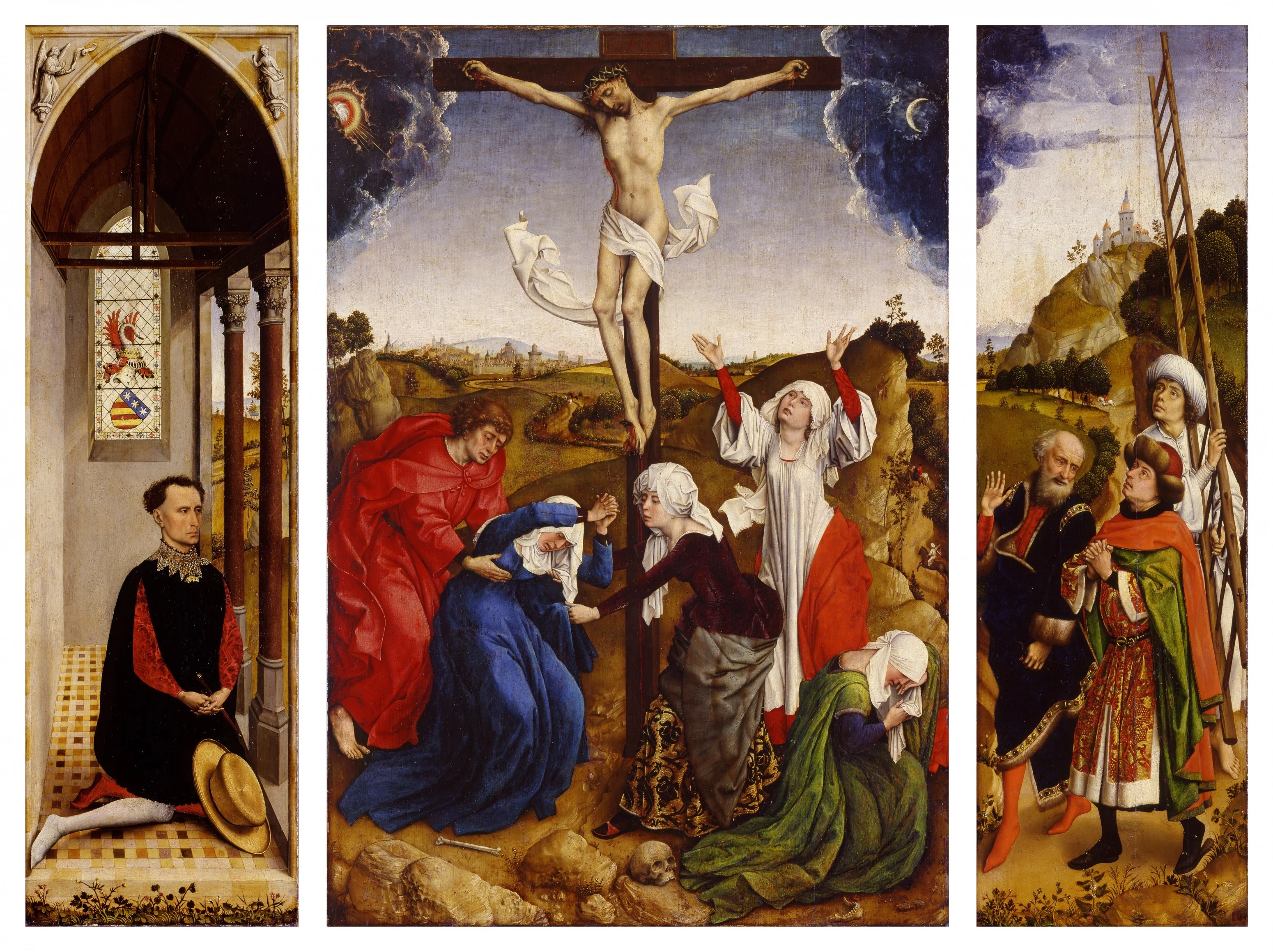
Abegg-Stiftung, Triptych with the Crucifixion of Christ, Rogier van der Weyden, workshop, c. 1440–1445, inv. no. 14.2.63

Das Triptychon zeigt in seiner Dramatik und Bewegtheit eine ungewöhnliche Facette der Rogieresken Kunst. Zugleich lässt es sich in kompositorischer wie in maltechnischer Hinsicht in ein enges Geflecht von Arbeiten eingliedern, die der Brüsseler Meister in jenen Jahren schuf und zu denen seine unbestrittenen Hauptwerke, die Grosse Kreuzabnahme und der Miraflores-Altar, zählen. Die vorliegende Monographie geht diesen Verflechtungen ebenso nach wie der Person des Stifters, den Verbindungen zu anderen Aufträgen sowie der Rezeption des Altargemäldes in der zeitgenössischen italienischen und nordeuropäischen Malerei.
Monographien der Abegg-Stiftung 20 | 90 S., 43 Abb., 1 Falttafel, brosch., 18 x 22,5 cm, 2014, ISBN 978-3-905014-59-4
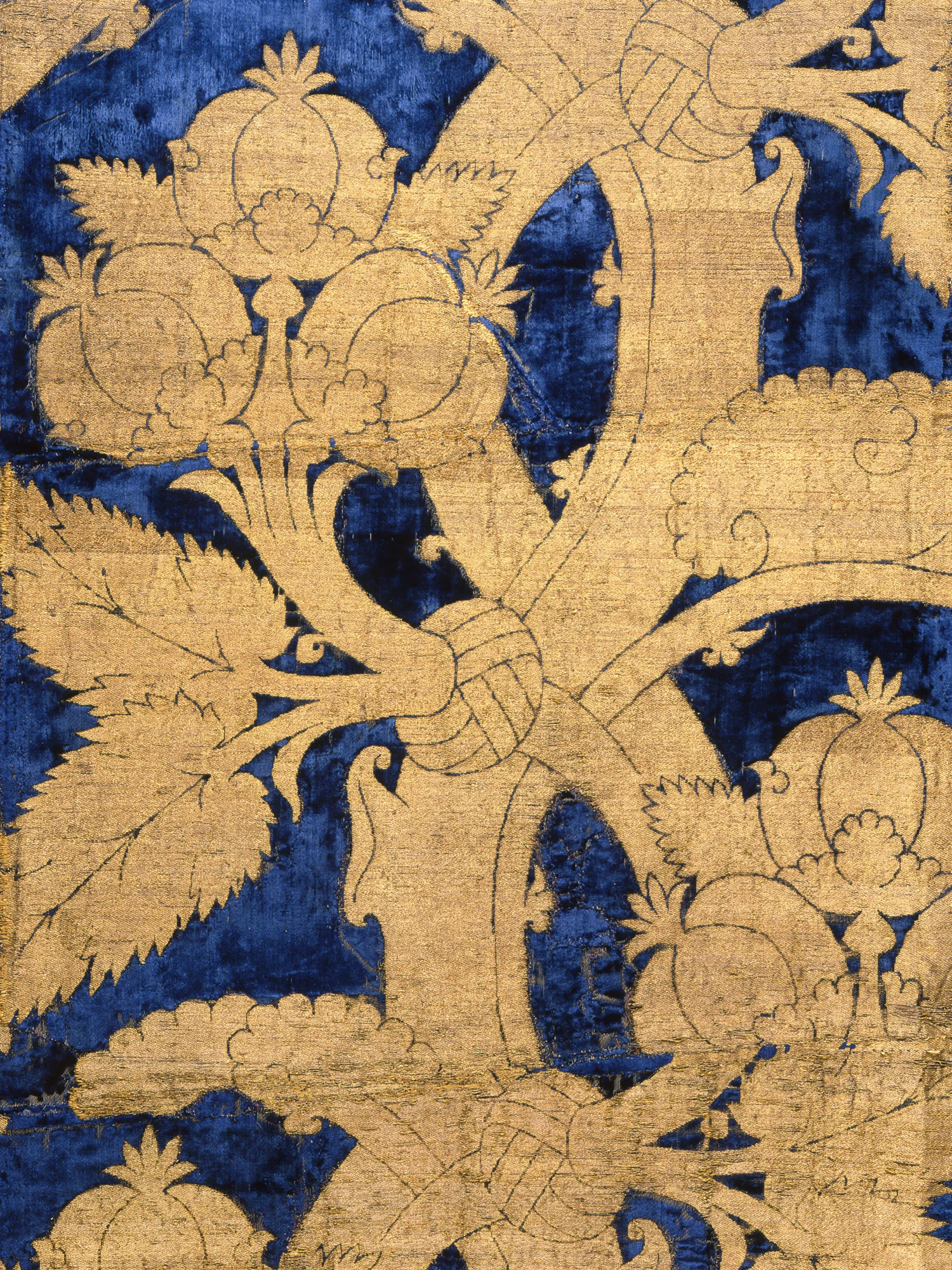
Stylised pomegranates are among the motifs that typically feature on Italian textiles of the Late Middle Ages. Whereas other velvets tend to show only the stylised outlines, however, the pomegranates on this one are modelled so as to look three-dimensional. The overlapping branches and delicate lines accentuating the round shape of the fruits create an impression of depth. Italian velvets with gold brocading were luxury export items and feature in numerous paintings both south and north of the Alps. | Italy, mid-15th century, silk, metal threads, h. 100 cm, inv. no. 818
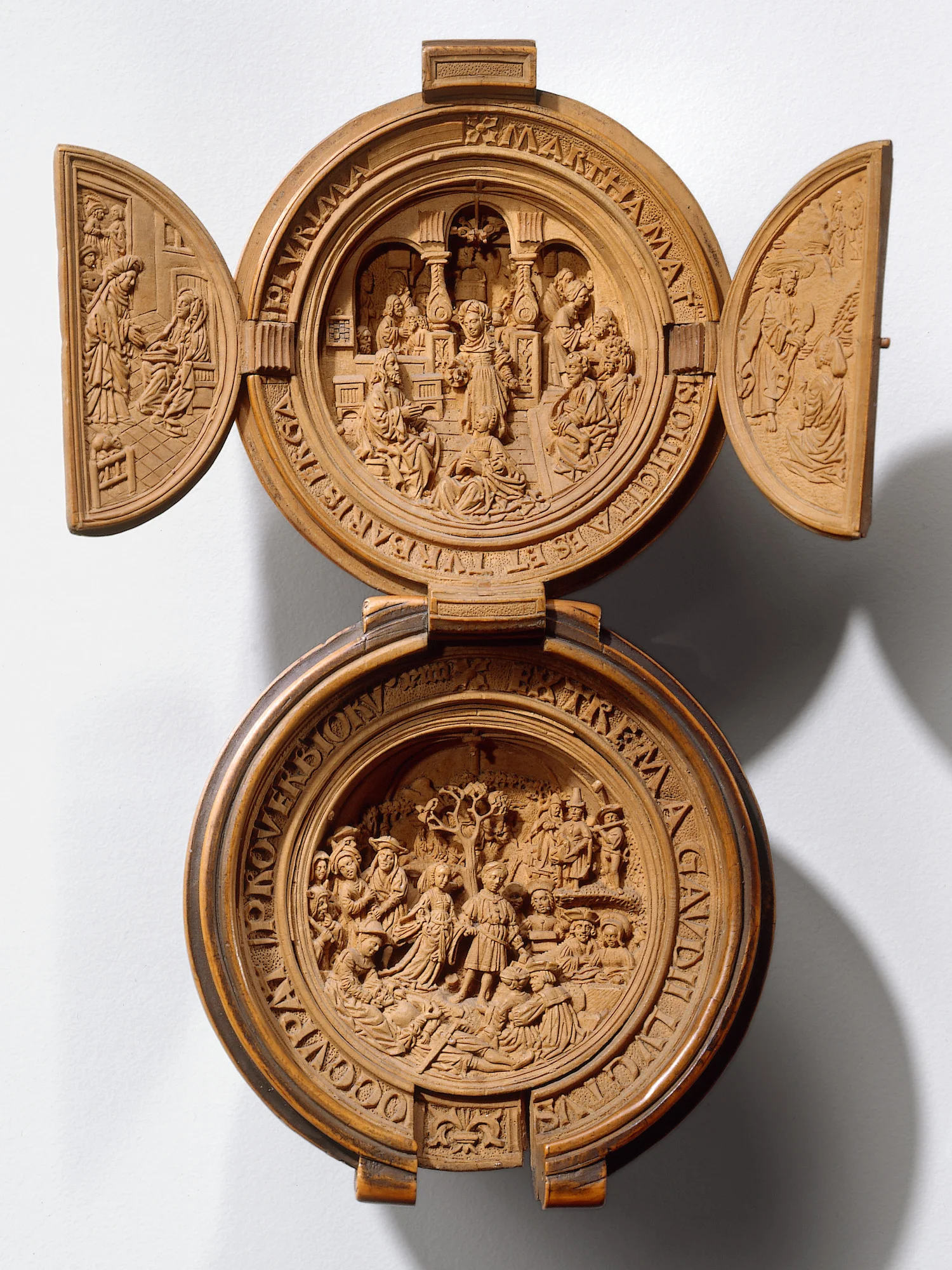
The opened prayer-nut shows Mary Magdalene dancing with a nobleman after an engraving by Lucas van Leyden of 1519 in the bottom half and Christ visiting the home of Martha and Mary in the top half. While Martha busies herself with entertaining her guest, her sister Mary listens raptly to what he has to say. Mary represents pious devotion, which is what this pendant for a rosary was intended to promote. The virtuosity of the miniature carving must also have fascinated princely collectors, who began amassing their cabinets of curiosities around this time. | Southern Netherlands, after 1519, boxwood, diam. 6.5 cm, inv. no. 7.15.67

Unter den nichttextilen Kunstwerken der Abegg-Stiftung finden sich zwei delikate Miniaturschnitzereien. Von kugeliger Gestalt und aussen mit Ornamenten reich verziert, offenbaren sie in ihrem Inneren faszinierend kleine und dabei höchst komplexe Bildwelten. Einem Rosenkranz angehängt, dienten sie der meditativen Versenkung. In der frühen Neuzeit wurden sie vor allem als Kunstkammerstücke geschätzt. Die reich bebilderte Publikation liefert Einblicke in die mittelalterliche Frömmigkeitspraxis. Zugleich eröffnet sie eine Perspektive auf die Tradition des Sammelns bis in die heutige Zeit.
Monographien der Abegg-Stiftung 15 | 86 S., 40 Abb., brosch., 18 x 22,5 cm, 2011, ISBN 978-3-905014-46-4
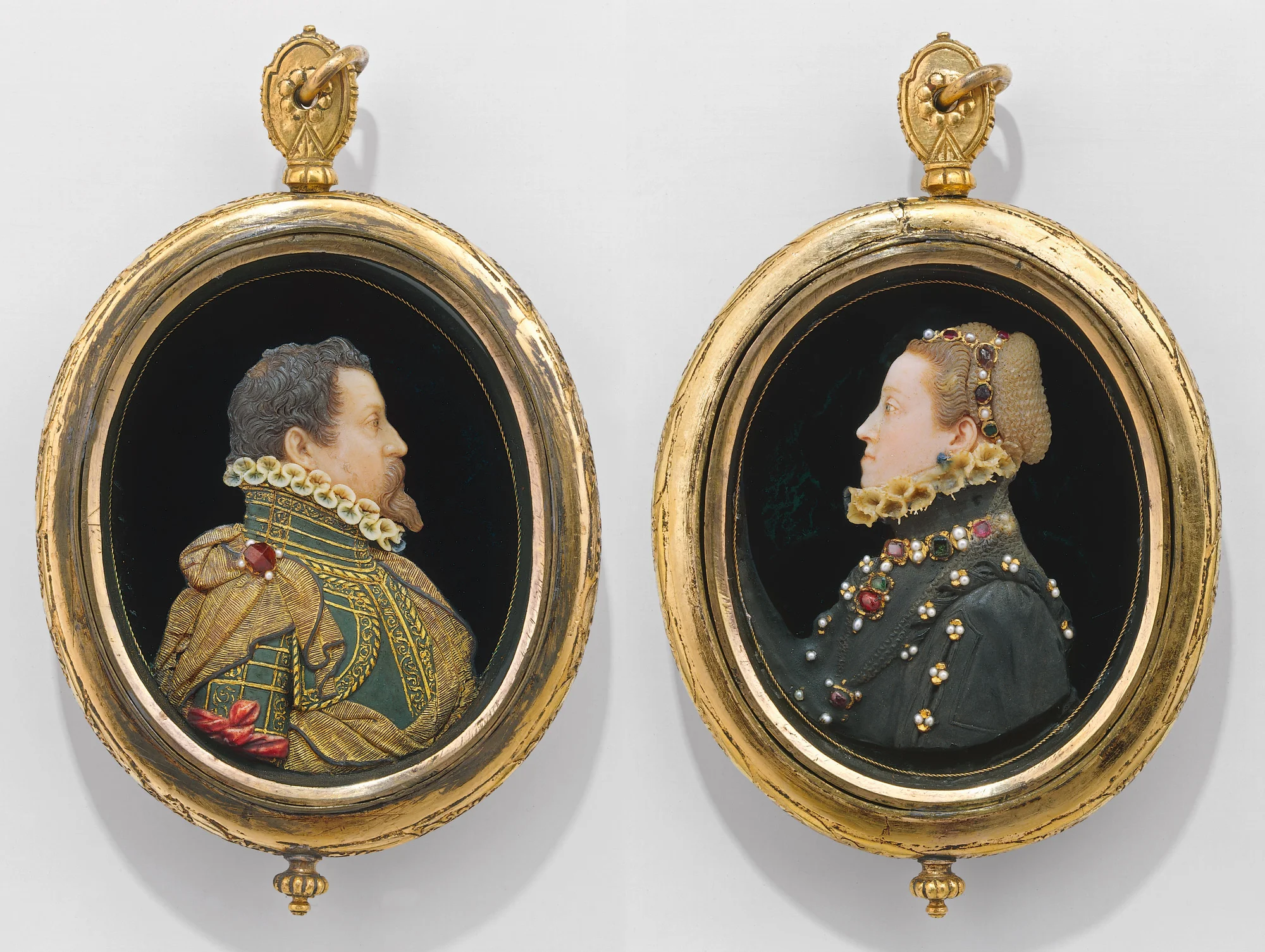
Antonio Abondio, c. 1575
The portraits show Charles II, Archduke of Inner Austria, and his wife Maria, whose seat was in Graz. Abondio was the first artist north of the Alps to use wax modelling for more than just medal-making moulds. By treating wax as a fully fledged medium, he elevated the wax portrait to a genre in its own right. Mounted in gold-plated copper capsules, these miniature portraits were often given to family members as gifts. | Pigmented wax, h. 13.5 cm, inv. nos. 9.7.63 and 9.8.63

Die Studie stellt die Bildnisse Erzherzogs Karl II. von Innerösterreich und seiner Gemahlin Maria vor. Sie werden dem italienischen Wachsmodelleur Antonio Abondio zugeschrieben und um 1575 datiert. Abondio war einer der bedeutendsten Medailleure des 16. Jahrhunderts und trug entscheidend zur Entwicklung farbiger Wachsportraits als einer eigenen Bildgattung bei. Die Herkunft der beiden Wachsbildnisse aus der Münchner Kunstkammer sowie ihre spätere wechselvolle Geschichte werden dargelegt.
Monographien der Abegg-Stiftung 17 | 74 S., 29 Abb., brosch., 18 x 22,5 cm, 2011, ISBN 978-3-905014-49-5
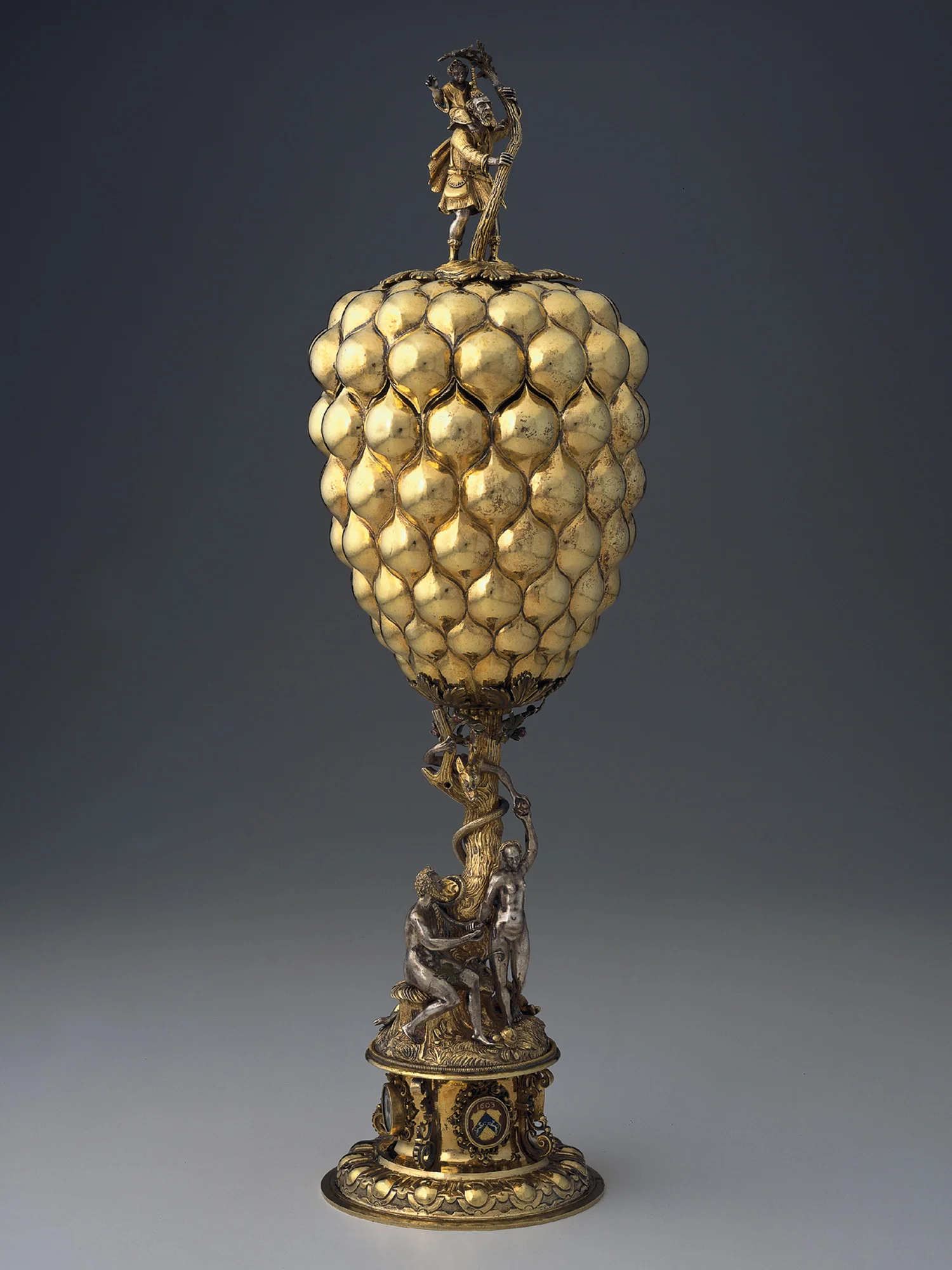
Ornamental vessels made of silver gilt in honour of special occasions were highly prized as mementos. At princely courts and in wealthy bourgeois households they were displayed on a table or on terraced buffets. Thanks to town and master’s marks, both the place of origin and even the goldsmith can be identified in most cases. Convex embossing counted among the most difficult goldsmithing techniques. The foot and lid of the cup are decorated with two figural groups showing the Fall and Saint Christopher respectively. | Nuremberg, Georg Rühl the Elder, c. 1603, silver gilt, embossed, h. 48.5 cm, inv. no. 8.75.63
Jan Brueghel the Elder, 1593
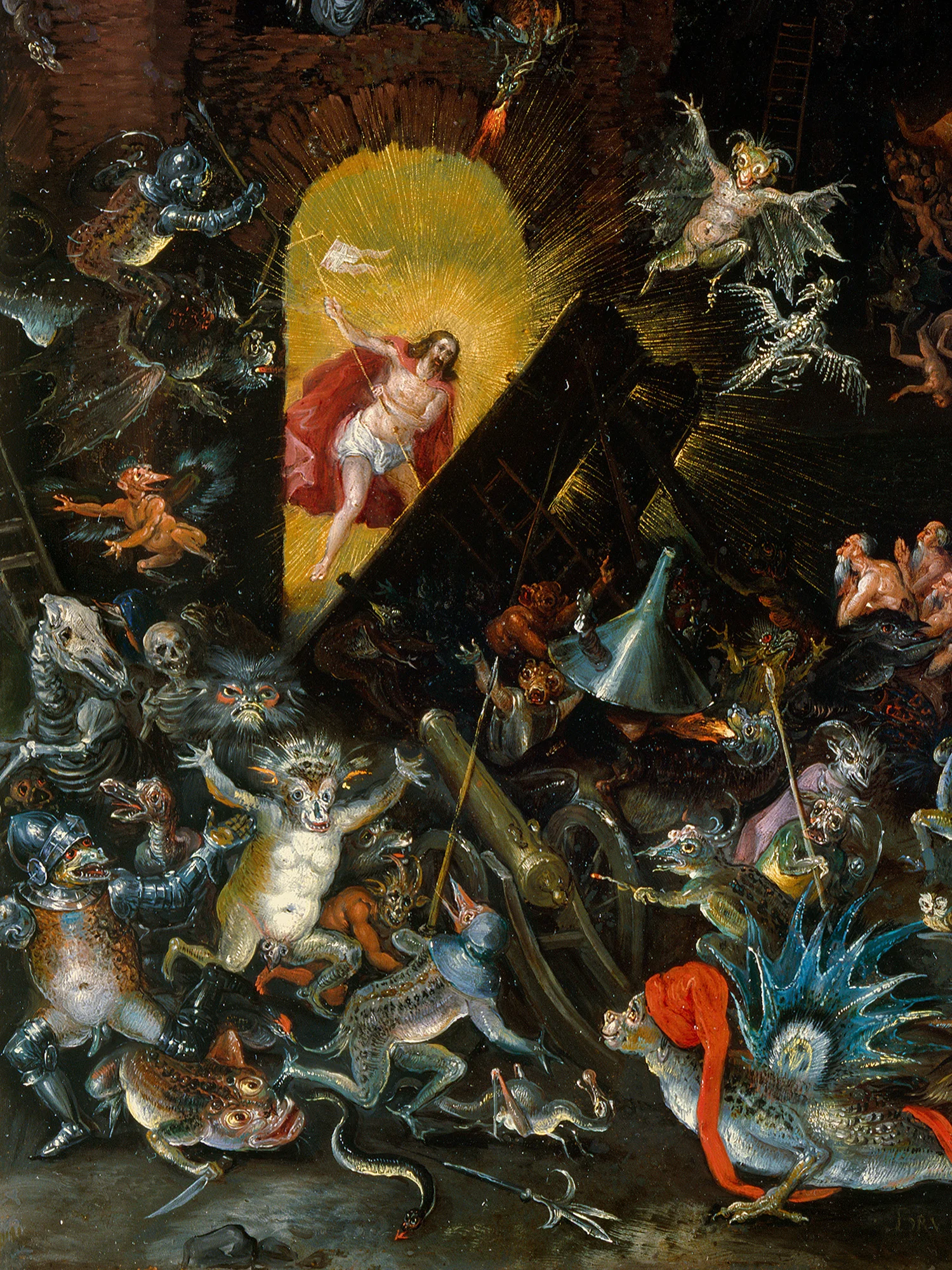
The scene of Christ entering Limbo is shown at the far left. The composition is nevertheless tightly focused on the essentials, thanks in part to the painter’s use of light and in part to the fact that all the figures are moving in the same direction. The panel was painted during a stay in Rome and counts among Brueghel’s earliest signed works. His hellscape populated by mythical creatures is reminiscent of paintings of Hieronymus Bosch. | Oil-based paint on copper, h. 25.6 cm, inv. no. 14.119.72
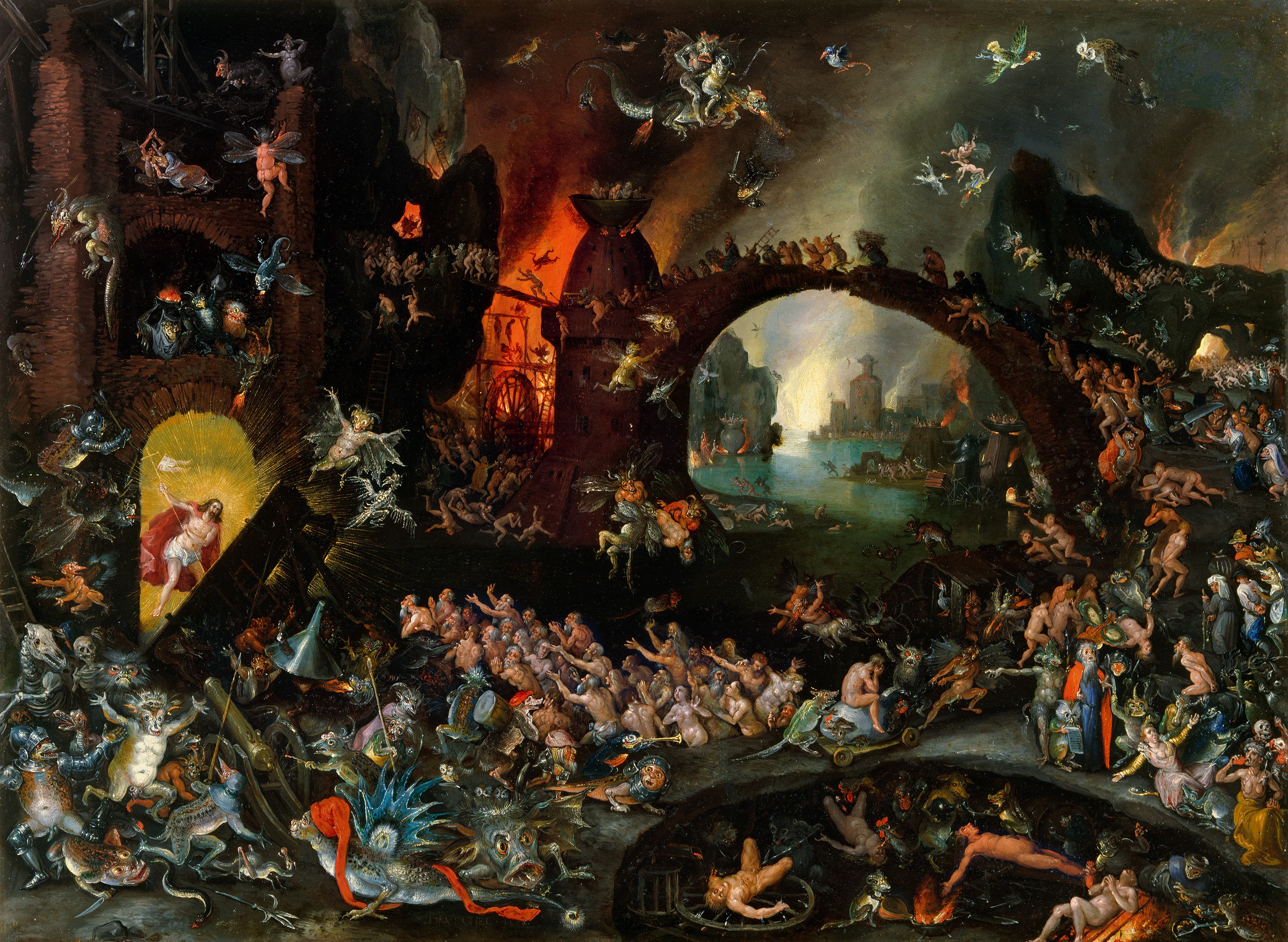
Abegg-Stiftung, Christ in Limbo, Jan Brueghel the Elder, 1593, inv. no. 14.119.72
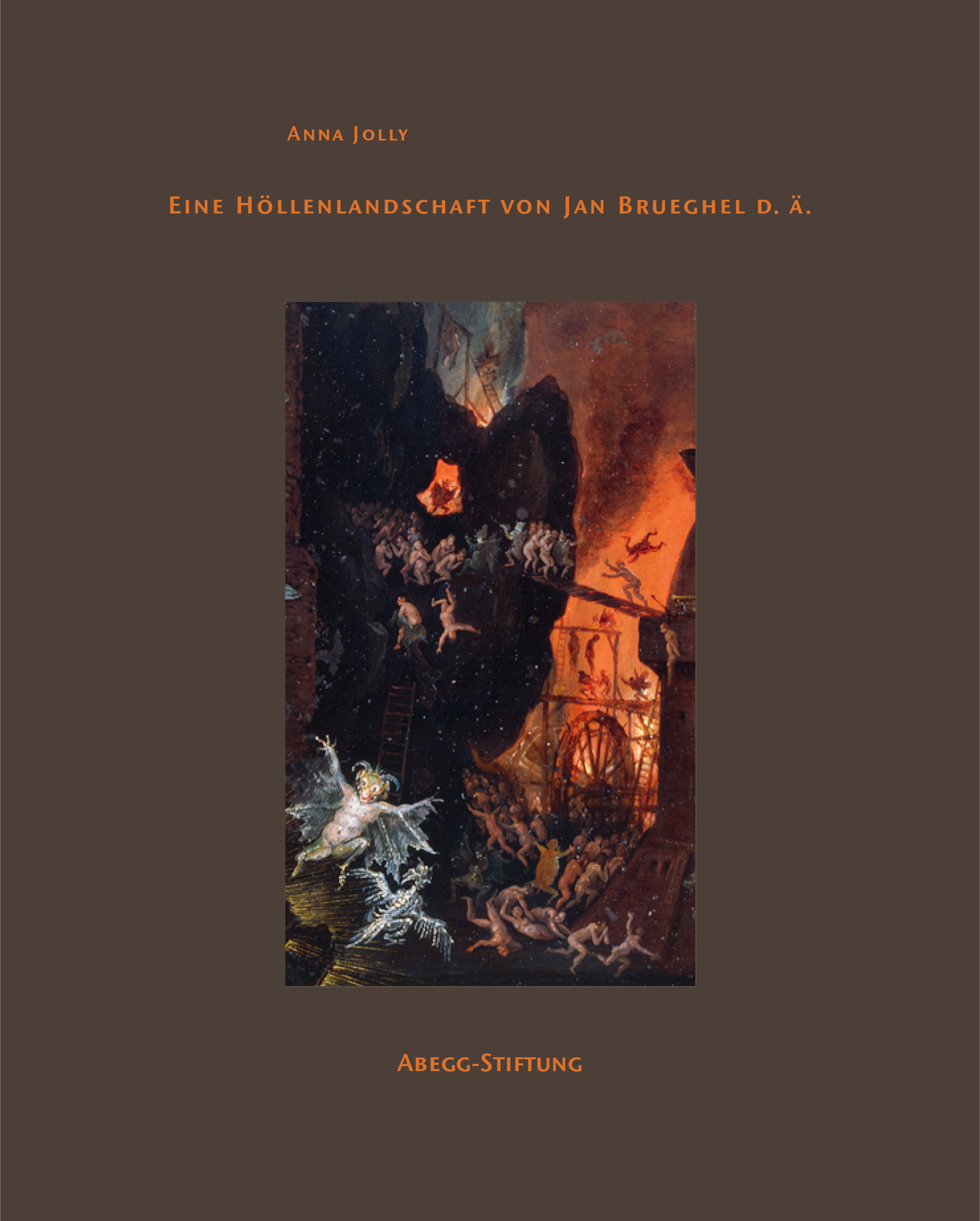
Das signierte und in das Jahr 1593 datierte Gemälde zählt zu den frühesten gesicherten Höllenlandschaften des Künstlers. Es wird mit dieser Studie erstmals publiziert und bietet einen Anlass, die frühen Höllenlandschaften Jan Brueghels vergleichend zu betrachten. Zugleich erlaubt die Datierung des Werks, das Umfeld seiner Entstehung während des dreijährigen Aufenthaltes des Malers in Rom nachzuzeichnen. Viele Detailfotos und Makroaufnahmen des Gemäldes sowie eine Fülle von Farbabbildungen ähnlicher Werke begleiten den Text.
Monographien der Abegg-Stiftung 14 | 68 S., 34 Abb., 1 Falttafel, brosch., 18 x 22,5 cm, 2011, ISBN 978-3-905014-44-0
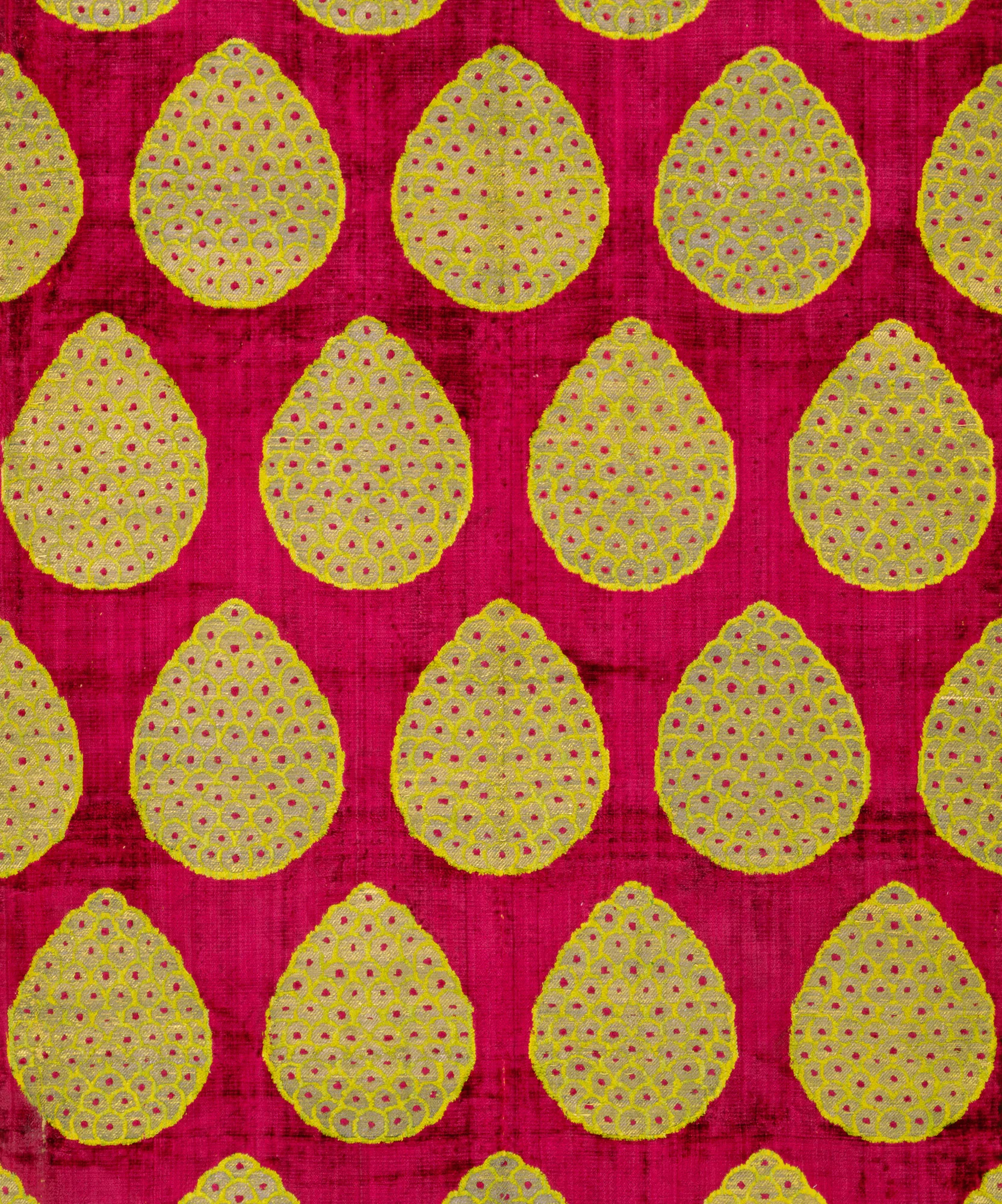
Ottoman velvets are barely distinguishable from European velvets in terms of weaving technique, but their designs often differ from the pomegranate motifs featured on 16th-century Italian weavings. This silk velvet with rows of pine cones is remarkable for the serene elegance of the pattern. The cones look almost as if they were floating on top of the red velvet pile. The yellow lines and red dots imitate the surface of natural pine cones. | Ottoman Empire, mid-16th century, silk, metal threads, h. 113 cm, inv. no. 5430
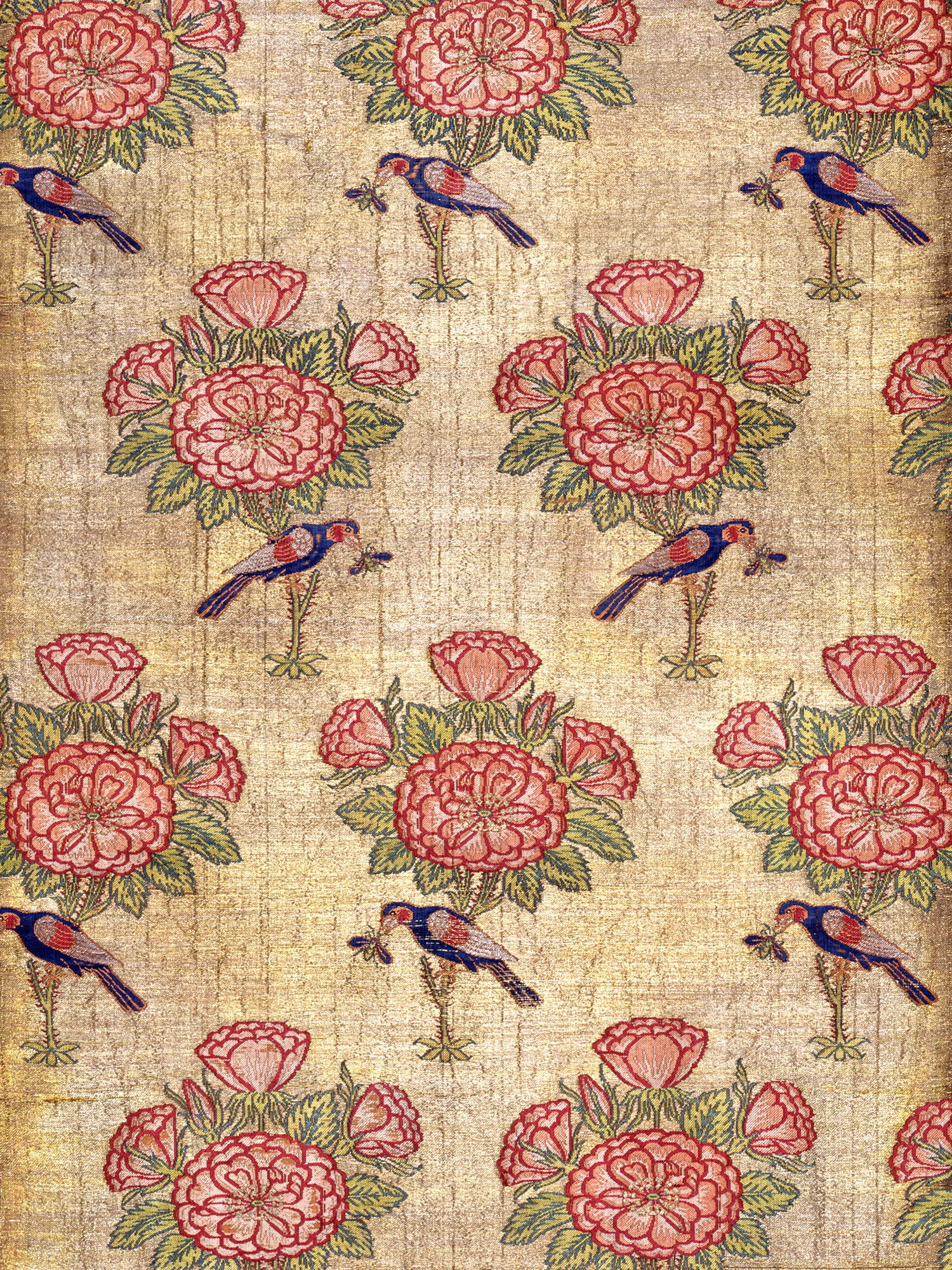
This fine weaving with a ground completely covered in gold threads was probably made in Persia during the period of Safavid rule (1501–1722). The naturalistic rendering of the rose and bird already points to the influence of European botanical illustrations on Persian art, which began towards the end of this era. Luxury textiles from Asia were much coveted collectibles in Europe from the early 17th century onwards. | Persia, late 17th century, silk, metal threads, h. 72 cm, inv. no. 5411
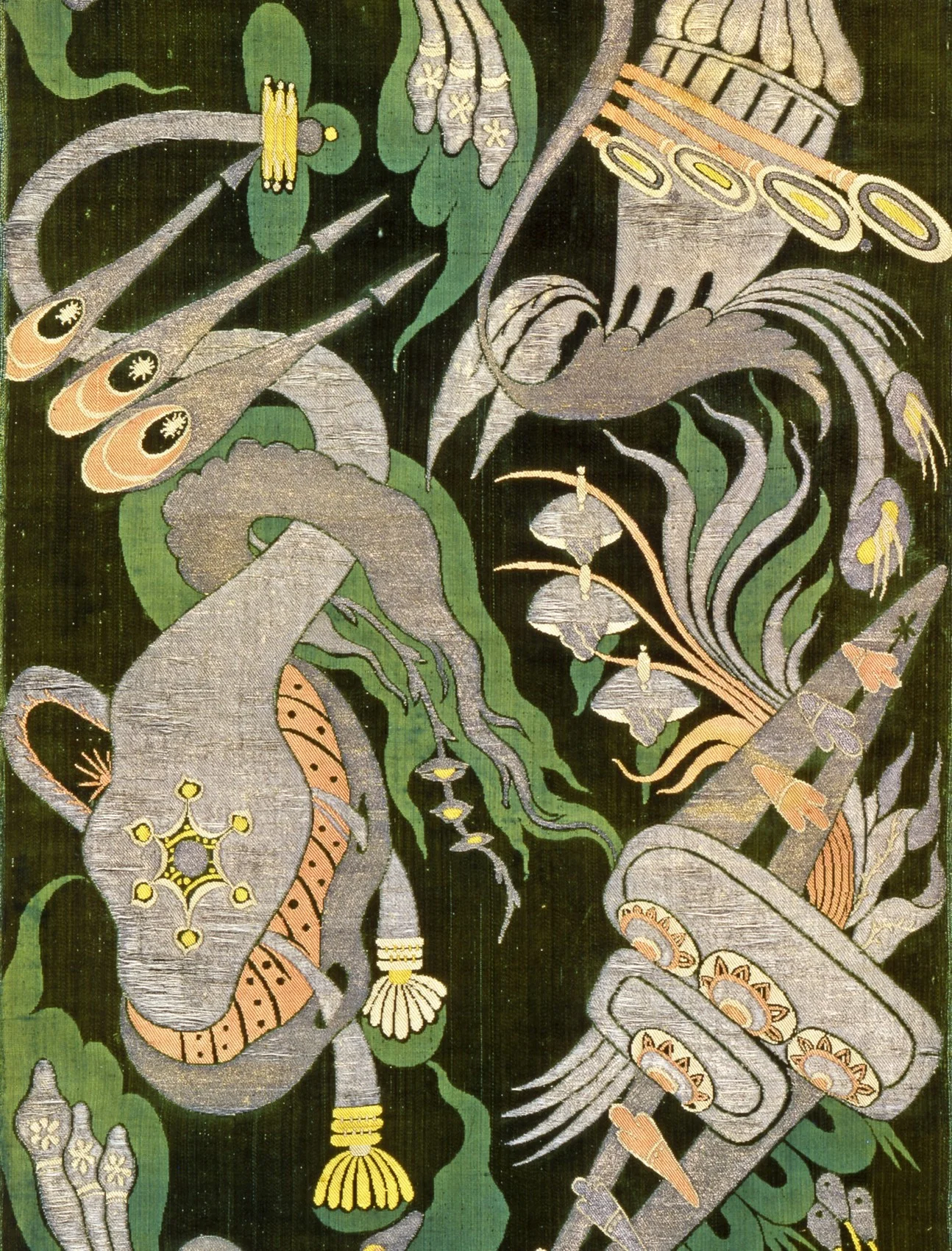
The silks later known as “bizarre silks” were popular from the beginning of the century until the 1720s. Their fantastical motifs are often hard to describe and reflect the influence of the Far Eastern models that arrived in Europe on the ships of the East India trading companies. The asymmetrical composition with diagonally arranged motifs clearly bears the stamp of Asian design principles. The green damask ground appears like a foil with motifs reminiscent of exotic sea creatures and seaweed moving across it. | France or Italy, c. 1700, silk, metal threads, h. 95.5 cm, inv. no. 260
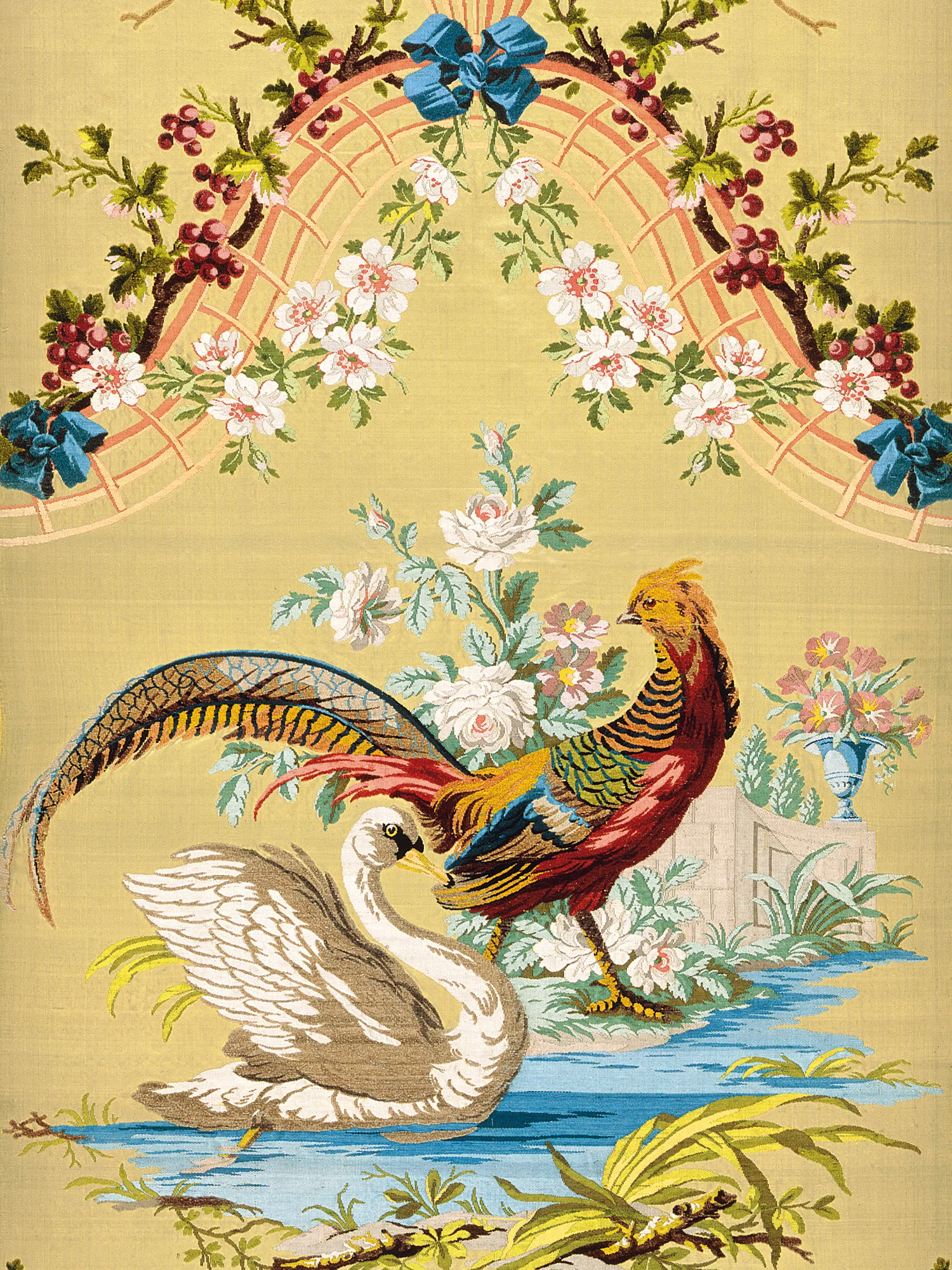
Silk weavings made specifically for furnishings with large pictorial motifs covering the entire width of the fabric began appearing in the second half of the 18th century. Among them was this silk designed by Philippe de Lasalle, the famous designer, engineer and manufacturer of Lyons. It was a design held in especially high esteem by Empress Catherine the Great of Russia, who had the salon of her summer residence at Tsarskoye Selo near Saint Petersburg furnished with silks of this pattern. | France (Lyons), c. 1770–1775, silk (lampas weave), h. 192 cm, inv. no. 5064

Die Publikation präsentiert eine Auswahl der schönsten und historisch bedeutendsten Dekorationstextilien aus der Sammlung der Abegg-Stiftung. Das Einführungskapitel behandelt die verschiedenen textilen Gattungen, ihre Verarbeitung und Verwendung in der Innenausstattung.
Riggisberger Berichte 12 | Mit englischer Übersetzung der Einführung. 260 S., 110 Abb., 10 Zeichnungen, brosch., 23 x 31 cm, 2005, ISBN 3-905014-28-9