This project is based on an international colloquium held at the Abegg-Stiftung in 2025. The occasion was the publicationof the five-volume catalogue raisonné of the textile treasure of Halberstadt. The publication of this new catalogue, like that of its predecessors on the textile treasures of Brandenburg, Stralsund, Brașov (Kronstadt/Brassó) and Gdańsk (Danzig), makes it possible for all these Central European textile treasures to be compared. This, in turn, will reveal how much each of them was shaped by the social and political importance of the parish or collegiate church to which it belonged. Among the other factors affecting the composition of the various treasures are economic vicissitudes and the trade routes typically taken by – and in some cases peculiar to – luxury textiles. Some of the treasures feature very special gifts or donations, which might have had practical devotional consequences, for example by prompting pilgrimages. How the treasures look today is in part a consequence of how they were preserved and handed down after the Reformation. While some liturgical textiles were quickly locked away and hence preserved virtually intact and in pristine condition, others, such as the medieval church vestments in Transylvania, remained in use even as late as the nineteenth century. The direct comparison of the treasures will bring to light many such differences in the conditions of their emergence and how they have fared in the meantime. It will also help account for differences in the overall appearance of each inventory.
Besides systematically presented portraits of the textile treasures of Halberstadt, Brandenburg, Gdańsk, Stralsund, Brunswick (Braunschweig), Sibiu (Hermannstadt/Nagyszeben) as well as Braşov and Bern, the book will also contain more general essays that will compare and shed light on key aspects of them, including the cuts, lining materials, the handling of specific outer fabrics and questions relating to their preservation and archival sources.
The contributions will be revised and expanded versions of the presentations given at the 2025 colloquium. The authors include Birgitt Borkopp-Restle, Maya Brockhaus, Juliette Calvarin, Leonie Dosch, Edmund Kizik, Susan Marti, Corinne Mühlemann, Barbara Pregla, Anja Preiss, Jörg Richter, Juliane von Fircks, Gerhard Weilandt, Evelin Wetter and Ágnes Ziegler.
The book is to be published in English so as to make the research into these textile treasures, which has hitherto been conducted almost exclusively in German, accessible to a broad, international readership.
Prof. Dr. Evelin Wetter
Curator of Textiles of the 13th–16th Century
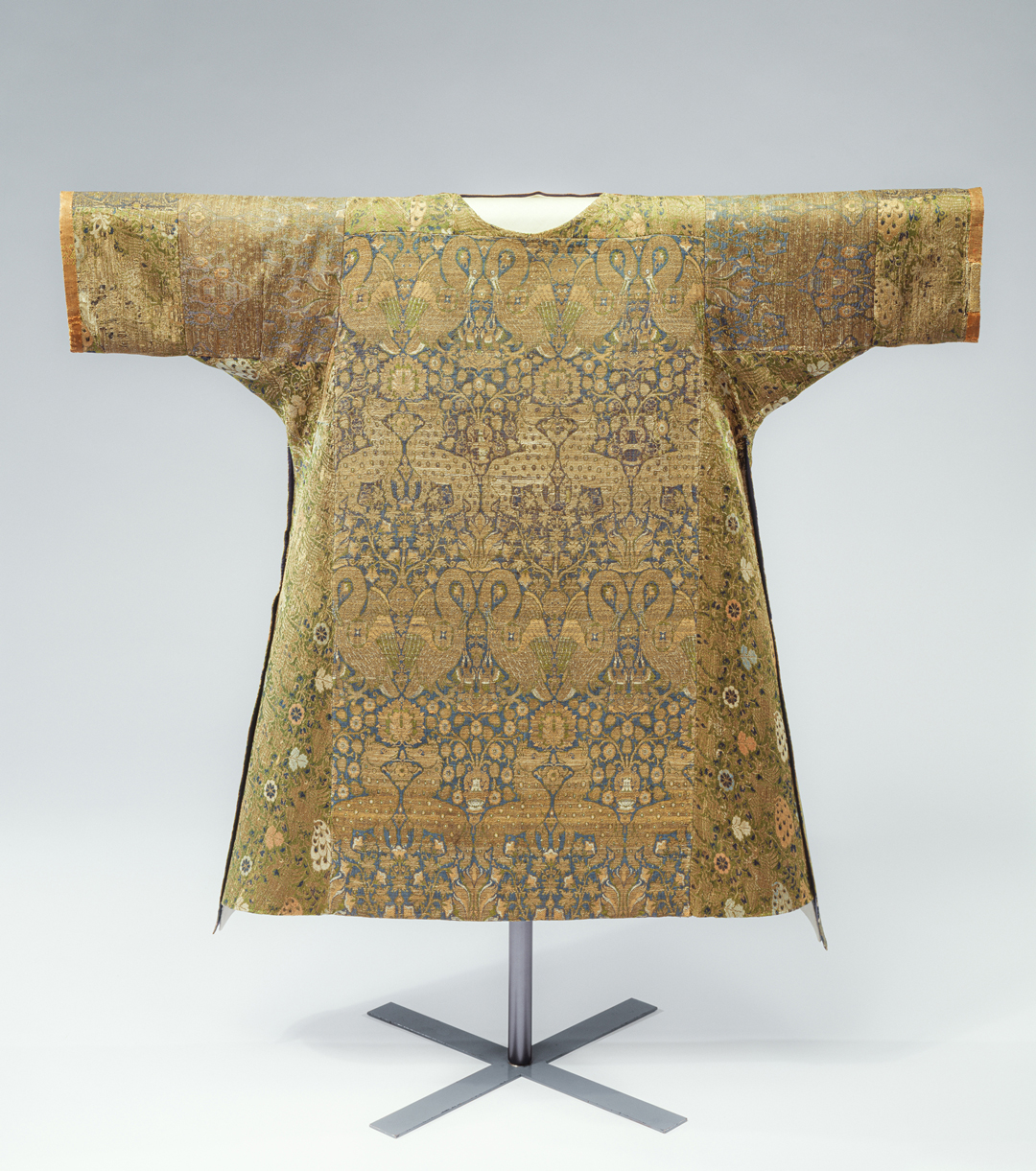
Dalmatic from Stralsund, 14th century (fabrics: Italy, China or Persia, Spain and Germany, 13th–14th century), Abegg-Stiftung, inv. no. 152 | Stralsund Museum is in possession of an almost identical tunicella that once formed the counterpart to the dalmatic in the collection of the Abegg-Stiftung.